Yondo Black Mandengue laid to rest
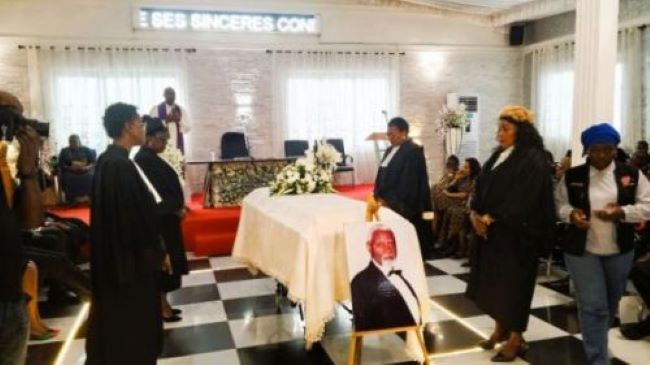
Two months after his death, lawyer and activist Yondo Black Mandengue was laid to rest on December 13 in Douala. Family members, fellow lawyers, political figures, and long-time companions gathered in Cameroon’s economic capital to pay tribute to a man whose name became synonymous with the defense of civil liberties.
Beyond mourning, the funeral took on the tone of a civic reminder. Speakers repeatedly stressed that justice has meaning only if it protects citizens rather than constrains them, a principle that guided Yondo Black Mandengue’s life and career.
A legal voice with political weight
Among those paying tribute was Pierre Ngahane, deputy director general of the Mission Libération de la France at France’s Ministry of the Armed Forces. He described Yondo Black Mandengue as “an exceptional lawyer, a conscience of Cameroon, and a tireless defender of freedoms and human dignity,” praising a career pursued “without yielding, without bending, and without betraying his convictions.”
While eulogies often simplify, speakers said Yondo Black Mandengue’s path remained clear and consistent: an unwavering commitment to human dignity and the rule of law. Several called on future generations to carry forward that legacy in the pursuit of a more just and peaceful Cameroon.
A national figure beyond the courtroom
At the Cathedral of Saints Peter and Paul in Douala, during the requiem Mass, opposition figure Maurice Kamto framed the tribute in national terms. He said Cameroon would need “men like Yondo Black Mandengue to build or rebuild the bridges missing between Cameroonians.”
Kamto described him as a passionate defender of free and constructive speech and a figure driven by a deep sense of humanism, arguing that his commitment went beyond professional duty. For Yondo Black Mandengue, the law was not an end in itself, but a tool in the service of freedom.
From France back to Cameroon
Born to a civil servant, Yondo Black Mandengue set his sights on becoming a lawyer early in life, motivated by a desire to defend others and uphold just causes. While studying law in France, he combined academic training with activism, holding leadership roles in student associations in Caen and within African student movements.
After qualifying, he practiced at the Caen bar before returning to Cameroon in 1971. At the time, the country had no national bar association. He joined fellow lawyers in advocating for its creation, which became a reality in 1972.
At the heart of sensitive cases
A decade later, he emerged as a central figure in Cameroon’s legal profession. From 1982 to 1986, he served as president of the Cameroon Bar Association. His tenure was defined by a firm defense of judicial independence and individual and collective freedoms.
One episode in particular shaped his legacy. During this period, he defended individuals accused of involvement in the failed April 6, 1984 coup attempt. Many of those defendants avoided the death penalty, including prominent political figures such as Issa Tchiroma Bakary and Garga Haman Adji.
Arrest, resilience, and late recognition
In February 1990, Yondo Black Mandengue was arrested for taking part in demonstrations calling for democracy and the return to multiparty politics, at a time when the ruling party and the state were closely intertwined. Released the same year, he continued to campaign, with consistency and integrity, for democracy, justice, and human dignity.
Institutional recognition came later. In 2024, the Cameroon Bar Association awarded him the title of the country’s first honorary lawyer, an exceptional distinction acknowledging both his career and his commitment.
On December 13 in Douala, it was not only a man who was buried. It was a vision of justice—understood not as an instrument of power, but as a shield for citizens—that was recalled and entrusted to those who remain.
Source: Business in Cameroon