
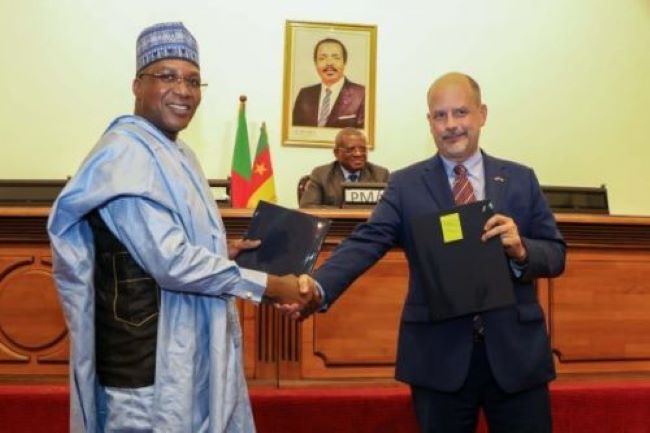
Yaoundé: US commit CFA240bn in 5-year support to Cameroon’s health system
On December 16, 2025, the United States and Cameroon signed a cooperation agreement in Yaoundé providing about CFA240 billion ($400 million) in US funding to strengthen Cameroon’s health system over a five-year period. The agreement was signed by US Ambassador to Cameroon Christopher J. Lamora and Minister of Public Health Malachie Manaouda, in the presence of Prime Minister Joseph Dion Ngute.
The deal follows an official announcement made the previous day by Dr. Rebecca Bunnell, Acting Deputy Assistant Secretary for Global Health Security and Diplomacy and Deputy Assistant Secretary for PEPFAR programs, who was on an official visit to Cameroon. Beyond the display of solidarity, the agreement also underscores the central role of external financing in shaping the trajectory of the national health system.
Targeted funding focused on major diseases
Under the terms of the agreement, US funding will primarily target the fight against HIV/AIDS, malaria, and tuberculosis, as well as the strengthening of global health security. It includes support for health workers, improved epidemiological surveillance, stronger supply chains, enhanced health data systems, and upgraded laboratory capacity.
In return, the Cameroonian government has committed to increasing its own health spending by about CFA270 billion ($450 million) over the same period, under a co-financing and shared responsibility framework. A key question remains largely unaddressed publicly: the state budget’s actual capacity to meet this commitment amid tight public finances and rising needs in other social sectors.
The Ministry of Public Health said the agreement “marks a major strategic shift in Cameroon–US cooperation, now oriented toward a strengthened bilateral partnership based on the principles of transparency, efficiency, and sustainable reinforcement of Cameroon’s health system.” However, the selective nature of the support—focused on a limited number of diseases and strategic functions—leaves other areas, such as primary health care and mental health, largely in the background despite their importance to the system’s day-to-day functioning.
US strategy refocused on bilateral engagement
The agreement is part of the new US global health policy, the “America First Global Health Strategy,” which prioritizes targeted bilateral agreements to maximize the impact of funding. Cameroon is among the 15 priority countries selected by Washington for implementation of this strategy, according to the ministry.
This approach also reflects a US preference for direct engagement with partner governments rather than channeling funds through NGOs or international organizations. The trend was illustrated in 2025 by the dismantling of the US Agency for International Development (USAID), decided by the administration of President Donald Trump [to be verified]. While this state-to-state approach may strengthen national ownership, it also reduces the role of intermediary actors that often provide technical oversight, implementation capacity, and additional transparency.
CFA640 billion invested over 20 years, but continued dependence
In his remarks, Ambassador Christopher J. Lamora highlighted Cameroon’s strategic importance in Central Africa. He said developments in Cameroon have direct effects across the region and beyond, citing areas ranging from counterterrorism and maritime security to irregular migration and epidemic control.
He noted that the United States has already invested more than $1.1 billion, or about CFA640 billion, in Cameroon’s health system over the past two decades. These funds have supported significant progress in the fight against HIV/AIDS through PEPFAR, with more than 400,000 people living with HIV currently receiving treatment and clinical services extended to all ten regions of the country. According to the World Health Organization, new HIV infections fell from nearly 48,000 in 2018 to 17,673 in 2024.
Joint efforts against malaria have also helped protect more than two million children in the North and Far North regions, contributing to a 35% reduction in child mortality. At the same time, US support has strengthened global health security through the construction of the National Public Health Emergency Operations Center and the training of more than 2,000 field epidemiologists. These gains, however, remain heavily dependent on continued external funding flows and priorities largely set in Washington.
HIV targets still out of reach despite funding
Despite these advances, HIV/AIDS remains a major public health challenge in Cameroon, with a generalized epidemic and prevalence still above 1% across all key populations. Health authorities acknowledge persistent challenges, including preventing mother-to-child transmission and improving care for key populations, particularly adolescents.
The newly announced investment is expected to strengthen national efforts to meet the goal of eliminating HIV/AIDS by 2030, while consolidating progress against malaria and tuberculosis. It remains to be seen whether system governance, fund absorption capacity, and domestic contributions will keep pace, to avoid a “bubble” effect in which indicators improve while aid flows, but prove difficult to sustain if funding is reduced or redirected.
Source: Business in Cameroon


