
UN says 2.4 million Libyans in need of humanitarian assistance
The United Nations has voiced concern about the alarming conditions of well over two million Libyans, who need humanitarian aid due to the militancy in the north African country. “More than 2.4 million people in Libya are in need of humanitarian assistance,” said Martin Kobler, the UN secretary general’s special representative for Libya, in a statement marking the World Humanitarian Day on Friday.
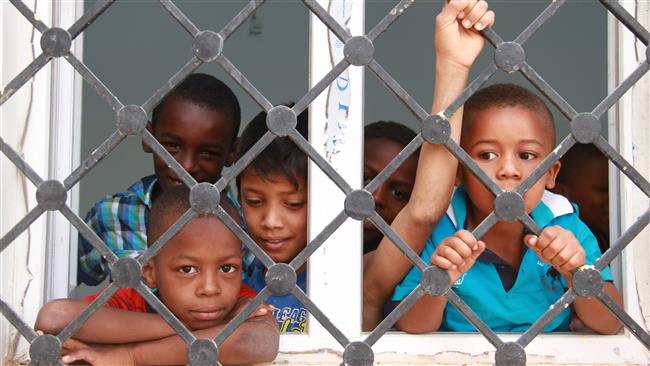
“They lack medicines, vaccinations and suffer from poor hospitalization services. Almost 300,000 children are out of schools and almost 350,000 Libyans are displaced within the country,” he further said.
The UN official also noted the predicament of over 270,000 refugees, who are stranded in Libya after fleeing their home countries. “The humanitarian needs created by the crisis in Libya are enormous and this should serve as an incentive for us to do our utmost to give hope to the people, particularly those in urgent need of humanitarian assistance,” he added.
Presstv
Cameroon: CPDM Olympic team returns home with no medal
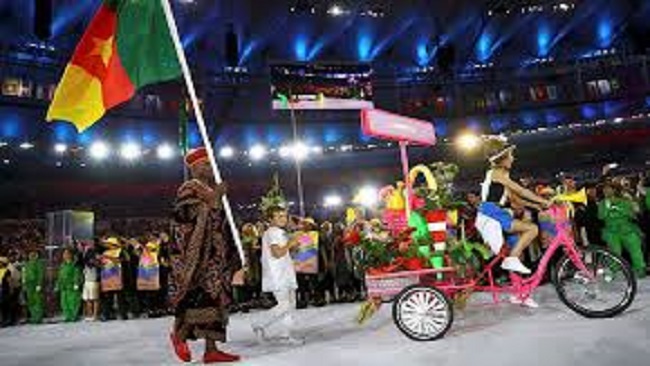
The CPDM Olympic team has ended its journey to the 2016 Olympic Games in Brazil with no medal won. The series of defeats began on the first day of the competition and the spell befell the entire team. Despite a first round win for the flag bearer that qualified him for the eight finals Wilfred Seyi’s determination and courage was not enough to make the Cameroon national anthem chanted at the podium.
All the athletes were eliminated in their respective sporting disciplines one after the other illustrative of the ill-preparedness to confront the world’s finest. CRTV’s Olympic Games analyst, multiple triple jump gold medallist, Francoise Mbango said although the Cameroon Olympic team did not win any medal, they had an overall satisfactory performance and the athletes need better preparation for the next edition.
The athletes have gained the experience of the Olympic Games and are better prepared psychologically to compete at international level. Rio de Janeiro was the first Olympic experience for a majority of the athletes who were discovering such magnitude of world class competition for the first time. Upon return, the Cameroonian athletes are expected to continue training with professional coaching and high level international competitions to better prepare for the next Olympic Games.
CRTV
Cameroon says Memve”ele Hydro-electric dam will resolve the energy deficit in the Southern regions
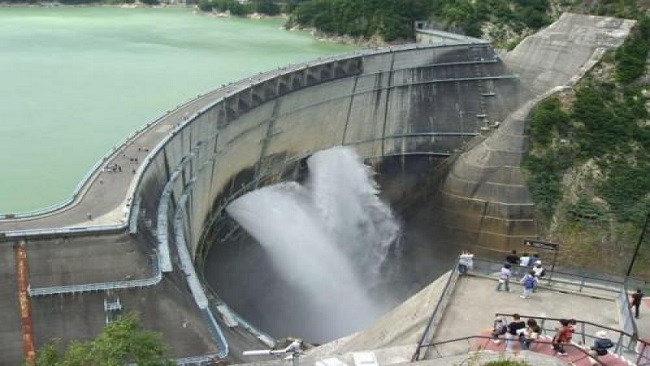
On Tuesday August 16, 2016 in Nyabissan, Ntem Valley Division of the South Region, the Minister of Water Resources and Energy, Basile Atangana Kouna, switched-on the button to close the main spillway of the Memve’ele Hydro-electric dam, so that the dam’s reservoir can be filled. The main reservoir which is 22 Km2 is expected to be filled with 80 million meters cube of water in ten days. It is from the main reservoir that water will be channeled through the canal to the power house for the production of energy.
The closure of the main spillway of the dam marks a crucial stage in the construction process. Presiding over the ceremony to close the spillway in Nyabizan, the Minister of Water and Energy, revealed that the realization rate of the Memve’ele Hydro-electric dam project now stands at 92%. The dam is expected to produce its first megawatts of energy by October this year and upon completion in June 2017, it will be producing 211 megawatts of energy to resolve the energy deficit in the southern part of the country.
CRTV
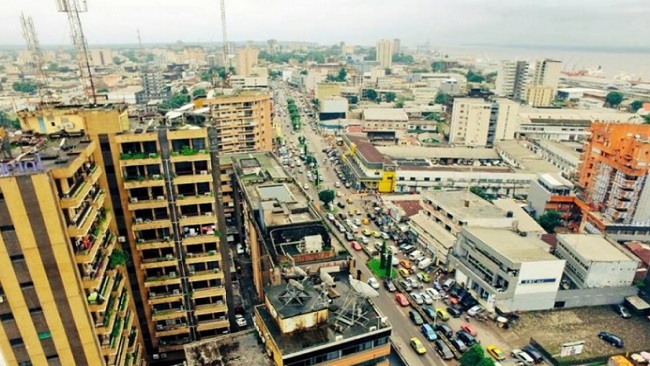
Douala ranked 9th most dangerous city in the world by UK based international news magazine
The authoritative UK international news magazine “THE ECONOMIST” has published a report ranking the city of Douala, the 9th most dangerous city in the world. The study was carried out by the Intelligence Unit (EIU) of the newspaper specialized in business reporting and analysis.
Eight places separate the Cameroonian economic capital and Damascus in Syria. The ranking was based on criteria such as security; terrorism, hostage-taking, easy access to administrative services, existence of modern health and education infrastructure and the level of corruption. The report painted Douala as a no man’s land and noted that the informal sector was growing at an exponential rate. The EIU revealed that people live in Douala in precarious sanitary conditions unworthy of modern metropolises.
It added that residents are assaulted in full view of the forces of law and order without them raising a finger. The city has been transformed into a giant trash where courtesy and civility no longer exist in the daily lives of the people who have turned their gutters into garbage dumps.
We learned from the report that Douala is also a city where victims are afraid to complain against their tormentors, often accomplices of corrupt police officers, who share, drugs and loot the flight. Of more importance is the fact that Douala is the dumping ground of European and Chinese antiques. All that is useless in Europe and China is found in Douala. The city symbolizes the failure of the Biya 34 years old regime.
By Chi Prudence Asong
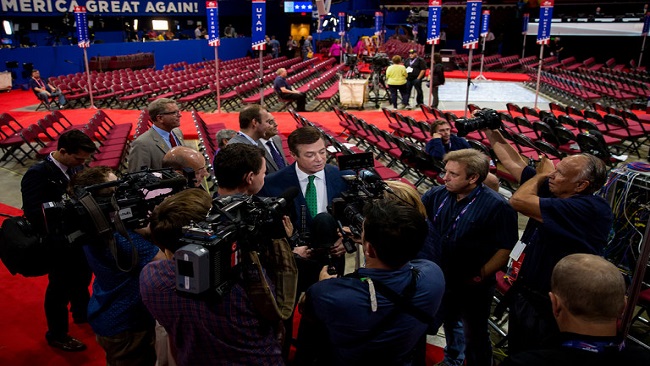
Another Donald J. Trump campaign manager resigns
Paul Manafort, installed to run Donald J. Trump’s operation after the firing of his original campaign manager, handed in his resignation on Friday, signifying the latest tumult to engulf the candidate, whose standing in the polls has steadily dropped since the Republican Party’s convention in July.
Mr. Manafort left nearly a week after a New York Times report about problems within the Republican presidential nominee’s campaign helped precipitate a leadership shake-up. His departure reflects repeated efforts to steady a campaign that has been frequently roiled by the unpredictable behavior of its tempestuous first-time candidate.
Mr. Manafort was also dogged by reports about secretive efforts he made to help the former pro-Russian government in Ukraine, where he has worked on and off over several years. Those news reports were blotting out much of the press coverage of the candidate this week. And they contributed to Mr. Manafort becoming viewed with trepidation by Jared Kushner, Mr. Trump’s son-in-law and a major force within the campaign, particularly after a number of false starts since the Republican National Convention, according to three people briefed on the matter.
“This morning Paul Manafort offered, and I accepted, his resignation from the campaign,” Mr. Trump said in a statement. “I am very appreciative for his great work in helping to get us where we are today, and in particular his work guiding us through the delegate and convention process. Paul is a true professional and I wish him the greatest success.”
Mr. Manafort, a veteran strategist who had managed Republican nominating conventions in the past, was hired by the campaign in late March, as Mr. Trump was facing a protracted delegate slog in his effort to capture the Republican nomination. When he joined the campaign, he was seen as a peer to Mr. Trump, 70, and someone whose advice Mr. Trump might heed. In fact, Mr. Manafort had pushed for the selection of Mike Pence, the Republican governor of Indiana, as Mr. Trump’s running mate.
But until this week, the role of campaign manager had remained empty since the June ouster of Corey Lewandowski, who played into Mr. Trump’s most aggressive instincts and with whom the candidate had a level of chemistry that he never forged with Mr. Manafort, according to several advisers who witnessed them interact. Mr. Trump has continued to seek out Mr. Lewandowski’s counsel since his firing.
Since the convention in Cleveland, Mr. Trump has engaged in a series of self-defeating battles, including belittling the mother of a Muslim soldier who was killed in Iraq and threatening to withhold an endorsement from House Speaker Paul D. Ryan. Aides have tried a range of efforts to rein in his impulses, including adding different travel companions.
The New York Times
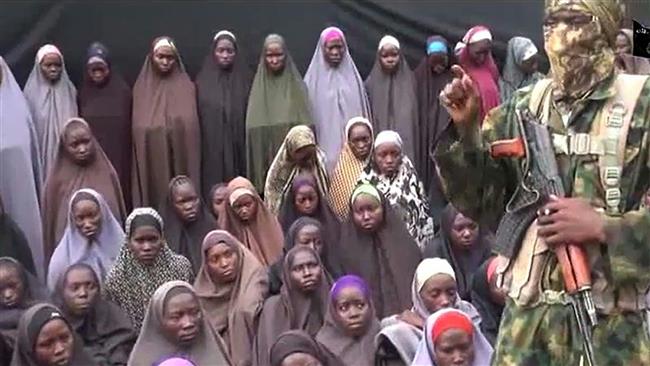
Nigerian army censured for threatening journalist
The Committee to Protect Journalists (CPJ) has censured the Nigerian army for threatening a local journalist with arrest for allegedly concealing information about the 2014 abduction of 200 schoolgirls by the Takfiri Boko Haram militants. “Nigeria’s military should not threaten Ahmad Salkida and instead ensure that he is free to work,” Peter Nkanga, the CPJ West Africa representative, said Friday.
“Journalists must sometimes rely on the trust of dangerous people. Coercing them to become informants risks putting all journalists under suspicion and in danger,” he added.
On August 14, Nigeria’s military spokesman Sani Usman threatened that Salkida and two activists, Ahmed Bolori and Aisha Wakil, would be detained unless they turn up for questioning on the location of the girls, who were kidnapped from the Nigerian town of Chibok in 2014.

The statement came a day after Boko Haram released a new video purportedly showing some of those girls and called for the release of comrades in exchange for the freedom of the abductees. Bolori and Wakil have already showed up for interrogation, and Salkida, who is currently in Dubai, has said he would “avail” himself to authorities.
“In the coming days, I will seek to get a flight to Abuja and avail myself to the army authorities,” he wrote on his blog, adding that he had nothing to fear as he acted according to the tenets of journalism. Salkida has contacts with Boko Haram and has been involved in failed negotiations between the group and the government of former President Goodluck Jonathan. In 2009, he was arrested over reporting on the activities of the militants.
The CPJ further said Salkida “fled his home in the northern city of Maiduguri in July 2011 after callers identifying themselves as Boko Haram members threatened him with death, following the publication of his profile of Boko Haram’s first suicide bomber.” Boko Haram terrorists kidnapped 276 girls from their secondary school in Chibok on April 14, 2014. Fifty-seven of the girls managed to escape afterward, but the fate of the others is still largely unknown.
Presstv
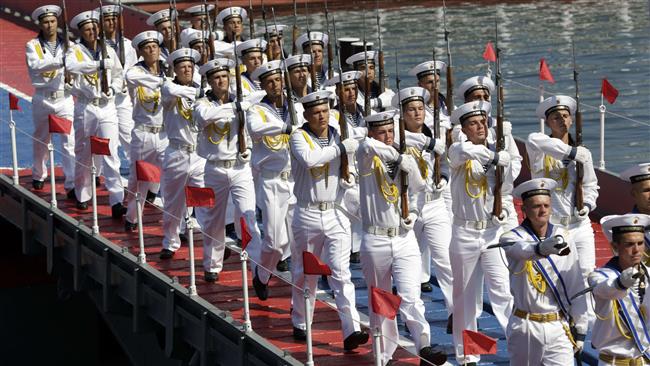
Russian forces engaged in naval drills in the Crimea peninsula
Russian military forces are engaged in naval and logistical exercises in the Black Sea peninsula of Crimea, the Russian Defense Ministry says. “The logistic support units embarked on working out the practical tasks of logistics support in the naval and land ranges of the Republic of Crimea,” Deputy Defense Minister Dmitry Bulgakov announced on Friday.
He said Russian vessels conducted service recovery tasks at sea, and the Southern Military District’s logistics units evacuated equipment from the battlefield, transported military equipment and performed mass jet refueling missions at the Opuk range.
Meanwhile Ukrainian President Petro Poroshenko has said he would not hesitate to announce the mobilization of Ukrainian army forces in response to what he described as military build-up by Russia in Crimea. “In the event of the exacerbation of the situation in the east and in Crimea… we will have to impose martial law and order mobilization,” Poroshenko said on Thursday.
Poroshenko also said he had ordered all Ukrainian army units near Crimea and in the eastern Donbass region to stand at the highest level of combat readiness.
Presstv

There are reasons why President Biya will seek another mandate come 2018
Paul Biya has for quite some time now embarked on a race against time. Fronted, eulogized and deified by his supporters as the master and controller of time, Paul Biya suddenly awakened to the reality that time plays tricks on people. In this mind-set, Paul Biya since the last mandate which he obtained after manipulating the constitution at the cost of the life and limb of many of the citizens he swore to defend and protect, put in motion a policy change anchored on a deconstruction of the corrupt machinery which has overseen his three decades of personal power at the helm of the country.
In his characteristic manner, Paul Biya used surrogates to make that he is a great leader who conceived and sought to implement the best of policies intended to transform the country into a model democratic and economic miracle in a troubled continent. But that his policies were frustrated by persons on whom he reposed confidence to execute them. He promised in a number of ends of year speeches to deal comprehensively with these “enemies within the house”. Biya desperately needed to destroy these expendable individuals to shift focus from his monumental failures, abuses and oppressive policies to a justification for a prolongation of his mandate to clean the mess. And he has done so admirably well and with little resistance from the concerned. Any form of reasonable resistance would have been surprising since these individuals are his creations and served at his pleasure.
However, with the mantra of war against corruption from which he carefully insulated himself through a constitutional amendment, he has vandalized his expendable lackeys with the zeal and brutality of a wounded lion. With this immunity, a purported war against corruption, an unrestrained access and control over state resources reminiscent of an Alibaba, Paul Biya acquired enormous powers to dismantle and establish new instruments of power to sustain his eternal imperial reign. The rallying war cry against corruption has since become the explanation and justification for thirty-two years of misrule, oppressive policies, failed economic policies, nepotism and the politicisation of national ethnicities.
These mantra precarious political and economic policies that have been the signpost of his three decades in power have driven the polity to the edge of a collapse into inter-ethnic conflict with wide ranging ramifications. Paul, Biya, like Ahidjo, Houephoet Biogny and Eyadema and other French neo-colonial lackeys needed establish his indispensability at the helm of the state to prevent an apocalypse. In this regard, he needs to sustain the atmosphere of permanent tension that places the country in a permanent state of emergency requiring motions of support against unspecified enemies and adversaries.
Prying on their own creations with the corrupt syndicate and presenting them as the causes of failure are not new in the politics of French neo-colonial Africa. These policies often include the framing of some collaborators for planning or fomenting real or imagined coop d’états or attempted coops to blackmail, intimidate and hoodwink the citizenry. The April 6 (1) and (2) attempted coups d’états contained elements of both. While waiting to move to higher gear, the epervier operation is fronting or satisfying this purpose well. However, despite the successes recorded, it is still an experimental political tool that has attained a tacit legitimacy from the tests conducted on Paul Biya’s political creatures.
One of the strongest arguments Paul Biya seem to be making by default in answer to critics accusing him of politicising the war on corruption is that the alleged victims and the methods he is employing are his creations; that both were possible thanks to him and him alone. In this regard, he may be right. The problem however is that he has fine-tuned the construction and deconstruction of corrupt political elite for use alone or in aggregate with other subterfuges to satisfy the realisation of his eternal power agenda in 2017and beyond.
At the moment his ethnic politics of divide and rule is playing out between the Beti South and the North in attempts to use the war against Boko Haram to black the Northern Power elite to shield its ambition and claims to the Presidency. This policy has had a serious hit in the Southern Cameroons. This is largely due to the fact that the evolving power game is either misunderstood by them or they are considered an irrelevant factor in the claims and battle for power. Also, their erstwhile leaders on whom they mortgaged are in jailed or are they timid, scared, uncomfortable and untrustworthy of the Biya’s new political agenda to reasonably and courageously stake out for a deceptive and foolhardy agenda of dividing a people who only paid lip service to the handoff politics of Paul Biya as opposed to Ahidjo.
It has dawned on them that try as they could; they are and will forever remain outsiders in the power equation directing the politics of Cameroon. Former frontline e CPDM power elites Ephraim Inoni, Forjindam and a host of others once dreamt that they were significant factors with the potential of wielding substantive political power and were promptly reminded and humiliated to the embarrassment of many who believed the perfidy.
Prior to this moment of apprehension, the politics of divide and rule were sadly implemented in the South West by withdrawing qualified young administrators from the centre of power to serve in the region at the pleasure of the respective Prime Ministers from the region when they mattered. Those who formulated this policy hoped to galvanize a support base made of administrative and quasi-political elite whom they used as alternative power structures to organize the grassroots to advance their individual political agenda as opposed to that of the province. They did not place sufficient trust in even the CPDM party structures comprising at times of demanding power seekers whose allegiance required constant incentives to sustain. The elite required only administrative positions and needed additionally to make sacrifices towards supporting the political agenda of these supposed leaders in order to retain their posts.
To their dismay, these individuals lost out for competition for relevance at the national level. Some realized and are bitter that these supposed leaders hoodwinked them to abdicate the pursuit of their professional or career to obviate potential competition for attention at the centre for Paul Biya’s attention. This explains why most of them have abandoned these leaders who involved them in senseless political adventures to unjustifiably influence elections in favour of the very power that is devouring its offspring. This politics of personal power has inflicted so much harm on the polity and divided communities and households, all in the name of competing for the attention of an elusive and unpredictable president.
Many within the CPDM political party are still living within the mind set a political agenda which has since undergone transformation. Paul Biy is currently inflicting a lethal assault on the CPDM and its power elite mired in embola-ic political myopia. Many have still not understood that Paul Biya is undressing the CPDM and its power elite in the market place of his neo-colonial politics of personal survival and relevance. Many have not realized that when pressed to bring about political and economic reforms, Biya has no choice than to sacrifice them. Many have been caught unawares by the new politics in which through sacrificing them, Paul Biya is making a case for his own political relevance and a justification why he must seek another mandate in the evening of his life to clear the mess and supposedly save an unstable polity from collapse.
The war against Boko Haram and in the Central Africa Republic have come like manna from heaven to support why Paul Biya should not yet abandon a sinking ship which is approaching an iceberg in a turbulent sub region. When a country is at war, it is in a defacto emergency situation. This atmosphere makes the potential for egregious violations for the purpose of maintaining law and order real. The prosecution of the war on two fronts, a dire economic and politics of poverty and corruption, the next circle of elections and potential tinkering of the constitution may spell doom for a significantly fragmented nation. This is the reason why the real patriots need to seriously debate, dialogue and provide solutions on how to save Cameroon from itself.
By Soter Tarh Agbaw-Ebai
Write back at soteragbawebai@gmail.com
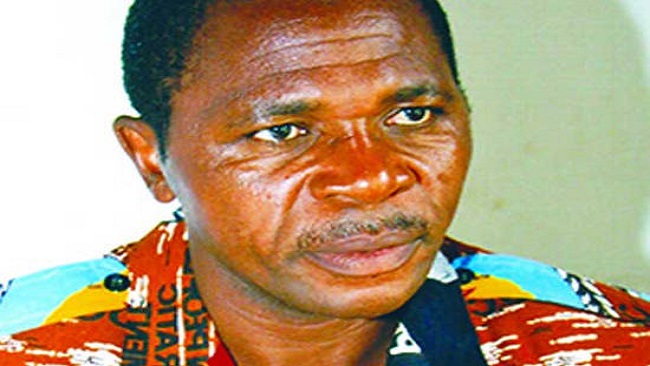
Minister Paul Atanga Nji: Taking the last kicks of a dying horse
Minister Paul Atanga Nji has been told by the attorney general of the Special Criminal Court to pay the state of Cameroon the sum of 365 million FCFA which he reportedly swindled during his time at the Cameroon Postal Cheque Centre. The amount was long established after a team from the supreme state audit revealed its findings to the presidency of the republic.
Cameroon Intelligence Report gathered that in a letter dated July 21, 2016, the attorney general of the Special Criminal Court reminded Atanga Nji, Minister of Special Duties at the Presidency of the Republic of the severity of the situation. Attorney General, Justine Aimée Ngounou Tchokontchieu noted in the correspondence to the so-called CPDM minister that the decision was based on revelations from the supreme state audit verification mission.
Local newspaper reports have also hinted that Paul Atanga Nji obtained huge sums of money via three cheques, with the complicity of certain employees of the Cameroon Postal Services (Campost). There are confirmed reports that Paul Atanga Nji received three dubious transfers. Two of these transfers, respectively 365 million and FCFA 20 million CFA francs were made from a bogus account. The third transfer, that involved the sum of 150 672 000 FCFA, was made also from an account without provisions.
Minister Atanga Nji, the man widely believed to be running the consortium of CPDM crime syndicates in the North West region has ever since been under investigation on the thorny issue concerning the financial management of CAMPOST from 2004 to 2010. In November 2014, our chief intelligence officer in Yaounde observed that Atanga Nji sent a letter to the Director of the Civil Cabinet at the Presidency of the Republic in which he suggested that he was prepared to give evidence before prosecutors at the Special Criminal Court. A source at the presidency noted Atanga Nji did ask for permission to attend a hearing at the court which was never granted.
Depicting the Special Criminal Court established to prosecute alleged corrupt government officials and the several Alibabas responsible for pilfering from the public treasury as the President’s court is no misnomer. We call it the President’s court because it is one instrument of power through which the President is reining in on perceived opponents from within his CPDM power conduit. An attribute of a genuine court is the fairness of the trial proceedings in cases which are brought before the court for trial. It is not the number of convictions entered against accused. A court is legitimate and recognized as such because of its exercise of judicial, executive, legislative and administrative independence. A court that is independent must be accessible to all citizens after all, is equality before the law, not a constitutionally protected value? The Special Criminal Court is lacking in these attributes of impartiality, judicial independence and accessibility. It is perceived more as the President’s Court than a Court of Justice.
Establishing this court was President Biya’s way of saving himself the embarrassment of being humiliated during his perennial trips abroad as the President of the most corrupt countries in the world. This ranking of the country as the most corrupt or one of the most corrupt countries had a potential to hamper President Biya’s personal pecuniary interests far from the borders of Cameroon. There was therefore a personal interest need to establish the court. Another personal interest need was to avail himself of a legal tool under his direct control to consolidate absolute power, blackmail potential rebels and competitors within the system and to stifle any form of institutional opposition. He perceived the court as a tool with which to whitewash his more than thirty years of corrupt governance and the rape of the economy.
By Soter Tarh Agbaw-Ebai with files from Cameroon-info.net and Sama Ernest