Understanding the Anglophone problem: The case of bilingualism
What is President Biya’s Cameroon? It is indeed a country that has not defined itself in relation to the African Union, the European Union, the United Nations or its boundaries. Is Cameroon’s nationalism civic, ethnic or imperial from France? Is Cameroon in West or Sub Saharan Africa? Is it a democracy, a regime-state or a compound polity like Saudi Arabia? Or is it better described as a military state?
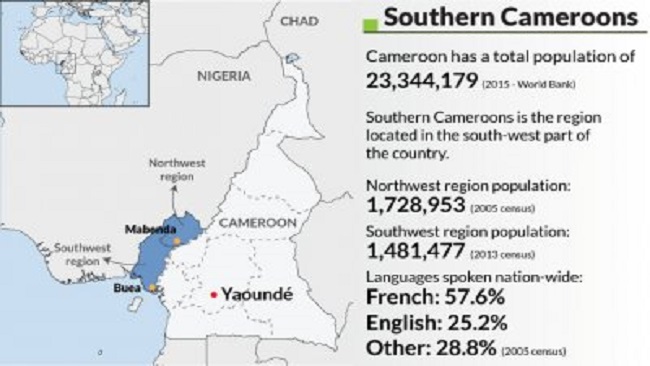
Although Cameroon has an official policy of bilingualism, it is in practice very much a Francophone country. This is not just because more than three-quarters of its 25 million people belong to the French-speaking regions, but especially because English is neither protected nor encouraged officially. Except in the South West and North West Regions, Anglophones must learn French to survive and succeed in their various occupations. In the public services and in major state-owned companies, the way up is totally barred from Anglophones who cannot speak French. Interestingly, Francophones feel at home and have no need to learn English because public affairs are conducted but in French. Since reunification on October 1 1961, Anglophones have suffered under this form of state terrorism and political genocide but Francophone rulers like President Paul Biya have refused to make a concession.
Whenever an international Anglo-Saxon personality like the former Commonwealth Secretary General Chief Emeka Anyaoku ,Kofi Annan or the great Nelson Mandela comes visiting, there is always a Cameroon government statement from the Chief Executive redefining the conduct of government and given impetus to bilingualism echoing that French and English were official languages of equal value and that bilingualism would be promoted throughout the country. Only God alone knows how Anglophone leaders have kept their faith in a president who himself has little regard for English because he has never throughout his 34 years in power addressed the nation in English.
President Biya has signed so many presidential decrees dishing-out special responsibility for the promotion of bilingualism yet it is still not obvious today in Cameroon to have sign posts in Douala, Yaoundé and other French-speaking towns in both languages as is the case in the North West and South West regions. Anglophones are still being turned away from public offices for making inquiries in English! Government ministers are still not obliged to deliver their speeches in English and French! Competence in both languages has till 2016 not become a necessary condition for promotion to senior public position! Presidential decrees and ministerial orders are still being published only in French!! There is still not a separate English radio and television channels for Anglophones to encourage the English Language and culture!
All these is happening under the watchful eyes of an Anglophone Prime Minister Yang Philemon who spent 25 years in Canada as Cameroon’s ambassador and who is suppose to be aware of the important lessons Canada’s bilingualism offers to the world. The Canadian federal government operates a code that defines the use of both English and French in such a way that officially both are of equal status. A national language board actually sees to it that the legal provisions for the equal use of the two languages are respected.
It is very disturbing that English which is the modern world’s language of science, technology, finance and business is been discouraged in a “Cameroun des grands ambition”. There are French speaking African countries such as Senegal that neither have Anglophones citizens nor have an official bilingual policy, but which have in response to globalization encouraged the use of English with remarkable results. The killing of innocent Southern Cameroonians will not bully us to submission. Change has come to Cameroon.
By Soter Tarh Agbaw-Ebai
Editor-in-Chief
Cameroon Concord News Group