
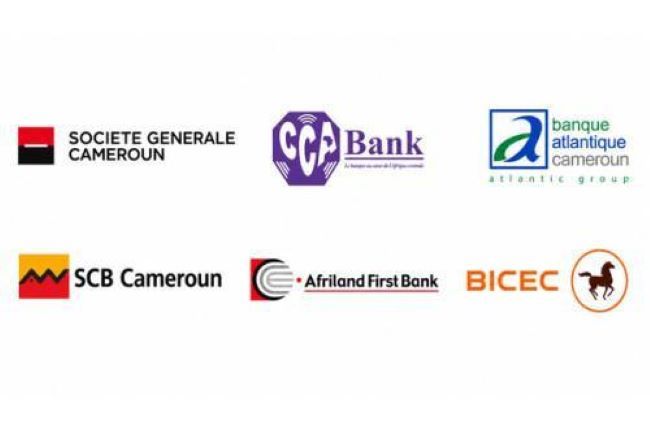
Cameroon’s top 5 banks control nearly three-quarters of new lending
Banks operating in Cameroon approved 207,119 new loans during the first quarter of 2026, with a combined value of CFA1.34 trillion, according to the latest Bank of Central African States (BEAC) report on lending rates across the Cemac region.
Cameroon remained the region’s largest credit market, accounting for more than half of all new lending issued across the six-member monetary union.
Despite that position, the value of new loans fell sharply. Banks extended CFA1.34 trillion in new credit between January and March 2026, down from CFA1.89 trillion during the same period a year earlier, a decline of nearly CFA550 billion. The number of approved loans, however, increased slightly, rising from 202,508 in the first quarter of 2025 to 207,119 a year later. BEAC said the increase reflected slightly stronger demand for bank loans. In practice, more loans were approved, but their average value declined.
Five Banks Dominate the Market
General Bank of Cameroon (GBC), formerly Société Générale Cameroun before the Cameroonian government acquired Société Générale’s stake, ranked as the country’s largest lender during the quarter.
The bank accounted for 17.64% of new bank lending, up from 11.07% a year earlier. It was followed closely by SCB Cameroun, the local subsidiary of Morocco’s Attijariwafa Bank, with a 17.48% market share, compared with 13.22% in the first quarter of 2025.
Bicec, controlled by Morocco’s Banque Centrale Populaire Group, ranked third with 14.76% of new lending, down from 17.60% a year earlier. The top five was rounded out by two Cameroonian-owned banks. Afriland First Bank captured 13.48% of new lending, up sharply from 7.81% a year earlier, while CCA-Bank, a former microfinance institution that has since become a commercial bank, increased its market share to 10.97%, compared with 3.98% during the same period in 2025.
Together, the five institutions accounted for 74.33% of all new bank lending in Cameroon during the quarter. BEAC nevertheless said the market remained competitive, noting that no single bank exercised significant influence over pricing or lending conditions. The comparison should be treated with some caution. BEAC noted that Commercial Bank-Cameroon (CBC) did not submit data for the first quarter of 2026 because of a reporting issue. The bank accounted for 10.92% of new lending during the first quarter of 2025.
Businesses Remain the Main Borrowers
Companies continued to receive the vast majority of bank financing. Businesses secured CFA1.21 trillion in new loans during the quarter, representing 90.26% of all lending in Cameroon, down from CFA1.59 trillion a year earlier.
Large companies remained the biggest borrowers, receiving CFA970.8 billion, or 72.60% of all new loans. SMEs obtained CFA236.1 billion, representing 17.66% of total lending, while households received CFA115.2 billion. Public administrations and local governments borrowed CFA14.1 billion. The data also show that Cameroon continues to rely heavily on short-term financing.
Short-term loans, excluding guarantee facilities, represented 73.23% of all bank lending, or CFA979.7 billion. Medium-term loans accounted for just 6.75%, while long-term financing represented 4.71%. Guarantee facilities made up the remaining 15.30%.
Borrowing also became more expensive. According to BEAC, the average lending rate in Cameroon rose to 9.03% during the first quarter of 2026, up from 8.26% a year earlier. Banks, which provide nearly all credit in the country, recorded an average effective lending rate of 8.97%.
The first-quarter rankings point to two major trends: a reshuffling of the country’s banking leaders around GBC, SCB Cameroun, Afriland First Bank, and CCA-Bank, alongside a sharp slowdown in the amount of credit flowing into the economy. For businesses, particularly SMEs, access to financing is no longer the only concern. The cost of borrowing, loan maturity, and the availability of longer-term financing have become equally important.
Source: Business in Cameroon


