
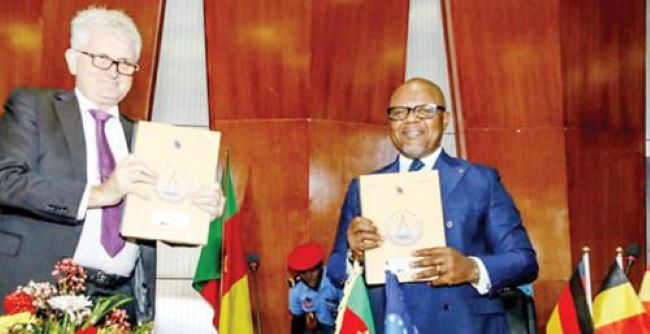
Yaoundé secures 36 Billion CFA Francs in EU Funding for digital economy
Cameroon has secured more than 36 billion CFA francs in European Union grant funding to accelerate digital transformation, strengthen business competitiveness and support key export sectors.
The financing agreements were signed in Yaounde during the Cameroon-European Union Economic Forum by Paul Tasong, Minister Delegate to the Minister of the Economy, Planning and Regional Development in charge of Planning, and Jean-Marc Châtaigner, Ambassador and Head of the European Union Delegation to Cameroon.
The funding will support three programmes: Digital Business Boost for Africa, Digital Acceleration in Cameroon, and Sustainable and Competitive Forests and Cocoa in Cameroon.
A major share of the financing is aimed at strengthening the digital economy. The Digital Acceleration in Cameroon programme will receive 9.83 billion CFA francs to help very small, small and medium-sized enterprises adopt digital technologies, improve productivity and adapt to evolving market demands.
Another 9.83 billion CFA francs has been allocated under the Digital Business Boost for Africa initiative, which seeks to promote a secure, inclusive and sustainable digital economy across Cameroon, Gabon, the Democratic Republic of the Congo and the Republic of the Congo. Implemented by a Polish development bank, the programme is expected to strengthen digital infrastructure, support innovation and reinforce business ecosystems that facilitate cross-border economic activity.
The largest allocation, 17.5 billion CFA francs, will go to the Sustainable and Competitive Forests and Cocoa in Cameroon programme. The initiative targets two sectors that play a critical role in the country’s export earnings and public revenues. The funding is intended to improve competitiveness and sustainability across the forestry and cocoa value chains while helping producers meet increasingly demanding international market requirements.
Speaking at the signing ceremony, Paul Tasong said the funding reflects the strength of cooperation between Cameroon and the European Union and supports the country’s development priorities.
“The digital sector generates greater speed, flexibility, interconnection and automation. These developments require businesses to adapt in order to remain competitive, particularly in a context marked by increasing competition,” he said.
According to officials, the programmes are aligned with Cameroon’s National Development Strategy (NDS30) and the European Union’s Global Gateway initiative, which promotes investment in infrastructure, energy, digital technologies, transport and strategic value chains.
Authorities expect the projects to support sustainable economic growth, create jobs and strengthen sectors that are central to Cameroon’s long-term development and export performance.
Source: Business in Cameroon


