
Biya regime signs digital trade agreement with ITC
Cameroon has signed a letter of intent with the International Trade Centre (ITC), a World Trade Organisation technical cooperation body, committing both parties to advancing e-commerce and the digital economy, with small and medium-sized enterprises (SMEs) as the primary beneficiaries.
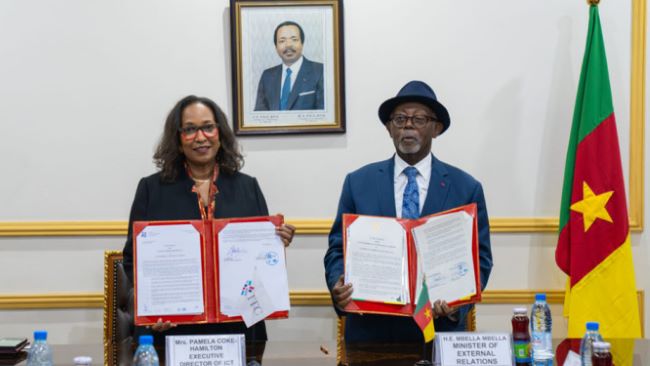
The agreement was signed on Thursday, March 26, 2026, on the margins of the WTO’s 14th Ministerial Conference (MC14) by Cameroon’s Minister of External Relations, Mbella Mbella, and ITC Executive Director Pamela Coke-Hamilton. The signing formalises a new phase in a partnership spanning more than 25 years across multiple sectors of technical cooperation.
The letter of intent commits both institutions to strengthening the business environment for Cameroonian SMEs, enabling them to participate in digital trade and expand their online market presence. It also provides for capacity building among policymakers through training, advisory support and knowledge exchange, as well as support for the review and development of digital economy policies and regulations aimed at promoting innovation, competitiveness and inclusion.
According to officials, the initiative aligns with Cameroon’s National Development Strategy, NDS30, and aims to strengthen the business environment while improving competitiveness in both traditional and digital trade sectors.
Cocoa and cassava, the two focal crops of the partnership, represent significant economic assets for Cameroon. Cassava remains a staple food widely consumed in multiple forms, while also serving as input for animal feed and industrial starch production. Cocoa, one of the country’s leading export commodities, places Cameroon among the top global producers, ranking fourth worldwide and third in Africa behind Côte d’Ivoire and Ghana. The quality of Cameroonian cocoa beans allows producers to secure premium prices on international markets, reinforcing the sector’s contribution to export revenues.
According to officials involved in the signing, the partnership will extend beyond agriculture into broader trade facilitation and digital transformation. ITC’s intervention will cover areas such as market analysis, export training, business advisory services, trade information management, and supply chain development. Additional support will be directed at policymakers through training and advisory services to strengthen regulatory frameworks for the digital economy and promote innovation and inclusion.
Pamela Coke-Hamilton highlighted Cameroon’s agricultural potential and reaffirmed ITC’s commitment to supporting local enterprises in accessing global markets. The organisation, a joint agency of the WTO and the United Nations, has a mandate to enhance the trade capacities of developing countries, particularly by enabling businesses to integrate into international value chains.
The agreement also builds on more than 25 years of cooperation between Cameroon and the ITC and signals a transition towards deeper engagement in digital commerce. Key components include facilitating SME participation in online trade, improving policy frameworks for e-commerce, and fostering knowledge exchange between institutions. A joint programme of work is expected to be developed, with specific projects to be implemented under the framework of the signed letter of intent.
The signing further coincided with discussions at a WTO side event on the role of e-commerce in rural development, where stakeholders examined how digital trade rules and investment facilitation mechanisms can support agricultural processing, trade expansion, and improved investment climates in developing economies.
As an early signal of the renewed collaboration, ITC and the Cameroonian government co-organised a side event at MC14 on e-commerce for rural development, examining how WTO rules can support agro and food processing sectors. Participating in the session were Cameroon’s Minister of Trade, Luc Magloire Mbarga Atangana, and Tunisia’s Minister of Trade and Export Development, Samir Abid. The session examined the WTO Agreement on Electronic Commerce and the Investment Facilitation for Development Agreement as policy tools for improving the investment climate in developing countries.
The ITC works with enterprises in developing and transition economies to strengthen their capacity to trade and contribute to national development.
Source: Business in Cameroon


