
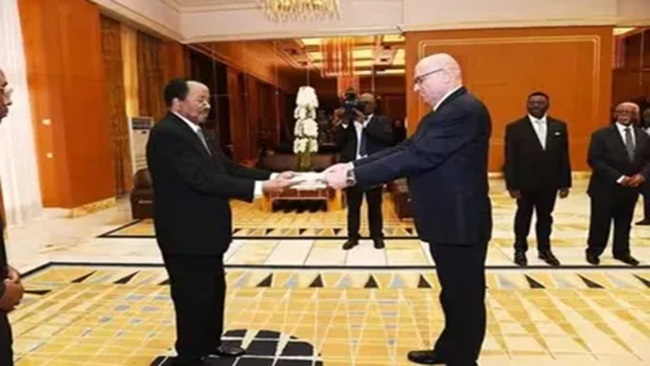
There are reasons why Israel has been President Biya’s key ally since 1984
In October 2025, Cameroon’s 92-year-old authoritarian president, Paul Biya, secured another term in elections widely regarded as undemocratic and fraudulent. For 42 years, Biya has ruled Cameroon through repression, violence, the detention of political opponents and journalists, and widespread corruption.
Yet Cameroon remains one of Israel’s most important partners in Africa, while Israel has been one of President Biya’s key allies since 1984.
The official website of Israel’s embassy in the Cameroonian capital, Yaoundé, presents a polished version of bilateral relations. It states that “the Republic of Cameroon and the State of Israel have maintained cooperative ties since Cameroon’s independence in 1960. Cooperation was temporarily suspended in 1973 (with the outbreak of the Yom Kippur War), when many African countries severed bilateral relations with Israel. In 1986, Cameroon was among the first African states to renew diplomatic ties with Israel.”
On the resumption of relations, the official account offers little detail. It notes that in 1986, Israel’s ambassador to Cameroon, Gadi Golan, said the two countries were “jointly engaged in a human-scale enterprise,” pursuing “direct and practical cooperation in line with the needs of a century nearing its end.” It also highlights a visit that August by Prime Minister Shimon Peres to Yaoundé, described as a mission to restore diplomatic ties. Peres reportedly brought emergency medical supplies and personnel to assist victims of a devastating volcanic gas disaster that killed thousands of Cameroonians.
Partially declassified files from Israel’s State Archives tell a different story. As in other African countries, the renewed relationship was driven less by humanitarian concerns and more by Israeli military assistance aimed at helping Biya consolidate power during a critical period – following a failed coup attempt and amid fears of his predecessor, Ahmadou Ahidjo, and his supporters. The cables confirm reporting published over the years while adding new details.
A Foreign Ministry review dated September 20, 1985, states that contacts began in March 1984, during a visit to Cameroon by the ministry’s director-general, who met Biya. “In April 1984, there was a failed coup attempt. The coup was suppressed and a purge was carried out.” In June 1984, “a large security delegation arrived in Israel, headed by the president’s military secretary, and was received by then–Prime Minister and Foreign Minister Yitzhak Shamir.”
The following month, an Israeli delegation – including military and intelligence personnel – traveled to Cameroon. Agreements reached with Biya included appointing a representative for Israeli interests in Cameroon, Israeli assistance in training the presidential guard, intelligence cooperation, and large-scale arms purchases. “All of the above agreements were implemented,” the document notes. Immediately after the meeting, “as a gesture of goodwill, Cameroon transferred $12 million to an account of the Defense Ministry.” Golan arrived in Yaoundé in late August 1984, accompanied by a large delegation from the Israel Defense Forces (IDF) and military industries.
In an October 23, 1984 cable, Golan – who initially served as head of the Israeli interests section attached to the Belgian embassy, before being appointed ambassador following President Paul Biya’s official announcement of the renewal of relations in August 1986 – reported that he had met with Samuel Missomba, head of the local internal security service, the National Documentation Centre (CND). Missomba told him that Cameroon required Israeli assistance “in establishing an intelligence-gathering system, as well as help in setting up units for operations abroad to collect intelligence or carry out missions against training camps of supporters of the former president in neighboring countries,” and also assistance in “monitoring the activities of the former president and his supporters.”
In a December 28, 1984 cable, the Foreign Ministry Africa Department director reported that CND chief Missomba told him at a dinner that two training courses would be conducted in Cameroon by Israel’s Mossad. In another cable dated May 24, 1985, Golan reported that he had met with Missomba, who said that participants in the Mossad training told him they had “never studied or even come into contact with the material being taught to them – it is an entirely new world for them,” and that a second cycle of the program had been scheduled. According to a cable Golan sent on December 26, 1986, Israel also conducted an intelligence course for the unit responsible for the protection of Biya.
A Foreign Ministry review from September 5, 1985, states that “military and intelligence assistance is being provided on a significant scale, with the Cameroonians paying in advance for services and equipment.”
According to an October 30, 1986 cable from the Israeli mission in Yaoundé, Biya approved sending security personnel to Israel for counterterrorism training. A November 28, 1986 cable reports that the head of the president’s office signed an extension of contracts for Israeli military advisers. An earlier cable, dated February 25, 1986, indicates that 11 IDF officers were involved in training Cameroon’s presidential guard and army.
Between October 26 and 29, 1987, a five-member delegation from a newly established intelligence service, the National Centre for Studies and Research (CENER), visited Israel to meet with the Mossad. In a November 20, 1987 cable, Golan wrote that Missomba – who had been appointed to head CENER and took part in the visit – said he was “deeply moved” by his time in Israel, including meetings with the Mossad chief and the prime minister.
A September 11, 1987 cable included a list of four Cameroonian officers set to travel to Israel “to examine electronic equipment for counterterrorism.”
According to a Foreign Ministry review dated December 11, 1987, “an IDF delegation is training the presidential guard and instructing at the parachuting school. The trained units have received advanced Israeli-made military equipment worth $40 million, paid in full in advance,” and the president had “an Israeli adviser on intelligence matters.”
In a December 19, 1987 cable, Golan described a meeting with Biya, who “expressed satisfaction with the development of cooperation with the Mossad” and sought advice on a successor to Missomba. According to Golan, Biya said that CIA officials had advised against appointing a police or military figure. He asked Golan’s opinion of Missomba’s deputy; Golan replied that the deputy had made a good impression during a visit to Israel.
Between January 10 and 17, 1988, a delegation led by Cameroon’s police commissioner and senior police officers visited Israel. According to a summary of the visit prepared by Foreign Ministry Africa Department director Benaad Avital, agreements were reached on training Cameroonian police – both in Israel and in Cameroon – in counterterrorism and firearms use, as well as in the operation of communications equipment purchased from Israel. Earlier, in a cable dated December 17, 1987, Golan noted that almost all of Cameroon’s police communications equipment was Israeli-made.
Most Foreign Ministry files on Cameroon remain classified. In 2018, however, we – a group of 76 Israeli human rights activists – petitioned the Supreme Court of Israel to revoke export licenses for arms supplied to the Rapid Intervention Battalion (BIR), known in Cameroon as “the Israeli unit,” which was found to have committed serious crimes against civilians in opposition areas. Our petition was based on verified evidence from Cameroonian journalists and opposition activists showing that Israelis had trained and advised the unit, whose soldiers used Israeli weapons including Galil, Galil ACE, Tavor rifles, and Negev machine guns. The court imposed a gag order on the case.
Just as President Biya has relied on Israel, Israel has also relied on him personally to maintain the stability of their bilateral relationship. How relations between the two countries will evolve after a change of power in Cameroon remains an open question.
Source: m.thewire


