
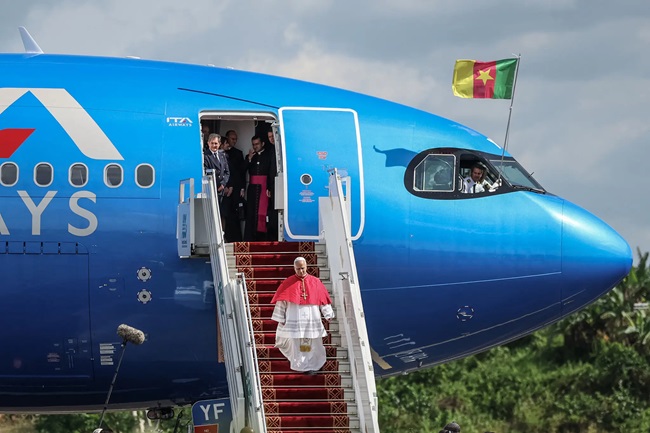
Why the Holy Father came to Cameroon
Pope Leo’s visit to Africa has placed Cameroon in the spotlight. Many have wondered why he chose Cameroon at this particular moment. For some observers, the visit risks being interpreted as conferring legitimacy on a government which, in their view, did not genuinely win the October 2025 presidential election.
The violence that erupted after the Constitutional Council proclaimed the results is eloquent proof that many Cameroonians did not believe in the credibility of the outcome. The aftermath was marked by frustration, despair and helplessness. For many citizens, the future looked bleak. Yet in his address to Cameroonian authorities, Pope Leo made clear the purpose of his visit: he came “as a shepherd and as a servant of dialogue, fraternity and peace.”
Those words help explain why Cameroon could not be ignored.
Multiparty politics without democratic change
Despite the return of multiparty politics in 1990, Cameroon has never experienced a change of government. The Cameroon National Union, which later became the Cameroon People’s Democratic Movement (CPDM), has remained in power to this day.
The mere existence of multiple parties does not automatically guarantee democracy. Without strong and independent institutions, elections become empty exercises. This recalls the memorable words of former US President Barack Obama in Ghana in 2009: Africa does not need strongmen; it needs strong institutions.
That observation remains painfully relevant in Cameroon. Since the reintroduction of multiparty elections, presidential polls have been held regularly, but opposition parties have repeatedly challenged the results. Many citizens see the electoral commission and related institutions as lacking independence because those who serve in them are appointed by the incumbent government.
Thus, while elections are organized, many Cameroonians regard them as simulacra of democracy rather than authentic expressions of the people’s will.
The first multiparty presidential election of October 1992 was already deeply controversial. The main opposition rejected the results, yet the ruling party was declared victorious. Subsequent elections in 1997, 2004, 2011 and 2018 followed a similar pattern, with the ruling party retaining power each time and opposition parties crying foul.
A cursory review of these contests suggests that they have too often been governed by the law of force rather than the force of law.
Why the 2025 election stirred hope
The presidential election of Oct. 12, 2025, generated an unprecedented level of public interest. Why did this election matter so much?
For many Cameroonians, it was a kairos moment — a decisive opportunity for national renewal after 43 years of President Paul Biya’s rule. Across the country, many citizens saw the vote as a chance to register their disapproval of a political system they believe has failed them.
The youth, in particular, are desperate for change. Many feel excluded from the affairs of state. They believe the machinery of government has been captured by a small elite more concerned with preserving privilege than promoting the common good.
Cameroon has gradually drifted toward gerontocracy, with aging leadership increasingly unable to meet the demands of the 21st century. Many believe that because of President Biya’s advanced age, real authority no longer lies clearly in elected office but in unelected circles around the presidency.
This perception has deepened public frustration.
Years of poor governance have also produced visible consequences: chronic corruption, failing infrastructure, declining educational standards, a weakened justice system, inadequate healthcare, poor roads, insecurity, prolonged electricity shortages, lack of potable water, and entrenched tribalism in both social and political life.
At the same time, unemployment remains high while the cost of living continues to rise. For many families, daily survival has become harder. Such conditions naturally fuel anger and disillusionment.
A flawed electoral process
Even before ballots were cast, confidence in the 2025 election had already been shaken.
There were complaints that the electoral register was not published in time, contrary to electoral rules. Many registered voters reportedly struggled to obtain their voter cards. Such irregularities cast doubt on the transparency and fairness of the process.
The exclusion of opposition figure Maurice Kamto further damaged public trust. For many Cameroonians, barring a leading challenger suggested that the regime was unwilling to risk genuine competition.
This decision plunged many citizens into despair. They feared another seven-year mandate for a political order they believed had exhausted itself.
The rise of Issa Tchiroma
Then came an unexpected development.
Issa Tchiroma, a prominent ally of President Biya, resigned from government and declared his candidacy. At first, many doubted his sincerity. Yet during the campaign, he appeared to persuade a significant number of voters with promises of reform, reconciliation and a fresh political direction.
He pledged to heal national divisions and, above all, to end the war in Anglophone Cameroon.
For many citizens hungry for change, Tchiroma became an alternative voice of hope. Some who voted for him may not have admired him personally, but saw in him a democratic means of sanctioning four decades of stagnation.
An old African proverb says: “A drowning person will clutch at a straw.”
That proverb captures the mood of many voters.
Images circulated on social media from polling stations appeared to indicate strong support for Tchiroma. Yet under Cameroonian law, only the Constitutional Council could proclaim the final results, which it did more than two weeks later.
In the 21st century, when many countries can produce election results within hours, such delays naturally breed suspicion.
The Anglophone war as a decisive issue
No issue weighed more heavily on the conscience of the nation than the war in Cameroon’s North-West and South-West regions.
Many Cameroonians are weary of this conflict, which is widely seen as the bitter fruit of bad governance, arrogance and longstanding marginalization. For years, families have been torn apart, innocent lives destroyed, homes burned, and communities displaced.
The economy of Anglophone Cameroon has been gravely damaged. Education has suffered immensely, with schools closed or functioning only intermittently for years. An entire generation has paid the price.
Yet many citizens believe the government has not shown sufficient willingness to engage sincerely with the grievances at the root of the crisis. Numerous initiatives — local church appeals, mediation proposals, and international efforts — have failed to secure lasting peace.
By contrast, Tchiroma’s promise to pursue dialogue, release political detainees, and open discussion on a political arrangement acceptable to both Anglophone and Francophone Cameroonians struck a chord in many hearts.
This likely explains why he attracted significant support in those regions.
Why the pope came now
Cameroon today stands at a crossroads of its history.
The disputed election, post-election violence, economic hardship, youth despair, institutional distrust, and the unresolved Anglophone conflict together form a national crisis. In such a moment, Pope Leo’s visit takes on deeper significance.
He did not come as a politician. He did not come as an electoral referee. He came as a moral voice.
He came because politics alone has not healed Cameroon’s wounds. He came because a suffering people need hope. He came because dialogue has been postponed for too long. He came because peace cannot wait indefinitely.
In Bamenda, one of the cities most marked by conflict, Pope Leo issued a strong and prophetic appeal:
“This is the moment to change, to transform the story of this country. The time has come, today and not tomorrow, now and not in the future, to restore the mosaic of unity by bringing together the diversity and riches of the country and the continent. In this way, it will be possible to create a society in which peace and reconciliation reign.”
Those words should trouble the comfortable and console the afflicted.
Cameroon’s unfinished future
What, then, does the future hold for Cameroon?
No one can say with certainty. But one truth is clear: no nation can indefinitely suppress the aspirations of its people. Citizens may be denied many instruments of power, but they still possess conscience, memory and hope.
The October 2025 election revealed a population yearning for renewal. The unrest that followed revealed a nation dangerously wounded. Pope Leo’s visit revealed that Cameroon’s crisis is not merely political — it is moral.
The hope of many Cameroonians is that his message will move those in authority to govern for the common good, respect the dignity of all citizens, and pursue justice with sincerity.
Cameroon still has the resources, talent and spiritual strength to rebuild itself. But that future will require courage, humility and truth.
The time for change, as Pope Leo reminded the nation, is now.
Culled from Herald Malaysia


