
Yaoundé seeks investor interest after positive World Bank assessment
The World Bank Group has commended Cameroon for its progress on major development projects, while calling for deeper structural reforms to secure long-term economic growth and attract greater investment. The assessment came during the IMF and World Bank 2026 Spring Meetings, held in Washington DC from April 13 to 19.
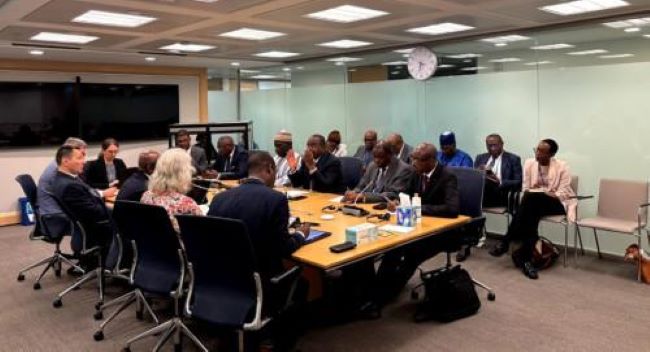
World Bank Group Vice President for Western and Central Africa Ousmane Diagana made the remarks during a high-level bilateral session with Cameroon’s delegation on April 15, which served as an occasion to review progress across key sectors and set priorities for the period ahead.
Diagana highlighted advances under Cameroon’s National Energy Compact, alongside initiatives including AgriConnect and a growing mining sector. Discussions also covered the Douala-Bangui corridor project, now in an advanced phase of preparation. The infrastructure link is expected to ease trade flows, improve transport and stimulate economic activity for Cameroon and its landlocked neighbors, reinforcing the country’s position as a strategic transit hub in Central Africa.
The World Bank reiterated its commitment to supporting Cameroon amid ongoing global uncertainties, particularly the conflict in the Middle East, which continues to disrupt supply chains for oil, natural gas, and essential commodities including fertilizer.
Representing the government, Finance Minister Louis Paul Motaze and Economy Minister Alamine Ousmane Mey expressed appreciation for the Bank’s contributions to Cameroon’s development, reaffirming commitments to fiscal discipline, structural reform acceleration, and development financing aligned with national priorities. Both ministers also welcomed the Bank’s recent rapid financing of the Forest Program, launched in April 2026, aimed at transforming Cameroon’s forest economy.
Speaking to the press, Minister Motaze said this year’s meetings carried particular weight, noting that the IMF had already assessed the economy under its Article IV consultation before the delegation’s arrival. He added that CEMAC heads of state had agreed on key decisions at a summit in Brazzaville, Congo, in January, setting a coordinated regional framework ahead of talks with IMF officials in Washington.
On the sidelines, the Cameroon delegation also met with private investors to brief them on economic conditions in the country.
On the war in the Middle East, Minister Motaze said the delegation had conducted scenario assessments, examining outcomes depending on whether the conflict continues or a ceasefire is reached. He said the conclusion was that “there would be very bad consequences,” adding that Cameroon was examining solutions to address those consequences, and that “our economy has been very resilient despite the various external shocks.”
Separately, Finance Minister Motaze used his Washington visit to hold talks with officials at the Cameroonian Embassy on the question of state asset accounting, specifically, the management and valuation of public property held abroad. Discussions covered the establishment of a reliable, up-to-date inventory of state-owned real and movable assets, as well as traceability and compliance with local standards. Embassy officials acknowledged challenges around asset valuation and maintenance, while reaffirming their support for the reforms under way. According to officials, the exercise is part of a broader effort to modernize public financial management and align Cameroon with international governance and transparency standards.
At a separate roundtable on the sidelines of the Spring Meetings, Cameroonian officials presented the country’s energy strategy to public and private sector stakeholders, framing gas as a direct driver of industrialization and economic transformation.
The Bretton Woods institutions have broadly described Cameroon’s overall progress as encouraging and positive, while underscoring the need for continued reforms to reinforce macroeconomic stability and sustain growth.
Source: Business in Cameroon


