Biya Orders Release of Maurice Kamto
Cameroon President Paul Biya has ordered the release of opposition leader Maurice Kamto, who was detained in January for organizing demonstrations in the central African nation.
A “national dialogue” to end hostilities in Cameroon’s restive English-speaking regions got off to a bad start this week, with key rebel leaders refusing to participate and demanding international mediation.
On Thursday, President Paul Biya said he would release 333 prisoners arrested in connection to the crisis, while recommendations were made to give anglophone areas “special status” with greater autonomy.
But the International Crisis Group said the absence of separatists from the talks “risks further frustrating anglophones, widening the gulf between the two sides and empowering hardliners”.
Fighting between Cameroon’s security forces and the separatists – who are demanding independence from the majority French-speaking country – has displaced more than 500,000 people, according to the UN.
Source: The New Humanitarian
Representatives of the Southern Cameroons Interim Government in Ground Zero said the release of more than 300 fighters ordered by French Cameroun President Paul Biya is not enough to stop the war that has killed at least 2,000 people in the central African state.
Separatists said calm can only return if leaders sentenced to life in prison are unconditionally freed. The president’s order came during a “national dialogue” sponsored by the government this week.
Biya’s order, issued Thursday, discontinues court proceedings against 333 separatist fighters from Cameroon’s English-speaking regions.
Biya said the order is part of efforts to calm a conflict that has killed at least 2,000 people in the past three years.
Order is a positive step
Sylvanus Ngufor, a Cameroonian sociologist who took part in the dialogue, said Biya’s order is a positive step, but said the government must do more to make English-speakers feel equal to the French-speaking majority.
“Our job is just starting,” Ngufor said. “All documents be printed in French and in English with the same sizes or logos. One language should not be a little smaller than the other. We are trying to rebrand the Cameroonian culture.”
Napoleon Ntamack, a 29-year-old taxi driver who traveled from the English-speaking town of Bamenda to take part in the dialogue, said peace can only return if top separatist leaders given life in prison by a military tribunal are unconditionally released.
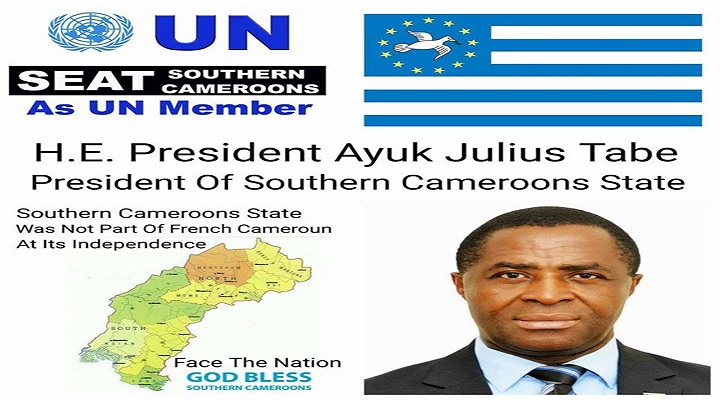
These include the top separatist leader, Julius Ayuk Tabe, who was arrested in Nigeria with 47 of his supporters and extradited to Cameroon last year.
“If they do not release the separatist leaders that they arrested from Nigeria, if they do not release them, whatsoever they are saying, there will not be peace in this country,” Ntamack said. “For those that they think whatsoever the dialogue has decided can give us the solution [peace], I do not think so.”
Autonomy must be addressed
Kobo Emmanuel, 35, said the English-speaking Northwest and Southwest regions must also be given autonomy.
“It is time for us to be given that opportunity to vote our governors, our administrators and to manage our resources,” Kobo said.
Fontem Esua, Catholic archbishop of the English-speaking town of Bamenda, said even after the president’s announcement, fighting was reported in four English-speaking towns, including Bamenda and Mamfe. He said this is an indication Biya must do more to end the conflict.
“The problem that has caused the situation in which we live now, is the fact that the people are not satisfied with the form of government,” Esua said. “The best form of government in order to satisfy our needs is federalism.”
Peace talk demands
Restoration groups refused to take part in the dialogue but said they would agree to negotiations if they take place in a foreign country with United Nations mediators and in the presence of world powers such as the United States, Britain, France and Germany.
The crisis erupted in 2016 when English-speaking teachers and lawyers protested discrimination at the hands of the French-speaking majority.
Source: VOA with additional editing from Camcordnews
Cameroon’s new head coach, Portuguese-born Antonio Conceicao da Silva Oliveira, fondly called Toni Conceicao, has a major task to win Africa Cup of Nations (AFCON) that the country will host in 2021, Cameroon’s Minister of Sports and Physical Education, Narcisse Mouelle Kombi said on Friday.
“Cameroon is also counting on the new coach to qualify the country for the 2022 World Cup.” Kombi said.
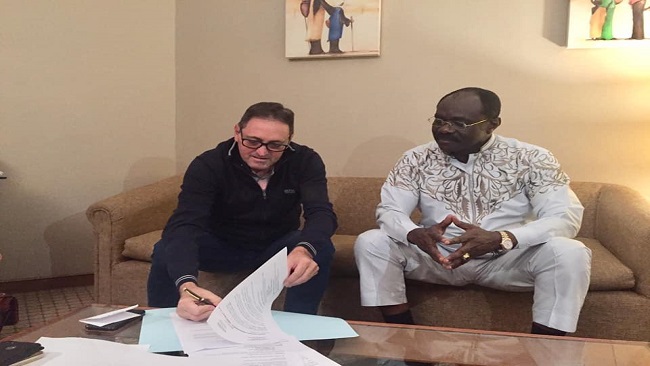
He made the remark after Toni Conceicao signed a contract in the capital Yaounde, to take over the management of the national football team, the Indomitable Lions.
The details of the contract were not disclosed
“The national football team is the heart of Cameroonians. You are responsible for something very sensitive.” Seidou Mbombo Njoya, president of Cameroon Football Federation (FECAFOOT) cautioned the coach after the signing of the contract.
The new coach said he was counting on the collaboration of “everyone” to achieve the results.
“I will do everything in the best interest of the team. We will select the best players both locally and internationally,” he said.
The new head coach was appointed late September. His recruitment ended a long controversy over the succession of Clarence Seedorf who was sacked after a dismal performance at the 2019 AFCON.
Toni, 57, is a renowned figure in international football. He had an intense career in European football and coached 12 clubs amongst them Portuguese sides Vitoria Setubal,Trofense, Belenenses.
Source: Xinhuanet
The government of La Republique du Cameroun will, in the days ahead, create a ministry of special status to take care of the people of Southern Cameroons.
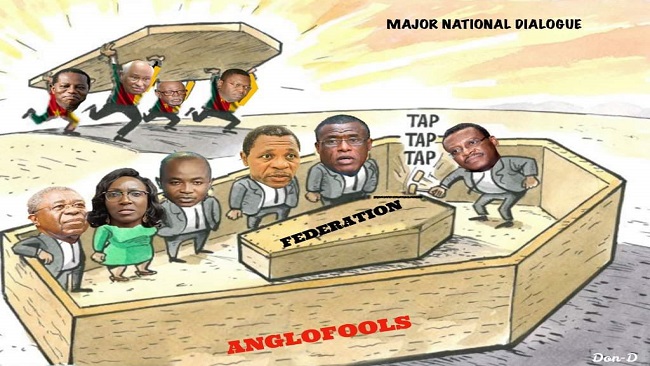
The government came to the conclusion that Southern Cameroonians were good enough to deserve a special status during the Major National Dialogue considered by Southern Cameroonians as a Major National Potluck, as it made it possible for all the country’s dishes to be served to participants at the hastily convened dialogue.
The dialogue, which is akin to the Berlin Conference, took place without the major Southern Cameroons stakeholders participating.
To ensure Southern Cameroonian journalists and activists who are critical of the government do not participate in the event, the government refused to grant general amnesty to Southern Cameroonians living abroad.
Though it offered invitations to many of the activists, the government also had an elaborate plan to arrest the activists upon arrival at country’s airports; a plan that had leaked to many activists who simply turned down the government’s invitation.
After three days of long and unnecessary deliberations, the government agents who attended the event totted by them as the idle opportunity that will bring peace to the two restive regions of the country, recommended that granting special status to Southern Cameroonians will be the ultimate solution to the crisis that is threatening to tear the country apart.
Many Southern Cameroonians are totally against the so-called special status that only emphasizes that Southern Cameroonians are inferior to their East Cameroonian counterparts.
Speaking to a disgruntled and frustrated Southern Cameroonian living in California, USA, it could be seen that he was really infuriated.
He swore that the fighting would continue until the government listened to the people.
“We still have a huge stomach for a fight. We will continue to challenge the system until we get what we want. We do not need to be treated any differently. We have the resources to take care of our two regions. A full-fledged federal system is what we want. Anything short of that will only cause things to deteriorate,” he said.
“If Mr. Biya and his people think we are joking, then they are mistaken. It is three years since some of Mr. Biya’s collaborators compared us to two cubes of sugar. Instead melting, we have been solidified and we have stood our ground. We have a huge war chest and we are still determined to take on the government. These guys thought they could roll us back in a week, but it is already three years and we are still around,” he stressed.
“We continue to be a nightmare to the Yaounde government. If they think they are doing us a favor, then they have to think hard again. This situation will continue until the government is brought down to its knees,” he stressed.
“We cannot lose all these men just to settle for the mess they call special status. The guys in Yaounde give the impression that they have not been affected by the crisis, but given the state of the country’s economy, it is clear that Southern Cameroonians have inflicted heavy losses on the beleaguered government,” he pointed out.
“CDC, PAMOL and SONARA are all out of business. These were huge revenue streams for the government, but Southern Cameroonians who have never benefitted from those companies have turned off those taps that made the government arrogant. Rebuilding those corporations will take more than money. There cannot be any real development without peace and if the government wants to bring back peace to the country, then it must meet Southern Cameroonians halfway,” he said.
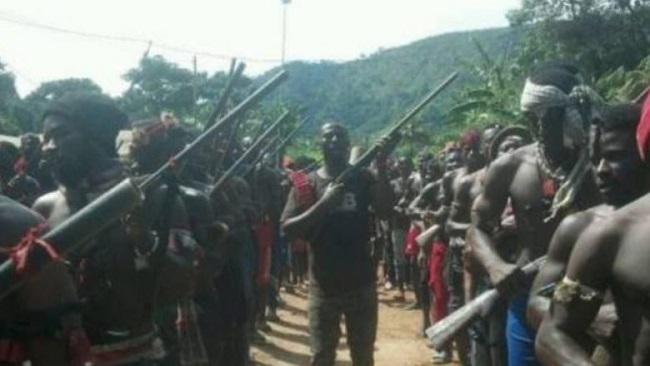
“The government has made some huge mistakes and those mistakes are keeping it awake all night. Now that arms are in the equation, it will be hard for the fighters to be rolled back. The fighters now have AK47 rifles. They started with hunting rifles and they have been courageous to frustrate the government. If the government really wants to clean up the mess it helped to create, it must make huge concessions. It must bend over backwards to achieve that goal,” he stressed.
“The ball is now in the president’s court. He created the mess. He is a low-energy guy and his inefficiency and the corruption he sowed in the country are finally coming back to bite him. He declared war on us without analyzing the situation. Though we have lost many of our fighters, we have succeeded to give the government a run for its money. Cameroon will never be the same again. It has changed and will continue to change. The authorities must come to terms with that if they must have a good night’s sleep. I pray they see the writing on the wall,” he concluded.
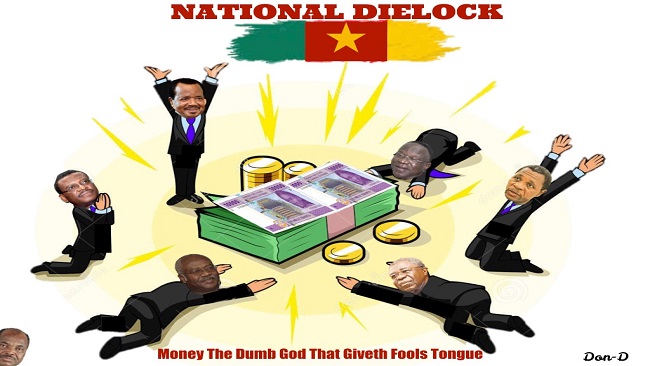
The Major National Dialogue convened by Cameroon’s President, Paul Biya, is finally over with no major decisions taken. Many Cameroonians have been looking forward to this dialogue known by many Southern Cameroonians as “die-lock” as the situation in the two English-speaking regions of the country deteriorates daily.
The recommendations of the dialogue convened by the government, organized by the government and chaired by the government will be sent to the head of state who many distrust and see as the architect of a messy conflict that has put the country in the spotlight for all the wrong reasons.
Though many Southern Cameroonians, especially those in the Diaspora, do not expect much from the dialogue, there is however a ray of hope that something positive might come out of the noise and partying that have characterized the process.
By organizing the dialogue, Biya has acknowledged that the country’s military, which is supposedly well-trained and well-armed, cannot roll back a hastily built ragtag armed group. It is also an acknowledgement that the government has failed in many respects. It has failed to enhance unity in the country. It has failed to grow the economy and it has failed to grow the peace that made Cameroon unique.
However, the dialogue must also be given some credit. It has created an opportunity for all issues facing our country to be discussed, though the time was short for any real solutions to be delivered. The discussion of those issues is, of course, an effort to address them.
While the dialogue itself is commendable, there are still many doubts in people’s minds. Cameroonians do not trust their leaders and they fear that the resolutions of the dialogue, though not meeting the expectations of Southern Cameroonians, may not be implemented as recommended by participants of the dialogue.
For more than three decades, the Biya government has not been honest to Cameroonians. Its cardinal objective has been to sustain itself in power and this has implied getting everything by crook. With such a political philosophy, the days ahead do not look promising. The government might simply pursue its own policy without thinking about the consequences of its actions.
It should be recalled that the Southern Cameroons crisis was born of the government’s arrogance and inefficiency. For years, the country has been slipping into chaos and calls by citizens only fell on deaf ears.
Those who were considered as being too vocal by the government were arrested and thrown to rot in jail. Instead of addressing the issues, the Yaounde government has been chasing shadows. For over three decades, it made sure only those who flattered the head of state had a huge chunk of the national cake. Every single achievement in the country was ridiculously attributed to the head of state, including even the delivery of children in hospitals without equipment.
As for the two English-speaking regions of the country, they were simply neglected and though most of the country’s wealth comes from the two regions, they have remained poor and there is no sign that their fate will change anytime, soon.
It worth mentioning that the country’s oilfields are in the southwest region, but the oil-producing areas of the region are unfortunately the poorest, with no modern infrastructure. Bad roads imply that many people are losing their lives daily and poor health care facilities mean many women and children cannot get the care they need.
The South West region accounts for more than 30% of the country’s wealth. It is also the region that accounts for more than 25% of the country’s cocoa production. Its fertile and volcanic soil makes it the country’s food basket. It accounts for more than 40% of the food that is exported to Cameroon’s neighboring countries like Gabon and Equatorial Guinea.
But the conflict that that has ruined the country’s economy has also robbed the region of its production capacity. The region’s economy has collapsed, and many farmers and fishermen have simply left the region. The holding of the national dialogue may therefore be good news for many in the two regions. Even those living out of the region are feeling the impact of the crisis.
The effects of the crisis have been rippling out to the other regions of the country. Inflation is on the rise and crime has increased in many cities in East Cameroon. Checking the impact of the crisis implies taking a hard and long look at the issues that triggered the crisis with a view to seeking lasting solutions. But will the government take such an approach and even when it does, will it listen to the wishes of the people? Will it ever hold that the will of the people is supreme?
While it has been recommended that the two English-speaking regions be given a special status as prescribed by the country’s constitution, it must be highlighted that Southern Cameroonians in their immense majority will never accept anything short of a federal system that will grant them the right to run their own affairs.
Before calling for a restoration of their independence, Southern Cameroonians had called for a federal system which was clearly and violently rejected by the government, and the leaders of the movement were hastily arrested and jailed in Yaoundé. Many have since escaped and are living broad. They have swollen the ranks of the Diaspora that has become a nightmare to the government.
Federalism may not satisfy many Southern Cameroonians, but it will calm down many minds that have been hurt. While it is impossible to bring back those who have lost their lives in the conflict, it is however possible to rebuild lives and to design a better future for all through consultations and dialogue instead of war.
However, if the government does not listen, the guns will start delivering death and destruction once the Prime Minister closes his hastily convened dialogue. While the dialogue was going on Friday, there was a shootout between government forces and Southern Cameroonian fighters in Bali, North West region. The fighters want an independent Southern Cameroons and in their minds their land must be liberated. If the fighting must end, the government might have to declare a ceasefire and grant amnesty to all those who have directly or indirectly been involved in the conflict.
Since erupting in 2016, the conflict pitting Southern Cameroonians against the government has resulted in the deaths of some 3,000 Cameroonians, including more than 1,000 soldiers. Besides the numerous deaths, government forces have also deleted more than 200 villages from the country’s map following orders from the president and the country’s defense minister, Joseph Beti Assoumo.
On many occasions, these forces were caught red-handed torching many homes and firing indiscriminately at innocent civilians who simply wanted to have a decent life. The government need to apologize for some of these atrocities if it must douse the fire that is in many minds.
If the past must be forgotten, the government must listen. It must avoid making this dialogue a platform for Mr. Biya to reinvent himself as the benevolent leader who wants to bring peace to the country. He declared war without engaging in any impact analysis. He conducted himself as if his army was killing national of another country. It will be hard for Southern Cameroonians to trust, talk less of forgiving for bringing death and destruction to their towns and cities.
The government has a huge crisis on its hands. If its efforts to end the war must bear any fruits, then it must also seek to repair its relationship with the country’s Diaspora. Long speeches and condemnation of Cameroonians living abroad will never bring peace to Cameroon. The government must go beyond its usual rhetoric. The Major National Dialogue might not provide solutions to all the issues, but it is a moment for the government to take a long and hard look at its actions; those actions that have gone a long way in shattering the peace that was the country’s hallmark for decades.
By Dr. Joachim Arrey
As China paraded some of its most powerful weaponry during celebrations marking the Communist state’s 70th anniversary on Tuesday, the United States Navy tested its newest piece of firepower in the Pacific.
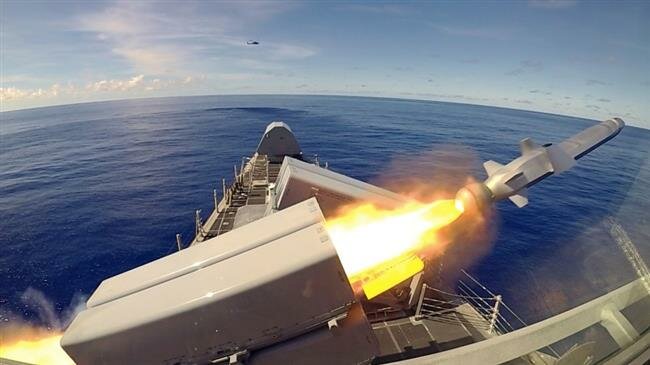
In the waters off Guam, the USS Gabrielle Giffords fired off a Naval Strike Missile (NSM), a sea-skimming cruise missile that is difficult to spot on radar, and can maneuver to avoid enemy defenses.
The NSM, along with a variety of other weapons, were fired at a surplus US Navy frigate, the former USS Ford, which was towed to the Pacific to act as a target in an exercises called SINKEX.
The Giffords is the first US Navy ship to deploy with the Naval Strike Missile, and analysts say it helps even the equation in the Pacific, where China has been increasing its missile arsenal in terms of quality and quantity.
China now enjoys a 3-to-1 advantage in cruise missiles over the US, but the Naval Strike Missile can eventually “change the game,” said Carl Schuster, a former US Navy captain now an instructor at Hawaii Pacific University.
“The Pentagon is building a military force that can operate on a more sustainable basis and has a better chance of fighting and surviving within the PLA’s deadly anti-access, area denial envelope,” said Rand Corp. senior defense analyst Timothy Heath, referring to the mix of ships, aircraft and missiles amassed by China’s People’s Liberation Army to control parts of the Pacific.
The PLA was showing off much of that new arsenal on Tuesday in Beijing — everything from intercontinental ballistic missiles to new submarine drones.
“It is to show how much progress it has made, and how much more advanced it is compared to years before. Now, China has better capability to defend itself. It deserves equal and fair treatment from other powers,” Carnegie Tsinghua Center senior fellow and military analyst Tong Zhao told CNN.
Much of the US-China tension has been focused on the South China Sea, one of the most contested areas in the world. Multiple countries claim parts of the commerce-heavy region, but Beijing’s claim is by far the most expansive, covering the majority of the sea.
The sleek, stealthy Giffords, is a littoral combat ship (LCS) designed for operations in the shallower waters around coastlines and islands.
Most of the ships in the US Navy’s growing LCS fleet, which will eventually number more than 30, are planned to be armed with the Naval Strike Missile, Navy officials told a Senate Armed Services subcommittee earlier this year.
Key to the Naval Strike Missile is its range of more than 100 miles, more than 30% farther than the Harpoon missiles the US Navy has been using in this anti-ship capacity.
The ability to work with the helicopter drone enables the ship to target outside what its own surface radars can see.
Tuesday’s live-fire SINKEX exercise in the Pacific also saw missiles launched from other US Navy aircraft, bombs dropped from US Air Force B-52 bombers, and Harpoon missiles launched two stealth frigates from the Singapore Navy.
“This exercise provided important opportunities for realistic at-sea training with live ordnance, conditions that cannot be duplicated otherwise,” US Navy Capt. Matthew Jerbi, co-commander of the the exercise, said in a statement. “Training alongside our Singapore partners in a complex exercise like this is invaluable.”
Singaporean Col. Lim Yu Chuan said the exercise was “a valuable platform for the two navies to strengthen our mutual cooperation and interoperability.”
“With the vast training space available in the waters off Guam, the exercise also provides the RSN (Singapore Navy)with the opportunity to conduct high-end exercises of substantial scope and complexity,” Lim said.
(Source: CNN)
Delegates at the ongoing national dialogue in Cameroon have welcomed the release of 330 prisoners and resolution to grant the English-speaking regions special status.
The country’s prime minister Joseph Dion Ngute, who is leading the dialogue process, announced on Thursday that president Paul Biya had ordered for the release of several hundred detainees linked to the separatist crisis.
“The president has asked for the release of more than 330 people who have been arrested because of the troubles in the Northwest and Southwest” regions,’‘ Ngute said.
The “dialogue,” launched by Biya, is meant to resolve a crisis that has left thousands dead, driven hundreds of thousands from their homes and inflicted escalating economic damage.
The premier said Biya sought “a measure to calm (the situation)… while we continue our work.”
He read a statement first in French and then in English, and was given a standing ovation by many participants.
Separately, the president’s office issued a communique that said there were “333 persons concerned” by the measure.
And late Thursday, delegates adopted a resolution at the dialogue’s plenary session recommending “special status” for the English-speaking areas “aimed at re-enforcing the autonomy of administrative areas”.
Armed separatists in the Northwest and Southwest regions launched a campaign two years ago for independence from Cameroon, where French is the predominant language.
Biya’s government has responded with a crackdown that rights groups have fiercely condemned.
The International Crisis Group has estimated that nearly 3,000 people have been killed in violence committed by both sides and more than half a million people have fled their homes.
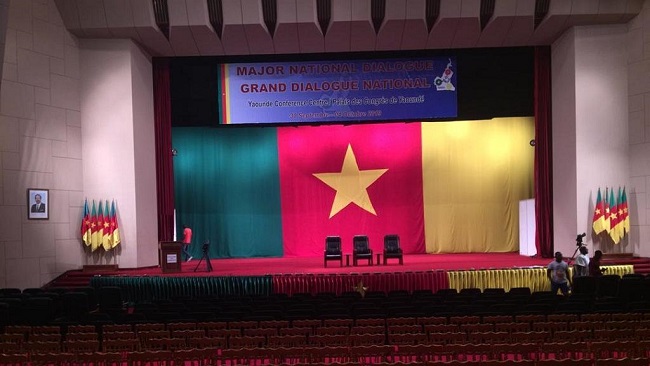
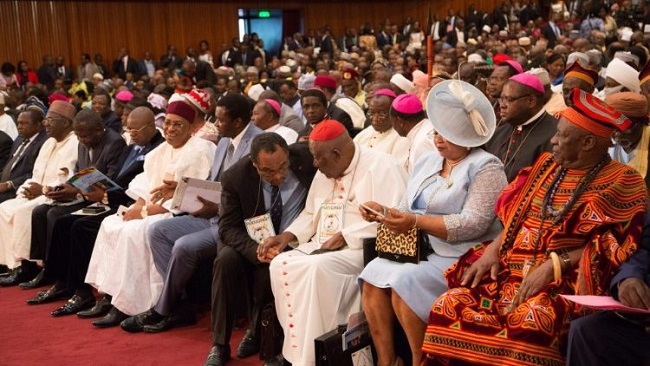
Biya’s “dialogue,” which opened on Monday and is scheduled to end on Friday, brings together political groups, civil society and religious groups, as well as representatives of the armed forces.
But armed rebel groups have snubbed the forum, and analysts have questioned whether the initiative can achieve much while the main separatist leaders are behind bars.
“We welcome the decision by the president to release 330 anglophone detainees. It is a step in the right direction,” Felix Agbor Nkongho, a leading anglophone lawyer and human-rights defender who is taking part in the forum, told AFP.
“But we call for a general amnesty to all those in detention and those in the diaspora under investigation.”
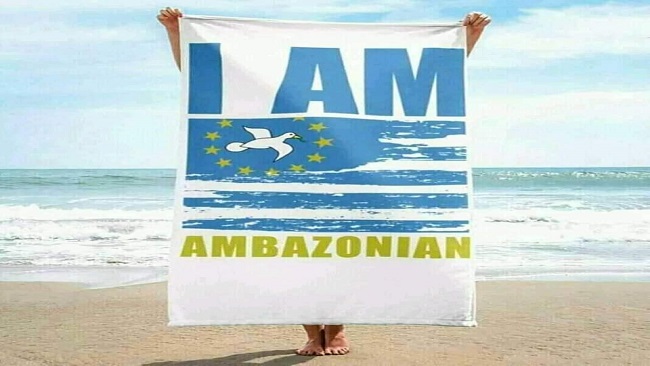
In August, secessionist leader Julius Ayuk Tabe, the self-proclaimed president of “Ambazonia”, was sentenced to life in prison along with nine of his supporters.
Biya, in his announcement of the “dialogue” on September 10, made no mention of any release of these figures, although he reiterated an offer to “pardon” any separatists who voluntarily lay down their arms.
English-speakers account for about a fifth of Cameroon’s population of 24 million.
They are mainly concentrated in the Northwest and Southwest regions, which were folded into Cameroon after the colonial era in Africa wound down six decades ago.
Resentment has festered there for years among English-speakers who complain of discrimination and marginalisation, especially in education, the judiciary and economic opportunities.
Biya, 86, who has been in power for nearly 37 years, has repeatedly refused demands for decentralisation or a return to a federal structure — a move blamed for radicalisation of the anglophone movement.
AFP
The Ambazonia Self Defence Council has denied any links with the so-called five ex-Ambazonia commanders who presented themselves in Yaoundé during the Grand National Dialogue forum stating that they are fake.
In a strongly worded statement issued today, the Ambazonia Self Defence Council informed Southern Cameroonians and the International Community that pictures and videos of alleged Ambazonia Restoration Generals attending the Yaounde peace talks were plain fiction.
“No Ambazonia General or Commander is attending the CPDM Convention dubiously called ‘National Dialogue”. What you are seeing is another effort and an attempt to manipulate and deceive our people and the International Community…” Part of the release reads.
The Ambazonia Self Defense Council further reiterated their position vis-à-vis the Biya Francophone teleguided talks observing that “Any call for Dialogue without the release of Ambazonians held in LRC jail are not accepted to us…The Ambazonia leader Sisiku Ayuk Tabe Julius and the Nera ten are the legitimate representatives of the Ambazonia people in any dialogue with LRC. They and all illegally held Ambazonians…must be released unconditionally prior to any talks.”
On the fourth day of the talks, five alleged Ambazonia Generals presented themselves to the Francophone dominated atelier and revealed that they have decided to drop their weapons in favour of peace.
Source: Journal du Cameroun
Ever since the Ambazonia leader, Sisiku Ayuk Tabe reorganised the Southern Cameroons Interim Government and appointed Comrade Dabney Yerima as Vice President, the top political priority to some Southern Cameroonians in the USA has been to deny the legitimacy of the Interim Government. These individuals including the disgraced Dr Ikome Sako and the former Communications Secretary, Chris Anu are simply being short-sighted, myopic and petty.
Southern Cameroonians now know that all those refusing to join forces with the Interim Government and rally behind Vice President Dabney Yerima do not have a vision for Ambaland, or a policy position, or even a personal agenda. They simply are for Sisiku Ayuk Tabe’s demise.
Clearly, the tables have turned and we now have a French Cameroun leadership that has successfully infiltrated a cream of Southern Cameroons front liners with a very different agenda and potentially dangerous ideas for the people of Ambazonia.
The all-out French Cameroun military onslaught and the deliberate silence observed by the international community has left Southern Cameroonians reeling, scrambling to protect their Interim Government, its policies and the leader President Sisiku Ayuk Tabe whom they hold dearly.
Progressive forces in the USA have joined Southern Cameroonians in Europe and South Africa in resisting the actions of failed leaders such as Ikome Sako and Chris Anu. These two men have been using unprecedented levels of energy against the Ambazonia leader, Sisiku Ayuk Tabe. Their nasty actions against the Interim Government that brought them to the lime light of Southern Cameroons politics have not been working shockingly well so far. But we of the Cameroon Concord News Group fear that their activities which is not going to last, because it’s not enough to just be against a leader, will continue to delay our trip to Buea.
Sako and Chris are only fighting whatever President Sisiku Ayuk Tabe and the Southern Cameroons Interim Government put on the table and this has greatly helped Vice President Yerima to settle down on the job and has allowed him to set the revolution agenda that badly needed a change.
Comrade Dabney Yerima is not playing games and he is not a man to mess around with! He has taken Southern Cameroonians back to the revolutionary principles and is slowly but surely crafting Ambazonia’s own new vision for what the Federal Republic of Ambazonia should be.
Frankly speaking, politics is a battle of ideas but NOT during a war of liberation. In spite of Paul Biya’s incoherent speeches, his disregard for historic facts on the Anglophone problem and his obvious personal flaws, Southern Cameroonians are miles away from Buea because some are still listening to empty talk from the disgruntled Sako and his Chris Anu gang.
It was very hard to pin Chris Anu to the job description assigned to him by President Sisiku Ayuk Tabe. As we write, Southern Cameroonians are still to comprehend whether Chris Anu was Communications Secretary or an ABC TV anchor man or better still a social media activist. He has never been clear about his ideas for Ambazonia, beyond attacking Sisiku Ayuk Tabe and picking up a regular cheap quarrel with the Secretary of Finance over unpaid ABC TV bills. Chris Anu’s slogans helped him recruit Barrister Fru into the anti Sisiku Ayuk Tabe wagon. But with the dust now settled, Barrister Fru has come to understand that slogans are not the same as a cohesive idea.
Sako, Boh Herbert, Chris Anu and Akwanga have never been more unified on any one topic than their dislike for the Ambazonia leader President Sisiku Ayuk Tabe. However, powerful men are almost always defined by what they are for, not what they are against.
Southern Cameroonians should know that the modus operandi of Sako, Boh, Chris and Akwanga has many perils and it is allowing the Biya Francophone Beti Ewondo regime to set the agenda for the Ambazonia war of independence. As long as they are only holding meetings waiting for what President Sisiku Ayuk Tabe or Vice President Dabney Yerima would say to launch an attack. Not only will Ambazonians be always on the defensive, it is also limiting our imaginations to a reality within the boundaries of Biya’s French Cameroun world.
Southern Cameroons will lose. The chips are stacked in favour of the Southern Cameroons Interim Government under the stewardship of Vice President Dabney Yerima. Even with unprecedented levels of attacks, it’s unlikely those fighting the Interim Government will be able to effectively resist every move by Comrade Dabney Yerima. Consequently, Ambazonia will remain a deeply divided country.
Correspondingly, if we are to take steps to mend the deep tears in the leadership of the struggle and the Southern Cameroons political fabric, Southern Cameroonians should not be defined by what they are opposed to.
Winning this war against La Republqiue du Cameroun does not require attacks on the Interim Government or an impeachment against Sisiku Ayuk Tabe. That has created its own problems. Winning this war against La Republique du Cameroun is not about seeing Sisiku Ayuk Tabe and his top aides bleed in Kondengui. Winning is far grander: channelling unprecedented levels of activism and financial resources into an idea for our beloved Ambazonia that not only combats the corrosive policies we’ve seen, but can lead to a permanently better future. That idea will create lasting good for future generations of Southern Cameroonians.
By Soter Tarh Agbaw-Ebai