
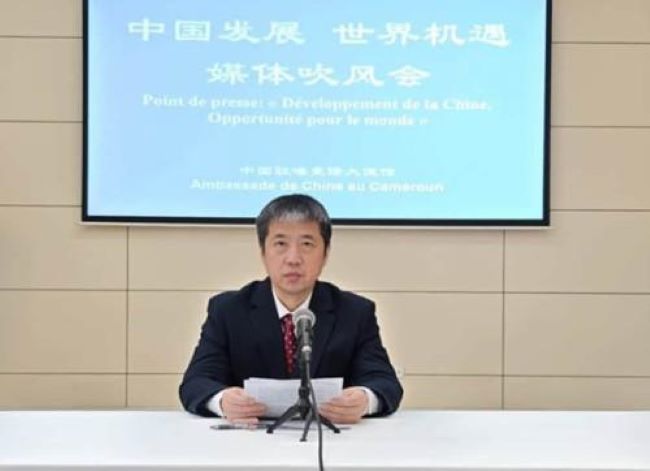
Yaoundé: China touts export, investment opportunities
Cameroonian exports to China rose 23.5% year-on-year from January through April 2026, while total trade between the two countries increased 10%, Chinese Ambassador Xu Yong said at a press briefing in Yaoundé on July 9.
The briefing, held under the theme “China’s Development, an Opportunity for the World,” also included discussions marking the 105th anniversary of the founding of the Communist Party of China.
The ambassador presented China’s major global initiatives covering development, security, civilization and global governance, describing them as strategic frameworks for cooperation between China, Cameroon and other countries.
A major economic announcement highlighted during the briefing was China’s decision to apply a zero-tariff regime to all products originating from African countries that maintain diplomatic relations with Beijing. According to Xu Yong, the measure, which took effect on 1 May 2026, makes China the first major economy to grant duty-free access to the full range of products from African countries with diplomatic ties to China.
The policy is expected to create new opportunities for Cameroonian exporters seeking access to the Chinese market, particularly in agriculture and agro-processing.
“The market of more than 1.4 billion people, combined with the stable and high-quality growth of the Chinese economy, will offer greater export revenue opportunities for African countries, including Cameroon,” Ambassador Xu Yong said while outlining the benefits of the tariff-free regime.
He noted that Cameroonian products, including cocoa beans, coffee, dried chili peppers, sesame and heat-treated cattle horns have already obtained sanitary and phytosanitary clearance for entry into China. China has also launched a Green Corridor 2.0 to simplify procedures for African agricultural exports.
Growing economic partnership
The ambassador said economic ties have strengthened since China and Cameroon elevated their relationship to a Comprehensive Strategic Partnership in 2024. He reported that from January to April 2026, Cameroonian exports to China increased by 23.5% year-on-year, while overall bilateral trade rose by 10%.
“China remains Cameroon’s largest trading partner. We hope the Cameroonian side will make full use of the zero-tariff policy to increase exports of quality products to the Chinese market,” Xu Yong stated.
Beyond trade, he said the tariff-free policy could encourage more Chinese companies to invest in Cameroon, supporting industrialization, agricultural modernization and integration into global value chains. These objectives align with Cameroon’s National Development Strategy, NDS30.
China’s economic outlook
Xu Yong also pointed to China’s economic performance as a foundation for future cooperation. He said China recorded 5% economic growth in the first quarter of 2026 and maintained positive momentum in the second quarter, supported by advances in artificial intelligence, quantum technologies, integrated circuits and other innovation-driven sectors.
China increased research and development spending by an average of 10% annually during its 14th Five-Year Plan period from 2021 to 2025, while continuing efforts to expand market access and international cooperation.
As Cameroon marks 55 years of diplomatic relations with China this year, both countries are seeking to deepen cooperation in trade, investment, infrastructure, cultural exchanges and multilateral engagement. Chinese officials say the next phase of the partnership will focus on expanding practical cooperation and helping more Cameroonian products reach one of the world’s largest consumer markets.
Source: Business in Cameroon


