
Africa’s new chief economists network seeks to strengthen economic coordination in CEMAC
The Central African Economic and Monetary Community (CEMAC) already has a common central bank, a multilateral surveillance framework, and regional consultation mechanisms. The African Chief Economists Network (ACE Network), launched on July 12 in Abidjan, will add value only if it helps speed up the flow of economic analysis and turns it into coordinated policy action.
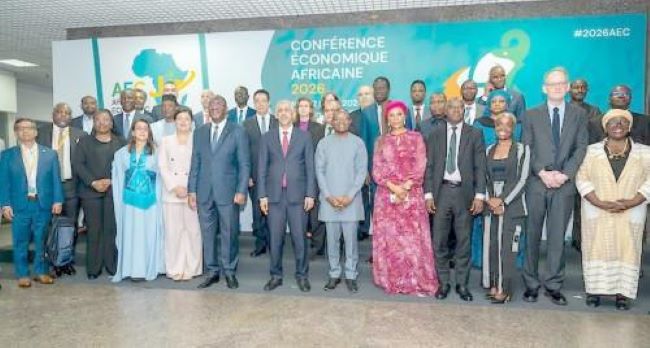
The African Development Bank (AfDB), together with the United Nations Development Program (UNDP), launched the platform at the close of the 2026 African Economic Conference. Organized from July 10 to 12 by the AfDB, UNDP, and the OECD, the conference focused on Africa’s geopolitical influence and commercial resilience.
The network will bring together chief economists from development institutions, central bank and treasury officials, advisers to heads of state, representatives of regional economic communities, academics, think tanks, and private-sector economists. For CEMAC, it could improve the coordination of economic assessments and strengthen Central Africa’s voice. Yet the continent’s greatest challenge remains turning policy recommendations into concrete action.
A rapid-response network
The ACE Network is not intended to become another international organization. Instead, it is designed as a flexible platform to harmonize economic advice, promote innovative policymaking, and strengthen Africa’s collective voice. It will hold annual meetings, quarterly virtual sessions, and rapid-response discussions during major economic shocks.
That role could be particularly relevant for CEMAC, whose member states face many common challenges, including oil price volatility, pressure on foreign exchange reserves, imported inflation, tighter financing conditions, fiscal vulnerabilities, and supply chain disruptions. The network would allow the region to compare its analysis with that of other African central banks, monetary unions, and institutions.
It will not replace either the CEMAC Commission, which oversees multilateral surveillance, or the Bank of Central African States (BEAC), which manages the region’s common monetary policy and foreign exchange reserves. Instead, its value will lie in improving knowledge sharing, comparing policy experiences, and helping African countries develop common positions.
Coordination is already central to CEMAC
CEMAC’s multilateral surveillance framework assesses member states’ economic and financial performance, monitors convergence criteria, and aligns national fiscal policies with the region’s common monetary policy. Its 2024 Multilateral Surveillance Report and 2025–2026 Outlook provides policy recommendations to governments, while a regional macroeconomic dashboard tracks economic, social, and integration indicators.
Those tools, however, have not guaranteed policy convergence. The region continues to face diverging fiscal policies, heavy dependence on hydrocarbons, tensions in the regional debt market, and uneven policy coordination. In 2025, the International Monetary Fund again called for a coherent regional strategy to safeguard public finances, financial stability, and the region’s external position.
The ACE Network could help bridge the gap between economic experts and policymakers, reduce duplication, and accelerate coordinated responses. That will require governments to share data, compare analyses, and engage openly on economic policy choices.
Opportunities for BEAC and Cameroon
For BEAC, the platform would provide access to a continent-wide network of expertise covering monetary policy, financial stability, payment systems, reserve management, capital markets, and external shocks. The central bank already produces statistics, economic reports, monetary policy reviews, research, and forecasts for CEMAC’s six member states.
The network could also help benchmark those analyses against the work of other African institutions while giving greater visibility to the region’s structural challenges, including its dependence on commodities, limited intra-regional trade, shallow capital markets, imported inflation, and infrastructure financing constraints.
However, it remains unclear whether BEAC, the CEMAC Commission, or other regional institutions will formally participate. The composition of the network and its geographic representation will therefore provide an early test of its credibility.
For Cameroon, CEMAC’s largest economy, the network’s usefulness will depend on whether it can turn research into practical policy tools. Government agencies could gain faster access to comparative analysis on non-oil revenue, public debt, spending efficiency, infrastructure financing, industrial policy, and domestic savings mobilization.
The platform could also strengthen Cameroon’s voice in discussions on the African Continental Free Trade Area (AfCFTA), climate finance, reform of multilateral development banks, and efforts to reduce the cost of capital. It may also offer valuable comparisons on how other countries have broadened their tax base, mobilized pension funds, financed infrastructure, or attracted private investment without shifting most of the financial risk onto public budgets.
That contribution, however, will remain theoretical if discussions stay confined to expert meetings. AfDB Senior Vice President Marie-Laure Akin-Olugbade underscored that expectation, saying: “We expect to see tangible results… and actions that truly change the lives of the men and women of our continent.”
Reducing Africa’s reliance on external expertise
For Kevin Chika Urama, AfDB Chief Economist and Vice President, the network should strengthen Africa’s intellectual sovereignty by producing more homegrown economic analysis, models, and policy proposals instead of relying primarily on external expertise.
Achieving that goal will require greater investment in statistics, universities, research centers, and data infrastructure—the “intangible infrastructure” that complements investment in roads, ports, transport, and energy.
Raymond Gilpin, Chief Economist at the UNDP Regional Bureau for Africa, described the network as “a unified force of African intellectuals.” He said it should become “a true engine for designing innovative solutions” to advance the Sustainable Development Goals and the African Union’s Agenda 2063. Hanan Morsy, Chief Economist at the United Nations Economic Commission for Africa, argued that increasingly interconnected global crises make such coordination essential.
Credibility still to be earned
More than 4,000 participants followed the conference virtually over three days, with discussions covering debt, development finance, capital markets, domestic resource mobilization, industrial policy, artificial intelligence, climate, and regional integration.
The new network provides a platform to extend those discussions. Its credibility, however, will depend less on the reputation of its members than on the quality of its work and its practical impact. That includes the establishment of an effective secretariat, dedicated resources, policy recommendations, economic alerts, joint studies, government uptake, and measurable results.
For CEMAC and Cameroon, three factors will determine whether the initiative succeeds: meaningful representation of Central African experts within the network, the regular production of recommendations tailored to the sub-region, and the integration of those recommendations into public policy.
Otherwise, the ACE Network risks joining the long list of African platforms whose recommendations rarely make it beyond expert circles. Its first real test will be proving that stronger coordination of economic expertise can lead to better coordination of public policy.
Source: Business in Cameroon


