
Mamfe Diocese to host 2017 National Episcopal Conference
The Diocese of Mamfe is ready to host the 2017 National Episcopal conference of the Bishops of Cameroon to run from the 7th to the 15th of January. This item is developing
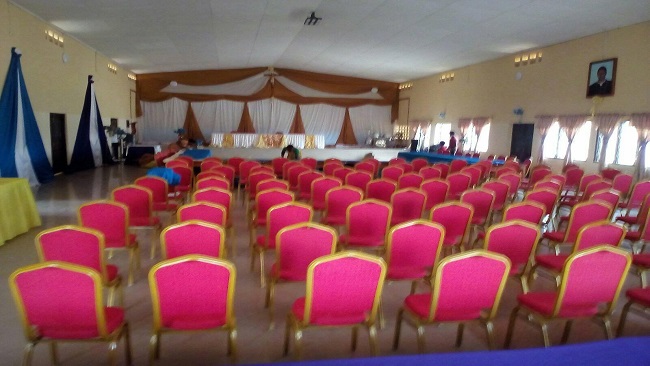
The Diocese of Mamfe is ready to host the 2017 National Episcopal conference of the Bishops of Cameroon to run from the 7th to the 15th of January. This item is developing
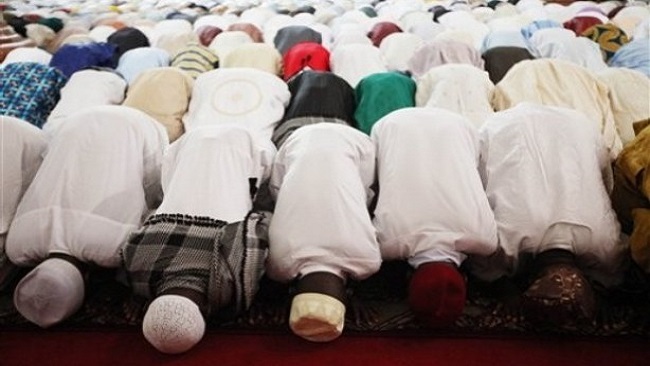
The Council of Imams and Muslim dignitaries of Cameroon, CIDIMUC have committed the nation into the hands of Allah for peace and harmony to prevail in the country in 2017. The motion was made as they begin their traditional prayer for the new year on Monday the 2nd of January 2017 in Yaounde.
Muslims clerics from the ten regions made supplications for a quick resolution to the issues raised by Common Law Lawyers and Anglophone Teachers’ Trade Unions.
According the Imam of Buea, Alhadji Mohammed Abubakar, the solution to the recent crisis in the two English speaking regions of the country is only through an honest dialogue between the government and the protesting groups. Imam Tuku Mohammed from Bamenda added his voice to emphasize on the need for peace in order for the disgruntled to get off the streets.
The supplications were not only centered within the English speaking regions but peace nationwide at a time when the country is faced with other security challenges. The Council of Imams and Muslim dignitaries in Cameroon is coordinated by Moussa Oumarou.
CRTV
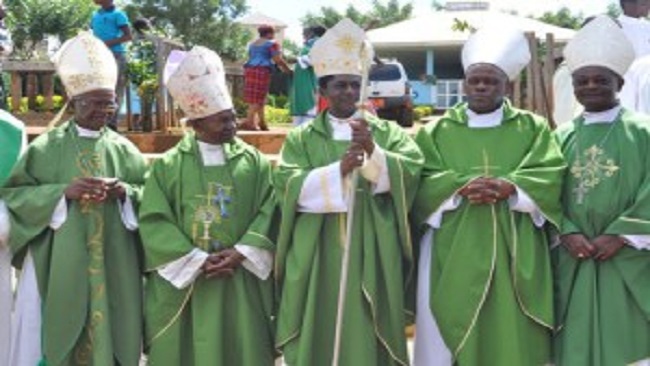
*BAMENDA PROVINCIAL EPISCOPAL CONFERENCE [BAPEC] ON THE SOUTHERN CAMEROONIAN ISSUES*
THE SECRETARIAT
ARCHBISHOP’S HOUSE
P.O. BOX 82, BAMENDA
NORTH WEST REGION
C A M E R O O N
BAPEC/PRES/2016/30
22 December 2016
*MEMORANDUM PRESENTED TO THE HEAD OF STATE, HIS EXCELLENCY PRESIDENT PAUL BIYA, BY THE BISHOPS OF THE ECCLESIASTICAL PROVINCE OF BAMENDA ON THE CURRENT SITUATION OF UNREST IN THE NORTHWEST AND SOUTHWEST REGIONS OF CAMEROON*
Your Excellency,
For almost one month now there has been a series of unrests and violence in some towns of the Northwest and Southwest Regions(1) of Cameroon occasioned by the strike of the Anglophone Lawyers and of the Teachers’ Trade Unions of the English Sub-system of Education. These have led to the loss of human life andto the destruction of property of some of our citizens. There have been flagrant abuses of human rights, as demonstrated by credible eyewitness accounts and by pictures on local television channels and social media. This has led to a premature end to the first term of the school year and paralysed the court system in these regions to the detriment of school children, students, parents and the administration of justice. At the moment, it seems that the government and the striking groups have reached an impasse and it is not likely that the schools are going to open even when the second term begins for the rest of the country. These unrests are symptomatic of a deeper unease among the inhabitants of this geographical circumscription of our nation.
We, the Bishops of the Ecclesiastical Province of Bamenda, which is coterminous with the Northwest and Southwest Regions, where we hold responsibility as Shepherds, cannot remain indifferent to this situation. The Church,in this season, celebrates the birth of Jesus Christ, the Prince of Peace. She has as mandate to proclaim the message of peace (Luke 10:5; Matthew 5:9), and has always stood for justice and peace, and worked for the attainment of the common good of society.Because of her role and competence, the Church is not identified in any way with the political community nor bound to any political system(2). This places her in a uniquely privileged position to provide a balanced perspective on the current problem between the government of Cameroon and the population of significant segments of the Northwest and Southwest Regions of Cameroon. It is for this reason that we have presumed to seize the moment and to make the following submission, with a view to assisting the government to seek a lasting solution to this problem and enable its citizens to live in peace and harmony.
*Historical Background of the Problem*
Most of the territory known today as the Republic of Cameroon was a German protectorate from 1884. However, German Kamerun also included British Northern Cameroons, which elected to become part of Nigeria in the plebiscite of 1961. This protectorate was divided into British and French Cameroons in 1916 and confirmed, with some slight modifications, by the Milner-Simon Agreement of 10 July 1919. British Cameroons, which was comprised of Northern and Southern Cameroons, was one fifth and French Cameroun was four-fifths of the entire territory. They were Class B Mandated Territories of the League of Nationsuntil 1946 when they became United Nations Trust Territories.
British Cameroons and French Cameroun were separate legal and political entities and historians have postulated that although this partition was said to be temporary Britain and France instituted two different administrative styles and systems which were to impact on any subsequent movement towards eradicating the provisional nature of the partition and facilitating reunification.(3) After the Second World War, the United Nations (Article 76, b) explicitly called on the British and French to administer their respective spheres of Cameroon towards self-government. It called on the Administering Authorities to “promote the political, economic, social and educational advancement of the inhabitants of the Trust Territories, and theirprogressive development towards self-government or independence as may be appropriate to the particular circumstances of each territory and its peoples…”
Before the London Constitutional Conferences of 1957 and 1958, three political options had emerged in British Southern Cameroons, namely independence as a separate political entity, independence in association with Nigeria, and independence by reuniting with French Cameroun. The Mamfe Conference of August 1959, which was called to hammer out consensus among Southern Cameroonians on one of the options, did not succeed to arrive at a consensus. The three political options persisted, with the most popular being independence as a separate political entity, the next being association with Nigeria and the least popular being reunification with French Cameroun.
Paradoxically, the UN General Assembly Resolution 1352 (xiv) on the British Cameroons’ Plebiscite of 1961, clearly ruled out the separate independence of Southern Cameroons(4), the most popular of the three options. This was thanks to the British who tactfully blocked every chance of the Southern Cameroonians voting for independence as a separate entity, convincing the United Nations that Southern Cameroon was not economically viable and could only survive by leaning on Nigeria or the Republic of Cameroon, and recklessly steering the Mamfe All Party Conference of August 1959 to ensure that the parties did not achieve consensus(5). In fact, the British wanted Southern Cameroons to gain independence in association with Nigeria. Consequently, the two questions adopted for the plebiscite were:
OR
Southern Cameroonians were apprehensive of this move and put pressure on John Ngu Foncha to lead a delegation to London in November 1960 to include the option of independence as a separate political entity. The request was rejected. Nevertheless, according to United Nations Resolution 1541(XV) Principles VII and VIII, Southern Cameroons was qualified to achieve independence either through association or integration which “should be on the basis of complete equality between the peoples of the erstwhile Non-Self-Governing Territory and those of the independent country with which it is integrated. The peoples of both territories should have equal status and rights”. It was with this understanding that on the 11th of February 1961 British Southern Cameroons voted to join French Cameroun while British Northern Cameroons voted to join the Federal Republic of Nigeria.
The Foumban Conference of 17th- 21st July 1961 agreed broadly what the “marriage” between the two Cameroons was going to look like. The Yaoundé Tripartite Conference of 2nd-7th August 1961 put this agreement in legal form. Worthy of note here is the fact that the draft 1961 Constitution was never presented to the Southern Cameroons House of Chiefs (SCHC) and the Southern Cameroons House of Assembly(SCHA) for deliberation and approval as should have been the case. Further, it was signed by President Ahidjo on the 1stof September 1961 as President of the Republic of Cameroon when the Federal Republic of Cameroon had not yet come into existence. Be it as it may, the two territories came together in this union as a Federation of East Cameroon and West Cameroon (1961 Constitution, Article 1-1).(6)
In September 1966, all the political parties went into dissolution to form one party in the Federal Republic of Cameroon (the Cameroon National Union), giving birth to one party rule. In 1968, Honourable Solomon Tandeng Muna was appointed to replace Honourable Augustine Ngom Jua without the required Parliamentary endorsement and in contravention of the law which did not permit Muna to handle the posts of Federal Vice President and Prime Minister of the State of West Cameroon concomitantly. Southern Cameroonians saw these moves as dictatorial and undemocratic. They had come from a multi-party democratic society where free debate, alliances, consensus, and respect for the Constitution were the accepted modus operandi.
*Referendum of 20th May 1972*
While West Cameroonians were still bracing themselves for life in a political dispensation which they regarded as imposed on them by circumstances beyond their control and struggling to cope with the manoeuvres of President Ahmadou Ahidjo, he proposed a Constitution that would make the Federal Republic a unitary state, the United Republic of Cameroon. As we all know, in those days it was politically unwise and even unsafe to hold and express views different from those of the President on any issue, and so there was no public debate on the constitution. This constitution was voted on in a national referendum organized and conducted by the Cameroon National Union (CNU), by now the sole political party in the Republic. The results show that the overwhelming majority of the electors in East and West Cameroon voted in favour of a unitary state. Looking back at what happened, many Anglophone Cameroonians now believe that this was the high-water mark of Ahidjo’s deceit and manipulation of West Cameroonians, and some have linked the birth of separatist movements in Anglophone Cameroon to this referendum.
*Subsequent Constitutional Amendments*
Three years later, the Constitution was amended to include the post of Prime Minister, appointed by the President. Following another amendment in 1979 the Prime Minister would be the constitutional successor of the President of the Republic.In 1984, a constitutional amendment changed the country’s name from the United Republic of Cameroon to the Republic of Cameroon. In the eyes of West Cameroonians, Law No 84-1 of 4 February 1984, was incontrovertible evidence that the original intentions of our Francophone brothers and sisters were to absorb Southern Cameroon and not to treat with it as equals. After thirty-threeyears of union, we had all ended up as citizens of the Republic of Cameroon or East Cameroon.
*The Anglophone Problem*
It should be clear, from the brief historical sketch presented above, what the crux of the so-called Anglophone Problem is. No matter what some self-appointed elite and spokespersons for Anglophone Cameroonians as well as government Ministers say in public, the participation of various strata of the population and the growing popularity of separatist movements among young and older members of the Anglophone community demonstrates that there is an Anglophone Problem. There is a consciousness among Anglophone Cameroonians that all is not well and something needs to be done about their plight.
_What it is_
The Anglophone Problem is:
iii. The cavalier management of the 1972 Referendum which took out the foundational element (Federalism) of the 1961 Constitution.
*The Management of the Anglophone Problem*
It is our conviction that the Anglophone Problem would have been solved, or at least mitigated, if it had been well managed by those concerned. A lack of proper management seems to be what has aggravated the problem.
_The Government and Government Ministers_
It is unfortunate to note that the government of Cameroon seems to have made every attempt to downplay or even deny the existence of an Anglophone Problem. Government Ministers (even those of former West Cameroon extraction) have denied the existence of any such problem in the media and in public speeches. Furthermore, it is widely believed in Anglophone Cameroon that government has consciously created divisions among the English-speaking elite, remunerating some allies with prestigious positions in the state apparatus previously reserved for Francophones only, and repressing all actions designed to improve on the status of Anglophone Cameroonians in the union. This seems to have been proven true in the recent unrests by the utterances of government Ministers in the Press Conference on CRTV, in the dispatch of an Anglophone Elite delegation to the Northwest Region, and in the brutal suppression of protests by certain professional groups and sections of the Northwest and Southwest Regions.
_Secessionist Groups_
In the face of this denial of the existence of an Anglophone Problem by government and the consequent deafening silence from the government to the cries and protests of Anglophone Cameroonians, certain groups have emerged in Anglophone Cameroon that call for the secession of Anglophone from Francophone Cameroon. The Southern Cameroons Youth League, the Southern Cameroons National Council, and the Ambazonia Movement are some of the most strident of these groups and are currently members of the Unrepresented Nations and Peoples Organisation (UNPO) in The Hague.
_Federalists_
There are different forms of federalism, and federalists in Anglophone Cameroon will differ as to the specific nature of the federal state they would want. However, they are all agreed that they do require a federation which recognises and preserves the region’s peculiarity, as did the 1961 Federal Constitution.
_Unitarists_
Successive amendments to the Constitution up to and including the Amendments of 1996 insist on the fact that Cameroon is one and indivisible (Article 1-2, 1996). Cameroon is described as a decentralised unitary state. Unitarists believe that everything must be done to avoid federalism or secession. However, even the decentralisation announced by the 1996 Constitution has not been implemented, and government and administration have been highly centralised.
*Symptoms of Discontent*
What some people mistake for the Anglophone Problem are just symptoms pointing to the fact that an overwhelming majority of Anglophone Cameroonians are not happy in the union which they entered with East Cameroon in 1961. They have complained against widespread and systematic marginalisation in various areas of public life which point to the existence of a huge problem. Some of these symptoms include the following:
_Marginalisation in Human Resource Development and Deployment_
iii. In human resource deployment, there is a gaping inequality in the distribution of posts of responsibility between Anglophones and Francophones. Of the 36 Ministers who defended the budgets for the Ministries last month, only one was Anglophone. In addition, there seem to be key ministries that have been reserved for Francophone Ministers only and Anglophones do not even qualify to be Secretaries of State under them. These include, but are not limited to, Defence, Finance, Territorial Administration, and Economy.
_The Treatment of the English Language_
There have been widespread protests about the way the English Language has been treated in the public life of the nation.
iii. Visitors and clients to government offices are expected to express themselves in French, even in the English-speaking regions, since most of the bosses in the offices speak French and make no effort to speak English.
vii. Basic Finance documents which businesses and other institutions are expected to work with are all in French. Examples include the COBAC Code, the CIMA Code and the OHADA Code.
_The Flooding of Anglophone Cameroon with Francophone Administrators and Workers_
Apart from the fact that Ministers, Directors General, Heads of Parastatals, Senior Divisional Officers, Heads of Law Enforcement Institutions, etc. are disproportionately Francophone, there seems to have been a conscious effort made to flood the Northwest and Southwest Regions with Francophone Heads of Service.
_Mismanagement of ‘West Cameroon’ Patrimony_
Apart from neglect of infrastructure in the Northwest and Southwest Regions of Cameroon and the mismanagement and ruin of buoyant companies like Cameroon Bank, West Cameroon Marketing Board, WADA in Wum, West Cameroon Cooperative Movement, etc., oil revenues are alleged to be used by those in power to feed ‘the bellies’ of their allies, and to stimulate the economy in other regions. In addition, there is also great anxiety in Anglophone Cameroon that its major agro-industrial enterprises, especially the Cameroon Development Corporation (CDC) and Plantations Pamol du Cameroun Ltd (Pamol), are sold or their headquarters moved elsewhere.
_The ‘Francophonisation’ of the English Educational Subsystem and the Common-Law System_
The flooding of state Anglophone educational and legal institutions with French-trained and French speaking Cameroonians who understand neither our educational subsystem nor the English Common Law undermines Anglophone education and legal heritage and subverts the original intentions of the founders of the nation to build a bi-cultural nation, respecting the specificity of each region. This is the cause of the current strikes by common law lawyers and teachers.
_Admissions into State Professional Schools_
The exclusion of qualified Anglophones in admissions into state professional schools (especially Schools of Administration, Medicine and Medical Sciences and Higher Teacher Training) even in the Anglophone Regions is a glaring example of marginalisation which the Teachers Unions cited.
These, and many others, have led to the unease and discomfort of the people of the Northwest and Southwest Regions. They perceived this marginalisation as institutionalised as they have been labelled “Biafrans”, “enemies in the house” and “traitors” by highly placed government officials and ministers who were never reprimanded for doing so.
*Gradual Erosion of Anglophone Identity*
There has been a misleading argument from some quarters where some have argued that an Anglophone is anyone who can speak English, as a way of countering Anglophone Cameroonians who protest the issues we have enumerated above. It might be helpful, for the purposes of our presentation and future discourse, to note here that ‘Anglophonism’ goes beyond the mere ability to speak or understand the English language. It speaks to a core of values, beliefs, customs, and ways of relating to the other inherited from the British who ruled this region from 1916 to 1961. ‘Anglophonism’ is a culture, a way of being which cannot be transmitted by merely learning a language. In fact, as Dr. Anthony Ndi intimates, Southern Cameroonians had “a distinctive outlook and way of life that went further than the mere fact that the educated ones among them spoke the English Language or a version of it. So, therefore, language could not even be the qualifying factor”.(8) This Anglophone identity is the reason most Southern Cameroonians who voted to join the Republic of Cameroon in 1961 did so. It was to preserve their cultural identity as a distinct people.
Anglophone Cameroonians are slowly being asphyxiated as every element of their culture is systematically targeted and absorbed into the Francophone Cameroon culture and way of doing things. These include the language, the educational system, the system of administration and governance (where appointed leaders are sent to lord it over people who cherish elected leaders), the legal system, and a transparent democratic process where elected leaders are answerable to the electorate who put them there in the first place.
Anglophone Cameroonians have seen through this and are raising their voices in protest. The two All Anglophone Conferences (AAC I and II) of the early 1990s, the rise and popularity of the SCNC and other secessionist voices are born of the frustration of Anglophone Cameroonians of being ignored and ridiculed for asking for what they deem to be theirs by right, namely the preservation of their culture. You would remember that, in his resignation letter from the post of first Vice President of the CPDM on the 9th of June 1990, J.N. Foncha cited in point 9 of the letter, as a reason for resigning, the fact that the constitution was “in many respects being ignored and manipulated”.
*A Natural Reaction*
The reaction of Anglophone Cameroonians to preserve their culture can only be described as ‘natural’. Is it any surprise that the first Opposition party that forced the door open for multi-partyism in Cameroon, the Social Democratic Front (SDF), came from Anglophone Cameroon? Following the formation of the party, the architect who brought Southern Cameroonians into the union with the Republic of Cameroon, John Ngu Foncha, resigned in disillusionment as the First Vice-President of the CPDM. He explained:
The Anglophone Cameroonians whom I brought into the union have been ridiculed and referred to as ‘les Biafrians’, ‘les ennemies dans la maison’, ‘les traitres’ etc., and the constitutional provisions which protected this Anglophone minority have been suppressed, their voice drowned while the rule of the gun replaced the dialogue which the Anglophones cherish very much.(9)
This is not to say that we do not see the other side of the argument. In any polity formed bytwo or more ethnic, cultural, religious, or linguistic groups, there is bound to be a majority versus minority problem. In any such situation, the wise thing to do would be to make constitutional provisions which would protect and safeguard the existence and rights of the minority, rather than trample on them. The Church teaches that “not even the majority of a social body may violate these rights, by going against the minority, by isolating, oppressing, or exploiting it, or by attempting to annihilate it.”(10) Cameroon prides itself as a state of law. In this area, she is at one with the Church which teaches that society should be organised on the principle of the “rule of law”. This is the principle “in which the law is sovereign, and not the arbitrary will of individuals”(11) So, apart from the plethora of issues which enhance Anglophone disaffection with the union, there is the additional problem that they are a minority in that union.
*Proposed Way Forward*
It is not for us to dictate to the Cameroonian people what form the government of this countryshould take or what solutions should be provided for the problems we have highlighted. The Church respects the legitimate autonomy of the democratic order and is not entitled to express preferences for this or that institutional or constitutional solution. Her contribution to the political order is precisely her vision of the dignity of the person revealed in all its fullness in the mystery of the Incarnate Word(12). That notwithstanding, we feel obliged in conscience as the religious and moral leaders in this part of the country, who exercise care over a people who are hurting, to propose the following lines of action which, hopefully, should lead to peace and harmony among our people.
_Honesty in the face of the Anglophone Problem_
One of the most disingenuous things any enlightened Cameroonian, talk less of educated Cameroonian of Anglophone upbringing, can do is to deny that there is an Anglophone Problem. If former French President, Jacques Chirac, the Commonwealth, the European Union, and many others have recognised that there is an Anglophone Problem and advised that the government of Cameroon and the discontented Anglophones engage in dialogue, how can Cameroonians deny that there is a problem? To play the ostrich and bury our heads in the sand is to sow disaster for the future of the nation we all love. It is to give way to extremist tendencies in the Anglophone community born of frustration at not being listened to or understood. Is it possible that the government has not heard the cries of distress of the All Anglophone Conferences which represented a broad base of Anglophone Cameroonians? Is it possible that the government has not heard the Parent-Teacher Associations (PTA), the Common-Law Lawyers, the Teachers’ Trade Unions, Students, and others who are not only uncomfortable but are choking under the present dispensation?
Is it possible for us to look this beast in the eye, confront it together and overcome it for the sake of peace and unity in our country? The government’s continued denial of any Anglophone Problem, and its determination to defend the unitary state by all available means, including repression, could lead to an escalation of Anglophone demands past a point of no return, and this is not something any responsible citizen would wish for their country.
_The All Anglophone Conferences (AAC) of 1993 and 1994_
In May1993, the 65-member Anglophone Standing Committee established by the AAC submitted a draft constitution which would provide for major political, financial, and fiscal autonomy for the two federated states, for the provinces inside both, and for the communities inside each province. Theyproposed the usual separation of powers between the executive, legislative, and judiciary, and a senate and national assembly for each federated state, as well as a rotating presidency for the Federal Republic, whereby after at most two consecutive mandates of five years an Anglophone would succeed a Francophone (or vice versa). This proposal was even reiterated for each of the federated states to ensure alternation between the provinces. This would be for us a lasting solution to the irksome Anglophone Problem, and would be acceptable to the majority of Anglophone and Francophone Cameroonians.
_The Implementation of the 1996 Constitution_
We know there is never a perfect constitution and that is the reason why constitutions are amended to make them responsive to changes in time and situation. The 1996 Constitution, even though some have had issues with sections of it, is good enough as an immediate remedy for the ‘woes’ Anglophones are listing and which make life together in this nation burdensome to them. As the second-best option, we recommend an urgent and immediate implementation of the 1996 Constitution. We recommend that all the institutions created by that constitution be put in place, and that those put in place be empowered with persons charged with rendering them functional. This would include the Regions, the Senate and, by extension, the constitutional council, administrative courts, the minor courts of accounting/auditing. It is important for Cameroonians, especially those who seek protection under the ‘rule of law’ and of the Constitution, to know that the constitution has really been deployed as a means of regulating the political process in Cameroon. It is our firm belief that if this is done immediately, it would satisfy the majority of Anglophone Cameroonians and silence the calls for secession which have characterized this period of unrest.
_Constructive Dialogue and the Establishment of a Roadmap_
In the short term and, because the Lawyers and Teachers Strikes have paralysed our legal and school systems, it is imperative for the government to dialogue with the Lawyers and Teachers as soon as possible and agree a possible roadmap regarding their legitimate and genuine demands. We cannot solve a problem if we are unwilling to talk to each other. In the spirit of the African family, we would expect the father of the family to find out from a hurting (even if errant) child what the problem is and what they can do to alleviate their pain and suffering. There are a good number of the problems raised by our lawyers and teachers which can be solved now and there are others which can be solved later, but we need to agree a roadmap and respect it. This will enable the Teachers’ Unions to call off the strike and permit our children, who have already lost four weeks of schooling, to return to school. Indeed, openness to dialogue and to cooperation is required of all people of good will, and in particular of individuals and groups with specific responsibilities in the areas of politics, economics and social life, at both the national and international levels(13).
_Respect for Human Rights_
While it is the duty of administrative and law enforcement officers to maintain peace and order in their areas of jurisdiction, many of them have been unnecessarily overbearing and arrogant. Issuing orders and threats for teachers to return to school, for instance, is not the way to solve their problem. Further, the current unrests have shown up a very ugly and embarrassing side of our administrators and the forces of law and order. Without any provocation from the lawyers or students at the University of Buea (who carried placards saying ‘No to Violence’ and raised their hands in the air), the forces of law and order brutalized some of them so badly and so inhumanely that seeing the pictures one would have thought they came from the Stone Age. It was shameful to see law enforcement officers drag female students in the mud, spray students’ rooms with tear-gas and contaminated water, and then lock some up for days just for exercising a basic human right to make their voices heard in a peaceful manner.
The Church teaches that
“A just society can become a reality only when it is based on the respect of the transcendent dignity of the human person… Every political, economic, social, scientific, and cultural programme must be inspired by the awareness of the primacy of each human being over society… For this reason, neither his life nor the development of his thought, nor his good, nor those who are part of his personal and social activities can be subjected to unjust restrictions in the exercise of their rights and freedom.”(14)
Our administrators and the forces of law and order need to be called to order. In the exercise of their duties for the common good of all citizens, they must never trample on the rights of those citizens and deal out subhuman treatment to them. Such behaviour contravenes the law and provides a seedbed for deep resentment which later manifests itself in very ugly ways.
It is in light of this that we propose that the government should immediately withdraw the forces of law and order from the streets of the Anglophone towns to which they have been deployed, open proper investigations into any abuses of human rights by the forces of law and order, and release or charge those who have been locked up as a result of the recent unrests. In this way, we would have a better climate for the negotiations which have been proposed between the government and the teachers and lawyers.
_Justice for All_
Every Anglophone group that has raised its voice in protest has chronicled a number of perceived injustices which either the group or the Anglophone community in general suffers. Again, if the government gives them a listening ear, it would become clear to all whether these perceived injustices are founded or just imaginary. As long as these people, rightly or wrongly, continue to feel that they are the victims of injustice, we cannot build ‘the Island of Peace’ in Central and West Africa we have been proclaiming that we are, and we cannot develop our country without this peace either. We do not believe, in conscience, that locking up people who speak up against injustice (real or imagined) will kill dissent and bring peace. Maybe some examples will help clarify the point we are making.
On the 14th of December 1967, Martin Luther King, Jr. made a statement outside a California prison where Vietnam war protesters were being held. He said: There can be no justice without peace and there can be no peace without justice. On the World Day for Peace, 1st January 1972, Pope Paul VI had as theme for his Message: if you want peace, work for justice. These great crusaders for social justice teach us that without justice, peace will be an elusive goal.
Of course, you would remember the Apostolic Visit of Pope St. John Paul II to Cameroon in August 1985. In his Address to the President, Constituted Bodies, and the Members of the Diplomatic Corps, he said:
« Devant les conflits qui demeurent ou renaissent, tout le monde doit se poser honnêtement la question de leurs causes. Les injustices commises par certains régimes, concernant les droits de l’homme en général ou les revendications légitimes d’une partie de la population qui se voit refuser la participation aux responsabilités communes, déclenchent des soulèvements d’une violence regrettable, mais qui ne pourront être apaisés qu’avec le rétablissement de la justice. »
These examples show that we need to examine, in a dispassionate manner, the root causes of the unease and unrest in the Anglophone Region of Cameroon and, if these causes are connected to injustice in any form, do all we can to root out those injustices.
*Conclusion*
Your Excellency,
We stated at the beginning of this Memorandum that it is our bounden duty as Shepherds of the people in the Northwest and Southwest Regions of Cameroon where there are unrests and dissatisfaction, to make a contribution to the solution of the problems that have been posed. We hope that you will find our contribution helpful as you try to navigate this very sensitive and delicate period in our nation’s history. We are aware of the gravity of your responsibility before the people of Cameroon and before History, and that is why we tried to do all we could to help. In addition, we commend you and the people of Cameroon to God in prayer, in the belief that He will give you the wisdom you need to carry out this task. We can only add that in this case, time is of the essence as some of our children have already missed school for a month.
A certain religious leader is credited to have said: There really can be no peace without justice. There can be no justice without truth. And there can be no truth, unless someone rises up to tell you the truth. What we have set forth here is what we believe to be the truth, told as part of our prophetic mission, in the hope that it will bring justice, peace, and harmony to this country which we all hold dear to our hearts.
May Mary, Queen of Peace, and Patroness of Cameroon, intercede for us and for our country.
+George Nkuo,
Bishop of Kumbo and President of BAPEC
+Cornelius Fontem Esua,
Archbishop of Bamenda
+Immanuel Bushu,
Bishop of Buea
+Andrew Nkea,
Bishop of Mamfe
+Agapitus Nfon,
Bishop of Kumba
_________
ENDNOTES
Troops deployed from Yaoundé and Douala killed innocent Southern Cameroonians, raped several of our children, injured many and carried dozens away from their homes and families under the watchful eyes of five Anglophone Roman Catholic Bishops. We of Cameroon Intelligence Report think it was a curious incident of the dog in the night-time. It had not barked. The same observation may be made about the Moderator of the Presbyterian Church in Cameroon. Why has there not been any joint pastoral declaration condemning the killings in Buea, Kumba, Bamenda and Kumbo?
Apart from the individual condemnation of Retired Cardinal Tumi of the Douala Arch Diocese- being the most vociferous and trenchant — there is still no unified, Episcopal reaction to atrocities committed by troops deployed to Southern Cameroons by the Biya Francohone Beti Ewondo regime. We understand that there exists a penalty on membership if Roman Catholics were to involve in such gross acts of human rights violation. Theoretically is excommunication.
The one million dollar question is: Why has the Anglophone Episcopal dog not bark? No draft condemnation was prepared after the killings and rapes!! Nothing has been issued on the matter by the Anglophone Roman Catholic Bishops. The reason is simple and is partly explained by divisions within the hierarchy, and by the speed at which the events occurred. The Archbishop of the Bamenda Arch Diocese, Bishop Cornelius Esua has been deliberately slow to react to events unfolding in Bamenda. All the Anglophone Bishops have resisted being pressurized by their majority following to respond to the happenings in Southern Cameroons.
Some Roman Catholics have stated that the Anglophone Bishops have proved the wisdom of not jumping into the fray — particularly as such an Episcopal condemnation would have been used by the Yaoundé regime against the people of Southern Cameroons. By remaining silent, the Bishops have justified the executions and extra-judicial killings in the South West and North West regions.
The aged and ailing archbishop of Bamenda and that of the Buea Diocese have failed to realize that what is happening now in the South West and North West would likely redirect the course of Roman Catholic history in British Southern Cameroons. Those raped and killed were not anonymous vandals as stated by the Bishop of Yaoundé, His Lordship Bishop Jean Mbarga in his homily on Christmas Day. These were young and dynamic Christians personally known to the bishops, and the clergy, as devout Catholic laymen.
We are not in any way suggesting that those who participated in the riots in Kumba, Bamenda, Buea and Kumbo were overwhelmingly Catholics. But we believe and fervently too that the silence maintained by the Anglophone Bishops is very disturbing. What the Bishops would have faced, in the wake of the killings and the rapes — had they condemned the brutal military intervention from La Republique — would have been a vicious attack from CPDM government ministers. But their current stance is generating a very strong dissident movement within the religious orders (male and female), the diocesan clergy, and even on the bench of bishops itself.
By Soter Tarh Agbaw-Ebai
Editor-in-Chief
Cameroon Concord News Group
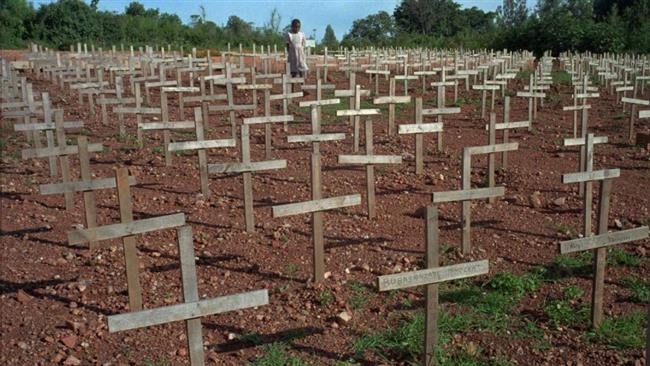
The Catholic Church in Rwanda has finally stepped forward with a long-awaited apology for its role in the mass slaughter of ethnic Tutsis in the East African nation. In a first-of-its-kind statement, the Conference of Catholic Bishops acknowledged that church members had contributed to the planning and the executing of the genocide by extremist Hutus that took the lives of 800,000 Tutsis as well as moderate Hutus. “We apologize for all the wrongs the church committed. We apologize on behalf of all Christians for all forms of wrongs we committed. We regret that church members violated (their) oath of allegiance to God’s commandments.”
In April 1994, the crash of a private jet which was carrying Rwanda’s then president Juvénal Habyarimana, a Hutu, and numerous other top officials gave rise to a massive anti-Tutsi outrage that served as a prelude to the massacre. Killings began immediately and were perpetrated by members of the army, gendarmerie, government-backed militias, clergy as well as civilians against key Tutsi and moderate Hutu figures who were likely to take over the reins after the president’s death.
Based on survivor accounts, a large number of victims were killed by priests and nuns in churches where they had been seeking shelter. Nevertheless, during the 22 years since the tragedy, the Catholic Church in Rwanda had been denying its role in the killings, which highlights the importance of this belated acknowledgement.
Rwanda’s Catholic bishops expressed regret for having failed to avert the genocide in the statement, part of which read, “Forgive us for the crime of hate in the country to the extent of also hating our colleagues because of their ethnicity. We didn’t show that we are one family but instead killed each other.” The statement takes on added significance in the context of efforts within the Catholic Church to propagate forgiveness during the Holy Year of Mercy announced by Pope Francis. The Extraordinary Jubilee of Mercy drew to a close on November 20, 2016.
Presstv
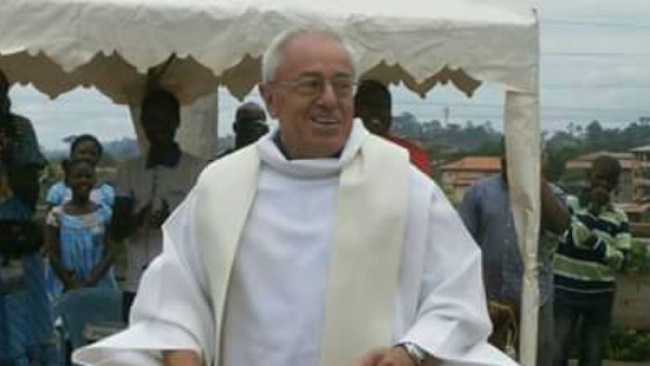
68 year old Rev. Father Carlio Girola, of the Arch Diocese of Yaounde was among those killed in the train tragedy at Eseka on Friday the 21st of October 2016. He was a Good Shepherd serving with the Roman Catholic Parish of Oyom-Abang neighbourhood, located in the 7th District of Yaoundé.
Father Carlio Girola was expected in Italy via a flight that was supposed to leave from the Yaounde Nsimalen international airport. The man of God turned down the Nsimalen offer and decided to travel by road to join other missionaries in an Air France flight from Douala via Paris to Rome. He reportedly travelled by coach until Manyai where a bridge had collapsed and prompted him and many others to make a U-turn back to Yaounde to use the train services.
Father Carlio took a selfie informing the “holy see” in Douala that he was already at the Yaounde train station and will be driving to Douala with the Intercity services 152. His pastoral mission here on earth ended at Eseka following the derailment of the Camrail train that claimed the lives of over 80 people. Blessed Are You Rev. Father Carlio Girola!! For You Believe
Father Carlo Girola was the ecclesiastical superior of the Xaverian congregation, located in Yaounde, Bafoussam, Douala, Yagoua and in the Republic of Chad. He was born in Oltrona San Mamette, in the Italian province of Como. From 1984 to 2007 he was a missionary in Cameroon and Chad. In 2007 he was elected member of the Directorate General of the Congregation in Rome. After the end of his term in 2014, he returned to Cameroon to work for the formation of theologians.
By Soter Tarh Agbaw-Ebai
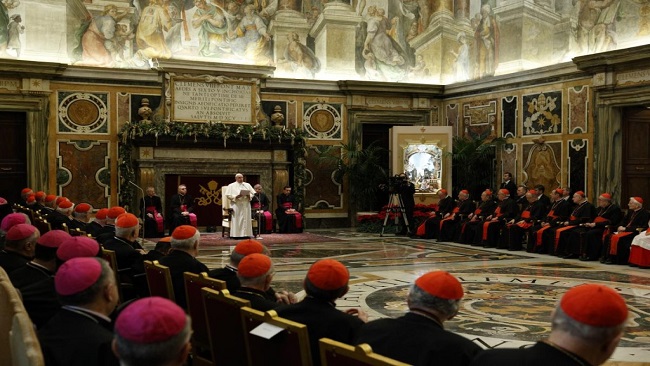
The Holy Father Pope Francis has appointed Bishop Faustin Ambassa Ndjodo and Reverend Father Alain Philippe Mbarga as Metropolitan Archbishop of the Archdiocese of Garoua and Bishop of the Diocese of Ébolowa respectively.
Prior to his appointment, His Lordship Bishop Faustin Ambassa Ndjodo was Bishop of the Diocese of Batouri and Reverend Father Alain Philippe Mbarga moonlighted as Rector of the Major Seminary in Nkolbisson in Yaounde.
Bishop Ambassa Ndjodo takes over from Bishop Anthony Ntalou, 76, whose resignation from the pastoral care of the archdiocese was accepted by the Holy See. Rev. Alain Philippe Mbarga becomes the third Bishop of the Diocese of Ébolowa, erected in 1991. The see was vacant since the appointment of Archbishop Jean Mbarga as the Archbishop of the Yaounde archdiocese in October 2014.
Bishop Faustin Ambassa Ndjodo was born July 26, 1964 at Ekouda in the Lékié Division in the Central Region while Reverend Father Philippe Alain Mbarga born on the 28th of January 1968 at Obout in Mbamayo.
By Soter Tarh Agbaw-Ebai
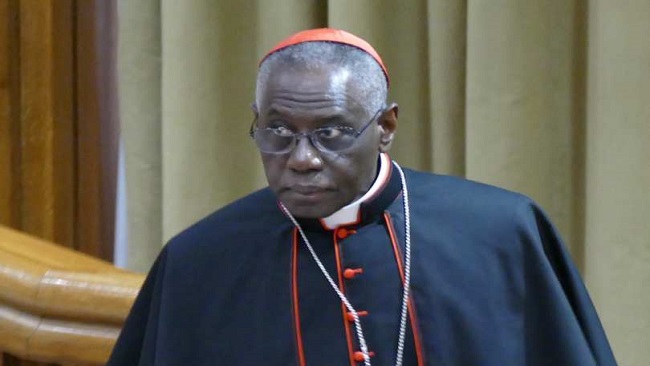
Pope Francis will personally replace Cardinal Robert Sarah at the inauguration of the academic year in the John Paul II Institute for Studies on Marriage and the Family in Rome in a last minute change. As the National Catholic Register reports, Pope Francis will surprisingly attend the opening of the academic year 2016/17 on October 27 instead of Card. Robert Sarah, head of the Congregation for Divine Worship and the Discipline of the Sacraments, who was originally picked by the institute to give the Lectio Magistralis.
This news follows recent nominations of the Institute’s new grand chancellor and president, Archbishop Vincenzo Paglia, who is also the new president of the Pontifical Academy for Life. His appointment is considered controversial. The new president will be the Milanese priest, Mons. Pierangeli Sequeri.
The John Paul II Institute took great initiative in preparation for and during the aftermath of the recent Synod of Bishops on the family. They have always tried to uphold John Paul II’s legacy of taking a clear stance on moral issues, such as the question of access to Communion for “re-married” divorced Catholics. Despite their clear expertise on the issue under discussion at the Synod, none of their professors were invited as consultants to the first, Extraordinary Synod on the family, in 2014.
Cardinal Robert Sarah recently made headlines by drawing throngs of people to the presentation of his most recent book, The Force of Silence in the French Institute of Rome. Earlier this year, Cardinal Sarah issued a high-profile call for clergy to celebrate Mass oriented toward the East, as the Church has done traditionally, after which he was silenced by the Vatican. Other tensions became clear in February when the Vatican announced that women could be chosen for the ceremony of washing the feet on Holy Thursday. This decree was published by Pope Francis himself – not by the congregation responsible for liturgy, led by Sarah – and Cardinal Sarah promptly responded in public statements clarifying that the decree’s introduction of women was not compulsory.
Merely the title of Cardinal Sarah’s new book seems to be a statement that could be read as a challenge to Pope Francis’ general style of governance of the Church. The news about Pope Francis assuming Cardinal Sarah’s place could be interpreted as a blow to the Cardinal of Guinea to silence him in the public sphere. On the other hand, the Pope’s presence could be explained merely as recognition of the 35thanniversary of the Institute, to be celebrated on November 22.
General concern equally arose with the new appointment of the Institute’s president, Mons. Pierangelo Sequeri. Sequeri was consultor for both the extraordinary and ordinary Synod of Bishops and took part in the working groups who helped draftAmoris Laetitia. It seems that the implementation of such documents would be in his field of interest. Yet only time and further developments in the Institute will tell if the nominations are in contrast to its mission.
Culled from LIFESITE
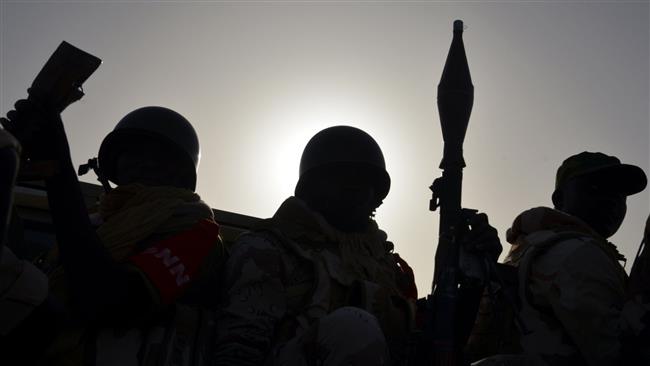
Nigerian government troops have surrounded a group of Shia Muslims gathered in a mosque to observe the mourning ceremonies for the martyrdom anniversary of Imam Hussein (peace be upon him). The worshipers had gathered in the mosque on Tuesday to commemorate the ninth day of the lunar month of Muharram, Tasu’a, the eve of the martyrdom anniversary of Imam Hussein, the third Shia Imam, and his 72 companions.
“Shortly before the Kaduna Markaz mosque on Zango Road was encircled by armored military vehicles carrying heavily armed soldiers and also an ambulance were among a convoy of 18 military vehicles seen nearby,” the Islamic Human Rights Commission (IHRC) reported. It noted that even women and children who attempted to leave the mosque were forced back in by the troops.
The incident occurred just a few days after Nigeria banned the Islamic Movement in Nigeria (IMN) and issued an arrest for its spokesman. “As was feared, the new law appears to be being used as an attempt to prevent the movement’s supporters from attending ceremonies commemorating the month of Muharram,”said the IHRC.

On December 13, Nigerian forces raided the house of prominent Shia Muslim cleric Sheikh Ibrahim Zakzaky, the leader of the IMN, and arrested him after killing those attempting to protect him, including one of the movement’s senior leaders and its spokesman.
The raid occurred a day after Nigerian soldiers attacked Shia Muslims attending a ceremony at a religious center in the city of Zaria, accusing them of blocking the convoy of the army’s chief of staff and attempting to assassinate him. The Sheikh himself, who was shot seven times during the attacks and blinded in one eye, still remains in army custody with no charges filed against him.
Presstv
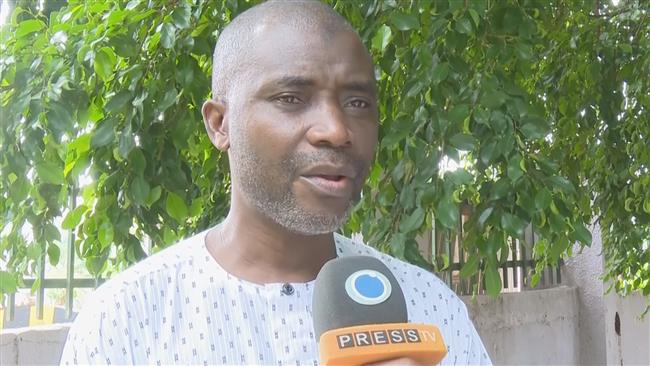
Nigeria has issued a warrant for the arrest of the spokesman of Islamic Movement in Nigeria (IMN) a few days after banning the group. Ibrahim Musa “owned up to being the spokesperson of an unlawful society,” said the governor of Kaduna state, Nasir El-Rufai, in a statement released on Sunday.
“This is deemed as a deliberate and determined affront… and the law has to take its course,” he added. After El-Rufai banned the IMN on Friday as part of a state crackdown against the Muslim community, Musa announced the move as illegal and vowed that the group would challenge it through “legitimate means.” Musa then told reporters that he is currently in touch with his lawyers over the arrest warrant. “Meanwhile I’ll not submit myself to the authorities as they requested,” he noted.

On December 13, Nigerian forces raided the house of prominent Shia Muslim cleric Sheikh Ibrahim Zakzaky, the leader of the IMN, and arrested him after killing those attempting to protect him, including one of the movement’s senior leaders and its spokesman. The raid occurred a day after Nigerian soldiers attacked Shia Muslims attending a ceremony at a religious center in the city of Zaria, accusing them of blocking the convoy of the army’s chief of staff and attempting to assassinate him.
On August 1, the Islamic Human Rights Commission released a report, saying the Nigerian army killed 348 Shia Muslims during the attack on the religious ceremony. The Sheikh himself, who was shot seven times during the attacks and blinded in one eye, still remains in army custody with no charges filed against him. Despite a Nigerian law which requires that charges be brought in court within 24 hours of an arrest, Nigerian President Muhammadu Buhari refuses to order Zakzaky’s release.
Presstv