Breaking News
José Mourinho rejects Benfica manager job
Former Manchester United and Chelsea manager José Mourinho is reported to have rejected an opportunity to return to Benfica to become the club’s new manager.
Britain’s Sky News reports that Mourinho said he feels it is too early to return to the Portuguese football at this stage of his career.
According to the report, Mourinho would rather take up a position at one of Europe’s leading clubs. He left Benfica after just nine league games when he managed the club in the year 2000.
At Chelsea, Mourinho won six trophies in three years before he left the club in a mutual agreement in 2007. Three years later, he moved to Inter Milan where he won a historic treble in 2010.
Mourinho was sacked in December last year, less than 24 hours after United lost 4-1 at Liverpool. He left them 19 points behind their bitter rivals.
Gabon soldiers read message on state radio as shots heard in Libreville
Soldiers in Gabon took control of the national radio station in the early hours of Monday and read a short statement announcing the establishment of a “National Restoration Council” in the absence of the country’s ailing president, Ali Bongo.
A New Year’s address by Bongo “reinforced doubts about the president’s ability to continue to carry out of the responsibilities of his office,” said Lieutenant Kelly Ondo Obiang, the leader of the self-declared Patriotic Movement of the Defence and Security Forces of Gabon.
In a video circulating on social media, Ondo Obiang is seen in a radio studio wearing military fatigues and a green beret as he reads the statement, which was broadcast at around 4:30 am local time (5:30 am GMT). Two other soldiers with large assault rifles stand behind him.
Ondo Obiang called on the military and Gabonese youth to join his movement and occupy public buildings and airports throughout the country.
“If you are eating, stop; if you are having a drink, stop; if you are sleeping, wake up. Wake up your neighbours… rise up as one and take control of the street,” he said his radio message.
An AFP correspondent said shots were fired near the radio station in the centre of Libreville, the Gabonese capital, with military vehicles blocking access to the site.
Bongo, 59, was hospitalised in October in Saudi Arabia after suffering a stroke. He has been in Morocco since November to continue treatment.
A spokesman for the presidency told Reuters he would make a statement shortly.
In his speech on New Year’s, Bongo acknowledged health problems but said he was recovering. He slurred some of his words and did not move his right arm, but otherwise appeared in decent health.
The Bongo family has ruled the oil-producing country for nearly half a century. Bongo has been president since succeeding his father, Omar, who died in 2009. His re-election in 2016 was marred by claims of fraud and violent protest.
(FRANCE 24 with REUTERS, AFP)
Trial of Ambazonian Leader: Interim Gov’t’s lawyer Falana drags La Republique to African Commission
Nigeria’s foremost human rights lawyer Femi Falana SAN has dragged the government of Cameroon to the African Commission on Human and Peoples’ Rights in Banjul, The Gambia over the impending trial of 47 asylum seekers and naturalised Nigerians.
The lawyer wants the commission’s urgent intervention to end “the ongoing human rights violations of the applicants who were forcibly returned to Cameroon by the Nigerian authorities.” Falana is asking “the Chairperson and the Bureau to urgently hold an extra-ordinary session of the African Commission to address the illegal and unfair return of 47 refugees and asylum seekers, and the continuing violations of the rights of the returnees by the government of Cameroon.
“We also urge the Chairperson of the Commission to speak out strongly and condemn the unfair treatment of the returnees by the government of Cameroon, and request the government to immediately release them from unlawful detention.”
The petition read in part: “Cameroon has ratified the African Charter on Human and Peoples’ Rights and United Nations Convention Relating to the Status of Refugees. At the request of the Government of Cameroon the Nigerian authorities illegally and unfairly returned 47 refugees and asylum seekers to Cameroon on Friday, January 26, 2018. The returnees are mostly leaders of the people of Southern Cameroon and who have been living in Nigeria with their families for years.”
“Some of them have been granted political asylum while others were asylum seekers in Nigeria. On Saturday, 7th January 2018, the Applicants assembled to meet in Abuja to discuss the problems being encountered by several Cameroonian asylum seekers in Nigeria but before the commencement of the meeting security personnel from Nigeria arrested the Applicants and took them to an underground detention centre in a military barracks in Abuja.”
“While the Applicants were detained in Nigeria, they were denied access to their family members, friends, lawyers and doctors. However, the representative of the United Nations Commissioner for Refugees was allowed to visit the Applicants.”
“When the Applicants’ lawyers received information of the plan to deport them to Cameroon, they rushed to the Federal High Court in Abuja to stop the illegal plan. The Applicants also reached out to the Comptroller-General of Immigration, the Minister of Foreign Affairs and the office of the United Nations Commissioner for Refugees in Nigeria.”
“As soon as the Office of the United Nations Commissioner for Refugees in Nigeria confirmed the information it dispatched a letter to the government of Nigeria pointing out that Nigeria has a legal obligation under international law not to deport the detained Cameroonians.”
“But in a demonstration of reckless impunity, the government of Cameroon pressured the Nigerian authorities to hand over the refugees. They were handed over to the Cameroonian security forces who forcefully took them away from Nigeria on Friday, January 26, 2018.”
“On account of the illegality of the deportation, the government of Nigeria could not announce that the refugees had been expelled from Nigeria but the Government of Cameroon decided to celebrate the deportation and threatened to prosecute the deportees for terrorism. We submitted a letter to the Office of the High Commissioner of Cameroon to Nigeria in Abuja to request for access to the Applicants who are currently held incommunicado in Cameroon. The request has to date not been granted by Cameroon.”
“Nigeria has no extradition treaty with Cameroon. Hence, the deportation was carried out outside the ambit of the extradition laws of Nigeria and Cameroon and the African Charter on Human and Peoples’ Rights.”
“In removing the Applicants from Nigeria, the government of Cameroon breached the human rights of the Applicants to enter Nigeria, reside, seek and obtain asylum guaranteed by Article 12 (3) of the African Charter on Human and Peoples’ Rights. The government of Cameroon also breached article 12 (4) of the African Charter, which provides that every individual shall have the right, when persecuted to seek and obtain asylum in other countries in accordance with the laws of those countries and international conventions.”
“Apart from the violation of the African Charter, the government of Cameroon breached its legal obligations under the 1951 United Nations Convention Relating to the Status of Refugees and the 1969 Organization of African Unity Convention on Refugees and which have guaranteed the rights of refugees and asylum seekers in Nigeria to protection.”
“The Applicants are the leaders of the movement agitating for the creation of the Republic of Ambazonia from Cameroon. In 2002, the Applicants filed a suit at the Federal High Court in Abuja to determine whether the people of Southern Cameroon were not entitled to self-determination within their clearly defined territory separate from the Republic of Cameroon. The government of Nigeria decided to settle the case out of court.”
“By a consent judgment delivered by the Court on March 5, 2002, the government of Nigeria agreed to file a suit at the International Court of Justice to have a judicial confirmation of the human right of the people of Southern Cameroon to self-determination. The government of Nigeria also undertook to take other measures as may be necessary to place the case of the people of Southern Cameroon for self-determination before the United Nations General Assembly and other international organizations.”
“The Applicants are not soldiers, but civilians. Even though they are not military men, the government of Cameroon has decided to try them before a military tribunal. The military tribunal to try the Applicants has since been constituted by the government of Cameroon.”
“Upon the arrival of the Applicants in Cameroon and without any investigation whatsoever, the government of Cameroon announced that they would be tried for terrorism. The Applicants have been detained illegally from January –November, 2018.”
“The Applicants have since been arraigned for terrorism before a military tribunal specially constituted for the purpose of persecuting them even though they have never engaged in terrorist activities in Cameroon.”
“The trial of the Applicants is scheduled to commence in Cameroon on January 10, 2019 whereas their lawyers who are based in Nigeria have been denied access to them and the opportunity to defend them.”
“It is the case of the Applicants that they had left Cameroon with their families and have been living in Nigeria where that had applied for asylum. Thus, by removing them from Nigeria the government of Cameroon has separated the Applicants from their family members who have been left behind in Nigeria.”
Source: NAN
Irish women put their feet up for feminist Christmas
Epiphany on 6 January is celebrated throughout Europe – with France’s ‘galette des rois’ cake, in Spain’s ‘cabalgata’ parade and in Italy’s broomstick-riding ‘Befana’ who brings presents. In Ireland, however, the day is known as Women’s Christmas.
Women’s Christmas, Nollaig na mBan in Irish Gaelic, or Little Christmas as it is alternatively known, is traditionally the day when women are able to rest after their hard work over the Christmas period. They gather with friends, possibly exchanging gifts, and don’t do any work for a day – instead leaving men to cook for them, look after the children and run the household.
The men of Ireland weren’t altogether delighted by the role-reversal. An Irish proverb went like this: “Nollaig na bhfear, Nollaig Mhor Maith; Nollaig na mBan, Nollaig gan Mhaith”, which means “Men’s Christmas: a fine big Christmas; women’s Christmas, a no-good Christmas”.
Before 1958, January 6 was the only day of the year when women in Ireland were allowed into pubs. Groups of women would pool together the money they had saved, and go and drink and eat in the pub.
Previously, women in Ireland would only set foot in a pub if they were chaperoned by a man. Those who braved the male-dominated domain of the Irish bar were viewed as not respectable. Women today go out with their friends to a local pub or a restaurant to celebrate. Businesses across Ireland have begun to take advantage of the day’s popularity with deals and promotions.
The day has also been used by feminist activists as an opportunity to celebrate women’s achievements and inspire change. The Irish Writers Centre in Dublin hosts an event on the day which pays tribute to Irish female writers and the Glasnevin Cemetery Museum runs a tour about women who shaped the nation.
This year HerStory, a cultural activism project, organised a festival to quite literally shed a light on the lives and achievements of important women throughout history and culture. On the eve of Women’s Christmas, buildings across Dublin were illuminated with projections of famous or influential women, from 16-year-old climate activist Greta Thunberg, to Irish footballer Anne O’Brien and Fuamnach, a witch from medieval Irish mythology.
The year 2018 was significant for women’s rights in Ireland. A hundred years after Irish women won the right to vote, they came out in huge numbers to vote on whether to repeal or keep the Eighth Amendment in the Irish Constitution, a law that grants equal right to life for the mother and the unborn child. The Republic voted to overturn the country’s draconian abortion ban by a landslide.
The first day of 2019 saw abortion services legally available for the first time, as well as new measures against coercive control in abusive relationships passed into law.
But the gender equality battle is not yet won. The Gender Equality Index 2017, produced by the European Institute for Gender Equality, highlights how Ireland still has progress to make on gender equality in the household: 90% of Irish women do cooking and housework every day for at least one hour, compared to only 50% men.
Culled from France 24
French cardinal to go on trial over child abuse cover-up
The highest-profile Catholic cleric to be caught up in a paedophile scandal in France is to go on trial on Monday charged with failing to report a priest who abused boy scouts in the 1980s and 90s.
Cardinal Philippe Barbarin, the archbishop of Lyon, is to stand trial along with five others from his diocese over allegations that they helped cover up abuse in one of the parishes in the area.
The 68-year-old, an arch-conservative, is one of the most prominent Catholic figures in France who faces up to three years in prison and a fine of 45,000 euros ($54,000) if convicted of failing to report the abuse.
He denies the allegations.
France’s Catholic church has been roiled in recent years by allegations against predator priests which have come to light in the wake of a global move by victims to come forward with evidence.
Clerics have been denounced in countries as far afield as Australia, Brazil, Chile, Ireland, and the United States, leading Pope Francis to promise to rid the church of the scourge that has done enormous damage to its standing.
‘Abused as a child’
The scandal in Lyon first came to public attention in 2015 when a former scout went public with allegations that a local priest, Bernard Preynat, had abused him as a child 25 years ago.
The scout, Francois Devaux, who has since formed a victims’ group, also filed a complaint against Barbarin, the priest’s superior, alleging that he had known about the abuse but had covered it up.
After six months of investigation and 10 hours of interviews with Barbarin, investigators dropped the case in 2016 after concluding that the allegations against him were either too old or impossible to prove.
But a group of victims succeeded in having the probe reopened which led to Barbarin and the others, including the archbishop of Auch and the bishop of Nevers in France, being ordered to stand trial.
“We hope this time to have a ruling that will be clear and obvious for everyone,” Devaux said before the start of the trial.
His victims’ group, La Parole Liberee (Freed Speech), began with a handful of people, but soon received calls and testimony from a total of 85 people claiming to have been victims of Preynat in Lyon.
The priest was prevented from leading scout groups after he was first denounced in 1991, but was later allowed to teach to children and held positions of authority in parishes until the scandal surfaced in 2015.
A lawyer for Barbarin, Jean-Felix Luciani, said the cardinal was counting on the trial to “re-establish some facts because you don’t repair one injustice by creating another one.”
Pope’s role
The story of Devaux, the victim who brought the scandal to light, is to be told in a film this year called “Grace a Dieu” (“Thanks to God”) which has been made by French director Francois Ozon.
The priest at the centre of the scandal, Preynat, has acknowledged abusing boys during interviews with investigators. He is set to go on trial this year charged with statutory rape.
Two other French religious figures have been convicted of failing to report child abuse in the past: the archbishop of Bayeux-Lisieux, Pierre Rican, in 2001, as well as the former bishop of Orleans, Andre Fort, last year.
The head of the Vatican’s powerful Congregation for the Doctrine of the Faith, Spanish Archbishop Luis Francisco Ladaria Ferrer, has also been accused of complicity in the alleged cover-up in Lyon.
In correspondence with Barbarin about the priest, the Vatican’s number three had advised the cardinal to take “necessary disciplinary measures while avoiding public scandal” — seen as a warning to keep the abuse quiet.
The Vatican has cited his immunity from prosecution and he will not go on trial.
Barbarin has retained the support of Pope Francis who met with him at the Vatican in October 2017 shortly after he was ordered to stand trial. “I have only one judge who is the Lord,” the cardinal said recently on a trip to the holy town of Lourdes in southern France.
(AFP)
Paris: Tear gas billows as ‘Yellow Vests’ protest against President Macron
Clashes continued between police and protesters, after ‘Yellow Vest’ demonstrators hit the streets of Paris for the eighth week in a row on Saturday.

The Yellow Vest movement emerged after French President Emmanuel Macron announced a fuel tax hike to encourage a transition towards greener energy.
The French government has now suspended the price hikes but the protests continue nevertheless.
Nigeria’s Buhari is related to electoral commissioner by marriage
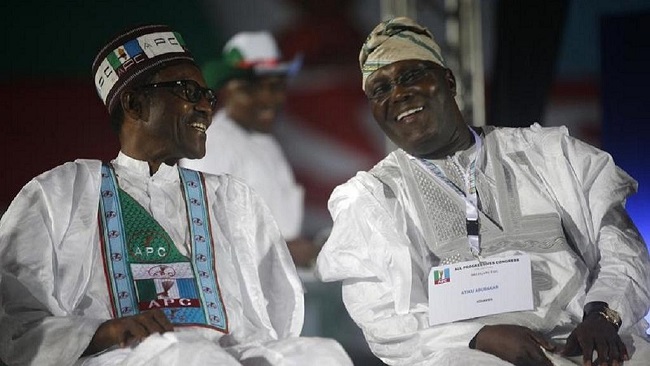
Nigeria’s president Muhammadu Buhari and a recently appointed electoral commissioner are only related through marriage in their extended families, rather than by blood as alleged by the opposition.
The People’s Democratic Party on Thursday accused Buhari and the Independent National Electoral Commission of plotting to rig the election with the appointment of Amina Zakari, whom the party said is Buhari’s niece.
“President Buhari and Commissioner Amina Zakari don’t share a family relationship,” a spokesperson for the president tweeted on Friday.
“An inter-marriage occurred in their extended families, so the imputation of blood relationship between the President and the electoral commissioner is a simple lie,” he added. Nigeria will hold presidential elections on February 16.
Elections in Africa’s most populous nation have for years been marred by allegations of irregularities including vote rigging, voter intimidation, cronyism and violence.
Opposition reject Zakari’s appointment
In a statement on Thursday, the People’s Democratic Party rejected Zakari’s appointment as “head of the collation of results,” calling her a “blood relation.”
A commission spokesperson did not respond to a request for comment.
Buhari, who is seeking a second term, reassured voters in October that the election would be free and fair after international observers raised concerns over how a gubernatorial vote was conducted at the time.
Africa News
US deploys military troops to Gabon over Congo violence
US President Donald Trump says the Pentagon has deployed 80 US troops to Gabon to secure American citizens and the US embassy in the Democratic Republic of the Congo after a presidential election there last week.
In a letter to Congress on Friday, Trump said the troops were deployed “in response to the possibility that violent demonstrations may occur” in the wake of the election in the Congo.
Trump’s letter said the personnel arrived in Gabon on Wednesday and additional forces may be deployed “if necessary.”
US military personnel “will remain in the region until the security situation in the Democratic Republic of the Congo becomes such that their presence is no longer needed,” the letter added.
The Congo general election was mostly held in a peaceful atmosphere despite incidents of violence, according to a preliminary report by African election observers.
Congo’s electoral commission is scheduled to release provisional results of the presidential election on Sunday.
Congo’s government says the election was fair and went smoothly but the opposition says the election was marred by serious irregularities.
The international community has raised concerns that a disputed result could cause unrest, as was the case after the 2006 and 2011 elections.
The US military has in recent years used the presence of Takfiri terrorists to build up its presence across Africa, where it reportedly has over 6,000 boots on the ground.
Source: Presstv
Biya’s cabinet remake: Full of messieurs and a lone madame
Cameroon president on Friday evening issued a decree naming a new Prime Minister to replace long serving Philemon Yang who was inching towards a decade in the role.
The decree of January 4, 2018 replaced Philemon Yang with Joseph Dion Ngute, a former Minister at the presidency and Minister Delegate to the Minister of External Relations.
The President went on to name a new cabinet that saw some ministers handed new portfolios with a number of new entrants.
The interesting list had one woman in the midst of about seventeen newly appointed men. The sole female appointee is Madam Courtes née Keutcha Celestine – Minister of Housing and Urban Development.
She joins Dr. Nalova Lyonga who was in March 2018 named Minister of Secondary Education. At the time she was one of two Anglophone appointees, the other being Atanga Nji Paul was appointed Minister of Territorial Administration which translates to the Interior Ministry portfolio – both maintain their positions.
The Cameroonian situation is not exactly in line with an African trend where Presidents handed cabinet posts to women especially to competent young women as was the case in Botswana, Zimbabwe and Mali in 2018.
Over in Ethiopia, Prime Minister Abiy Ahmed in October 2018 named a cabinet that had as many men as women. The historic cabinet also gave women sensitive roles as the Minister of Defence and Minister of Peace – a portfolio that oversees the sensitive security sector of the country.
The new list as published by the presidency:
On Friday 4 January 2019, the President of the Republic, His Excellency Paul BIYA signed four decrees to reshuffle the government.
Dion Ngute Joseph was raised to the position of Prime Minister, Head of Government.
The following officials were also appointed:
– Minister of State, Minister of Higher Education: FAME NDONGO Jacques
– Minister Delegate at the Presidency in charge of Public Contracts: TALBA MALLA Ibrahim
– Minister Delegate at the Presidency of the Republic in charge of Relations with the Parliament: WAKATA Bolvine
– Minister of Agriculture and Rural Development: MBAIROBE Gabriel
– Minister of Arts and Culture: BIDOUNG KPWATT Pierre Ismael
– Minister of Communication: SADI Rene
– Minister of State Property, Surveys and Land Tenure: EYEBE AYISSI Henri
– Minister of Basic Education: ETOUNDI NGOA Laurent Serge
– Minister of Employment and Vocational Training: ISSA TCHIROMA Bakary
– Minister of Housing and Urban Development: COURTES née KEUTCHA Celestine
– Minister of Mines, Industry and Technological Development: DODO NDOKE Gabriel
– Minister of Small and Medium-sized Enterprises, Social Economy and Handicrafts: BASSILEKIN III Achille
– Minster of Public Health: MANAOUDA MALACHIE
– Minister of Sports and Physical Education: MOUELLE KOMBI Narcisse
– Minister Delegate at the Ministry of Justice and Keeper of the Seals: MOMO Jean de Dieu
– Minister Delegate at the Ministry of Transport: NJOYA ZAKARIAOU
– Ministers in charge of Special Duties at the Presidency of the Republic
GHOGHOMU Paul MINGO and NDONG SOUMHET Benoit
– Minister of State, Secretary-General of the Presidency of the Republic: NGOH NGOH Ferdinand
– Ministers, Deputy Secretary-General of the Presidency of the Republic :
ELUNG Paul CHE and MOHAMADOU MOUSTAPHA
Source: Africa News