
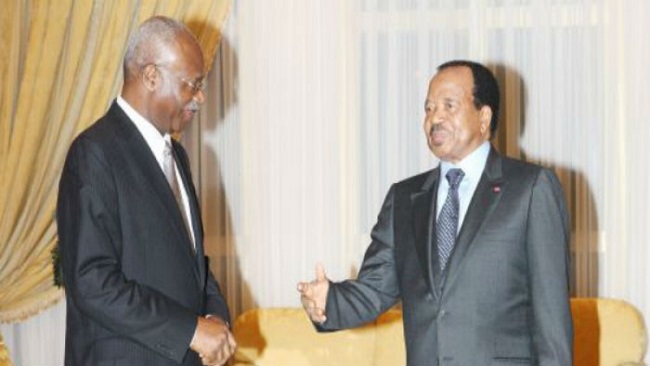
A Crown of Thorns: The Tragic Irony of Philémon Yang’s Praise for Paul Biya
As the nation teeters on the brink of collapse, haunted by its own fractured identity, former Prime Minister Philémon Yang has stepped forward not to call for reform or justice but to once again decorate the presidency with laurels. In a recent public declaration, Yang hailed President Paul Biya as the best candidate to ensure peace, stability, and development in Cameroon.
To the average Cameroonian who wakes each morning in a country consumed by war, corruption, and deep institutional decay, such praises land not as reassurance but as salt in an open wound.
After more than four decades in power, President Biya is not just a symbol of continuity. He has become the face of an enduring and painful crisis. Yet from polished podiums and elite gatherings, the political establishment continues to sing his praises while the nation bleeds in silence.
A Tale of Two Cameroons
There is the Cameroon that Philémon Yang speaks of. A land of order, progress, and unity under the steady hand of its long-standing and dictatorial ruler. And there is the Cameroon most citizens live in. A nation where soldiers torch villages in the Northwest and Southwest, where journalists disappear into detention cells, and where mothers grieve over the charred remains of their children!
In this other Cameroon, peace is a myth, stability is enforced through fear, and development has taken a long painful detour.
What Mr Yang calls leadership, many Cameroonians now recognize as survival politics. A regime that sustains itself not through vision but through silence, suppression, and self-preservation.
Samuel Wazizi The Journalist Who Vanished in Custody
Perhaps no story better captures this brutal contradiction than the tragic fate of Samuel Wazizi, a journalist arrested in August 2019 in Buea for reporting on the Anglophone crisis. Daring to speak aloud what others whispered in fear. For months, his family and legal team were kept in the dark about his whereabouts. It was not until June 2020 that the government finally confirmed what many feared. Wazizi had died in military custody, allegedly due to severe torture.
No one has been held accountable
There was no public inquiry, no independent investigation, and no justice. His death sent a chilling message across the media landscape. In today’s Cameroon, telling the truth can cost you your life or exile.
Yet, Philémon Yang invokes stability without mention of the silence that now blankets the press and the country.
Ngabou Ngarbuh and the Memory of Fire
What kind of peace allows the massacre of children?
In Ngarbuh in 2020 and later in Ngabou, families were ripped apart in unspeakable acts of violence reportedly at the hands of state forces. The haunting images of babies burned in their sleep, mothers executed in broad daylight, and entire villages left in ashes are etched into the national memory. These are not the birthmarks of peace. They are the scars of abandonment.
Still, the state’s response has been slow, evasive, and muted. Instead of confronting these horrors, the political elite chooses to elevate a narrative that serves power over truth.
Development Deferred, Justice Denied
While Mr Yang speaks of development, hospitals collapse under the weight of neglect and roads in rural regions are impassable during the rainy season. Unemployment remains high and the wealth gap continues to widen. The COVID-19 pandemic further exposed the fragility of Cameroon’s health infrastructure. A system more responsive to elite interests than public needs.
And what about justice? For many, it remains a phantom. A luxury reserved for those with connections. The poor are left to navigate a system designed to exhaust rather than empower. Victims of abuse from arbitrary arrests to land grabs find little relief in courts where power not law determines outcomes.
A Legacy of Fear Disguised as Stability
What Philémon Yang and others in the ruling elite call stability has in practice become the art of managing fear. Dissent is criminalized. Protesters are jailed. Artists and musicians like Longue Longue have faced harassment and physical abuse simply for daring to speak. Cameroon has become a place where criticism is conflated with criminality and where silence is no longer a choice but a survival tactic.
The Danger of Ritual Praise
The most dangerous lies are not the ones told by dictators but the ones repeated by those who know better.
Philémon Yang, a seasoned politician with decades in public service, cannot claim ignorance. His endorsement is not just political theatre. It is an act of betrayal. A betrayal of the suffering Anglophone mothers, the silenced journalists, the displaced families, and the young Cameroonians who see no future in a country where truth has no microphone.
The Final Irony
In the end, it is not Biya’s rule that shocks the conscience. It is how many in the elite continue to applaud while the country drowns. Their praises echo in marble halls while ordinary Cameroonians bury their dead, walk miles for medicine, or flee their homes under gunfire.
To call this peace is to spit on grief.
To call this development is to mock despair.
To call this stability is to ignore the tremors shaking the nation’s soul
The truth is not convenient but it is necessary. Until those in power begin to speak it, Cameroon will continue to stand as a republic of silence wrapped in empty applause.
By Ntam Charles in Bonn, Germany


