
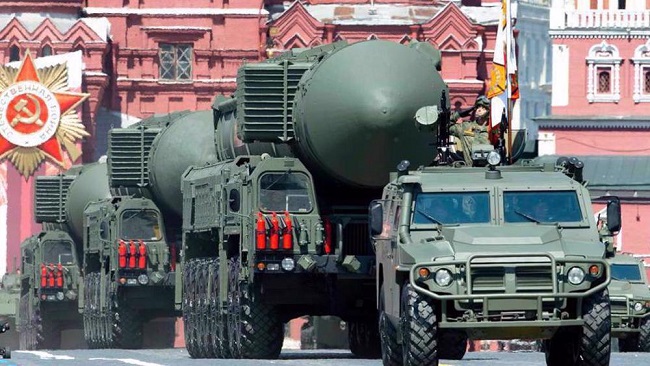
Russia and Belarus stage joint nuclear weapons drills
Russia and Belarus staged joint nuclear weapons drills on Monday, authorities said. Russia deployed Oreshnik, its latest hypersonic, nuclear-capable missile, to Belarus last year, upping the stakes in its rivalry with the NATO military alliance.
“During the exercise, it is planned to practice issues related to the delivery of nuclear munitions and preparation of their use in cooperation with the Russian side,” the Belarus defence ministry said.
The scheduled training “is not directed against third countries and does not pose a threat to security in the region”, it added in a statement on social media.
Aviation and missile forces would take part in the drill, the ministry said.
Last week, Ukrainian President Volodymyr Zelensky ordered troops to reinforce the border with Belarus in the north, claiming Moscow was preparing a new offensive from there.
He said Russia, which used Belarus as a staging post for its invasion in 2022, wanted to drag the former Soviet republic deeper into the war.
The Kremlin dismissed Zelensky’s allegations on Monday, calling them “an attempt at further incitement”.
Belarus, a landlocked eastern European country ruled for over 30 years by close Putin ally Alexander Lukashenko, depends heavily on Moscow economically and militarily.
Ukraine’s foreign ministry condemned the drills, saying that deployment of tactical weapons in the country constituted an “unprecedented challenge” to global security.
“By turning Belarus into its nuclear staging ground near NATO borders, the Kremlin is de facto legitimising the proliferation of nuclear weapons worldwide and setting a dangerous precedent for other authoritarian regimes,” the ministry said in a statement.
Russian President Vladimir Putin has repeatedly invoked nuclear rhetoric throughout his now four-year full-scale invasion of Ukraine as the West stepped up military support for Kyiv.
In 2024, the Kremlin released a revised nuclear doctrine that placed Belarus under the Russian nuclear umbrella. Putin has said that Moscow will retain control of its nuclear weapons deployed to Belarus, but would allow its ally to select the targets in case of conflict.
Russia has used a conventionally armed version of the Oreshnik – Russian for hazelnut tree – to strike facilities in Ukraine on two occasions, first in November 2024 and then again in January. The missiles were fitted with inert dummy warheads both times, Ukrainian officials said.
Putin has claimed that Oreshnik’s multiple warheads plunge at speeds of up to Mach 10 and can’t be intercepted, and that several such missiles used in a conventional strike could be as devastating as a nuclear attack.
Intermediate-range missiles can fly between 500 to 5,500 kilometres. Such weapons were banned under a Soviet-era treaty that Washington withdrew from in 2019, accusing Moscow of having failed to abide by the agreement.
The ending of the New START agreement in February, which US President Donald Trump declined to extend, formally released the world’s two largest nuclear powers from a raft of restrictions.
Moscow last week tested its nuclear-capable, intercontinental ballistic missile Sarmat.
Source: Reuters


