
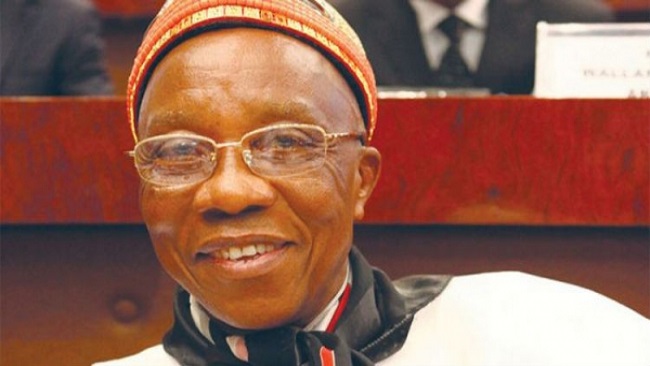
Senator Chief Tabetando leaves behind not just a record, but a reckoning
Early this morning, Hon. Victor Mengot, Minister of Special Duties at the presidency of the republic made public the passing into eternity of His Royal Highness Chief Barrister Tabetando CPDM Senator for the Mamfe Central Sub constituency. The late political figure also moonlighted as the traditional ruler of Bachuo-Ntai village.
Minister Victor Mengot posted “Dear Comrades, it is with a heavy heart that I announce the passing into glory of the last standing senior politician of his generation. Senator Nfor Tabetando passed on this night after a protracted illness. May his soul find solace at the bosom of the Lord.”
The journey of Senator Chief Tabetando to the land of his ancestors invites not just mourning, but reflection on a life well spent and a life that seemed to straddle ambition and duty, power and responsibility, legacy and contradiction.
There are prominent Anglophone political and academic figures that pass through the Cameroon political and business spaces like brief weather but there are those like Chief Tabetando who alter the atmosphere itself. Chief Tabetando’s voice hin und zu unyielding, unexpectedly conciliatory but carried across chambers and communities alike. Whether Cameroonians both Francophones and Anglophones agreed with him or not, it was extremely difficult to ignore him!
Ever since his passing, tributes have been flowing with predictable reverence from Manyu citizens at home and in the diaspora. Words like “icon,” “pillar,” and “visionary” appear readily in the public lexicon of grief. However, we of the Cameroon Concord Group think that a more honest remembrance of His Royal Highness Chief Tabetando demands we resist flattening him into something too polished. The Supreme Leader of the Bachou-Ntai people was not carved from marble; he was shaped in the friction of real business and politics, where ideals meet compromise and conviction meets consequence.
As a student of the great Chief Emmanuel Tabi Egbe, His Royal Highness Chief Tabetando rose, as many admired Anglophone leaders do, from circumstances that required resilience. His early struggles so often cited in his speeches were not merely narrative decoration; they informed his instincts, his alliances, the Chief’s sense of what was worth fighting for. This begs the question: Did Chief Tabetando remain anchored to those humble beginnings, or did the machinery of political power in Yaoundé slowly redraw his compass? The answer, depending on whom you ask from both sides of the river Moungo, is both.
Frankly speaking, there were moments when His Royal Highness Chief Tabetando embodied the highest aspirations of public service, championing policies that spoke to equity, advocating for voices long sidelined in both the South West and North West regions. And there were other moments, harder to reconcile, when his silence over the Cameroon government teleguided killings in Southern Cameroons spoke louder than any speech he gave. These contradictions do not diminish Chief Tabetando’s legacy; they define it. To remember Chief Tabetando truthfully is to hold both the light and the shadow.
Death has a way of clarifying what life obscures. It strips away the immediacy of political rivalry and leaves behind a more enduring question: after Chief Tabetando, what remains? Not the headlines, nor the victories, but the imprint on people’s lives including the hundreds of well-paid jobs created in Euroil, medic care for all in his Bachuo-Ntai Kingdom, roads built and the laws passed or blocked during his time in the Senate.
Perhaps the deeper, more uncomfortable reflection is not about His Royal Highness Chief Barrister Tabetando alone, but about the Cameroon political system in Yaoundé that shaped him. Political and business elites do not emerge in isolation; they are products of collective expectations, pressures, and permissions. In examining Chief Tabetando’s life, we are also examining ourselves—what we reward, what we tolerate, what we demand.
There is a great temptation in moments like this to seek closure. To be sure, to wrap a life in a neat conclusion and declare it either triumph or cautionary tale! But His Royal Highness Chief Tabetando resists that simplicity. Chief Tabetando’s story feels unfinished not because of its abrupt end this morning, but because his life story asks questions that outlive him.
What does it mean to serve your people with integrity when compromise is inevitable? How does a great political elite wield power without becoming defined by it?
And when the final reckoning comes—as it does for all—what measure truly matters?
As he passes into eternity, His Royal Highness Chief Tabetando leaves behind not just a record, but a reckoning. Not just memories, but mirrors.
And perhaps that is the most enduring legacy of all.
To this I put my name
Soter Tarh Agbaw-Ebai


