
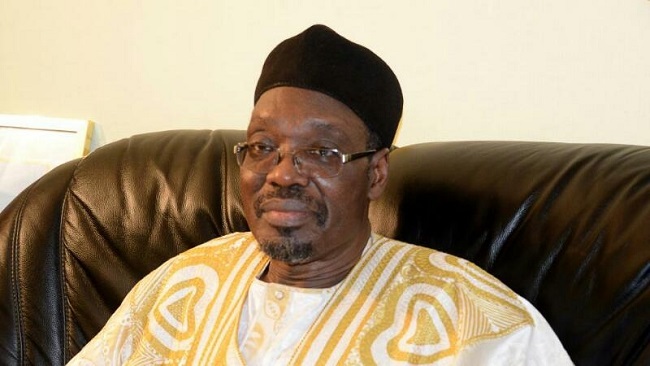
Race for Etoudi: Tchiroma’s ‘consensus’ candidacy faces doubt
The proclamation of Issa Tchiroma Bakary as the “consensus candidate of the opposition” for the October 12, 2025 presidential election is drawing controversy in Cameroon. The designation, announced by the Union for Change 2025 political platform, was presented as the result of a unanimous vote during its general assembly. However, the purported support for his candidacy remains largely unverified, raising doubts about the maneuver.
Unsubstantiated Claims
The Union for Change, recently established by Anicet Ekane, head of the Manidem party, and Djeukam Tchameni, leader of the Movement for Democracy and Interdependence, claims the designation was based on attendance sheets signed by participating parties and individuals. The documents, which would prove the consensus, have not been made public. When contacted by SBBC, Anicet Ekane remained silent. An associate of his said, “There is Manidem and Djeukam Tchameni’s party. The rest are unknown to me.” Calls to the phone numbers listed in the communiqué were also unanswered, leaving the proclaimed unanimity to appear as a paper-thin consensus.
Tchiroma’s campaign team offered some details, claiming that “more than twenty political parties and civil society figures” have aligned behind the former Minister of Communication. However, they refused to provide a list of names. “I prefer not to reveal the names of the other parties, it’s strategic,” a campaign source said, adding that the attendance sheets were “not a public tool” and would remain sealed. In effect, the public is being asked to accept the existence of this coalition on faith.
Rivals Reject the Endorsement
Even more telling is the fact that none of the other ten candidates vying for the presidency against incumbent Paul Biya has endorsed the move. Tchiroma’s camp claims to have consulted all the contenders, stating, “They did not join because their platforms did not align with what we were proposing… We remain in contact.“
However, the reality is far more confrontational. The main challengers have refused to accept what they call a unilateral proclamation. Bello Bouba Maigari, through his campaign director Pierre Flambeau Ngayap, denounced the move as “isolated actions by small groups or individuals without a mandate.” Célestin Bedzigui, president of the Liberal Alliance Party (PAL) and a supporter of candidate Ateki Seta Caxton, was even more direct. “This proclamation is false, especially since the authentic candidates are working hard to overcome their differences,” he said, adding that it was “the statement of authentic political huckster zombies… seeking to impose their solitary, lewd fantasies as the political reality of the moment.” Akere Muna’s spokesperson, Paul Mahel, offered a similar assessment: “A consensus candidate is the result of a consultation among candidates.”
A Political Gamble
Despite the posturing, it’s clear that Tchiroma has failed to rally his peers. His team’s supporters argue that the goal is not to demonstrate broad support, but to create momentum. “The most important thing is to take action to shift the political landscape,” said an analyst close to the government. “Since none of Mr. Biya’s eleven opponents can break away, the goal is to isolate the minor candidates to push for a strategic withdrawal.” The initiative seems less about a genuine consensus and more of a gamble: imposing a name and hoping that support will follow.
Tchiroma is no political novice. A former Minister of Communication and a veteran parliamentarian, he has a reputation for surviving political reshuffles. Yet he is also a controversial figure, with a history of shifting allegiances between opposition and government, which raises questions about his current role as a champion of unity.
The Union for Change 2025 is sticking to its plan, announcing a “major rally” to officially present its candidate. However, without clarifying the identity of its allies, the operation looks more like a staged event than a genuine show of force. The entire episode highlights the chronic inability of Cameroon’s opposition to unite. For the past three decades, every presidential election has followed the same pattern: a proliferation of candidacies, a failure to unite, and divisions exploited by the ruling regime. The Tchiroma affair once again demonstrates this paradox. Instead of converging, opposition forces are fragmenting, with grand pronouncements and petty squabbles. With a month to go before the vote, the opposition remains in disarray. While Tchiroma presents himself as a “consensus” candidate, he struggles to convince anyone beyond his inner circle. His supporters call it a strategy. His rivals call it a bluff. Regardless, the initiative serves as a stark reminder that without true unity, a change in government in Cameroon remains a distant prospect.
Source: Sbbc


