Ghana: Local media declare opposition candidate winner of presidential election
Two local media outlets in Ghana have claimed that main opposition leader Nana Akufo-Addo has won the country’s presidential election. The private radio stations Joy FM and Citi FM said on Friday that Akufo-Addo, the New Patriotic Party (NPP) candidate, gained an absolute majority over incumbent President John Mahama from the National Democratic Congress (NDC) in the election, which was held on Wednesday.
The country’s electoral commission has yet to begin releasing official results. The count is proceeding at a slow pace and the electoral agency said it needed 72 hours since the closing of the polls to publish final results. “Please be patient,” commission head Charlotte Osei told reporters on Thursday, adding, “Accuracy is more important than speed.” The two local media sources, however, said Akufo-Addo had won between 53-55 percent of the vote, and Mahama around 45 percent. Akufo-Addo, 72, who has served as attorney general and foreign minister in the past, had failed in two previous bids for the post of president, in 2008 and 2012.
The 57-year-old Mahama is running for a second term as president. While Election Day itself was relatively peaceful, there are fears that the delay in declaring the result could stoke tensions. In a statement issued late Thursday, the Coalition of Domestic Election Observers “condemned” Akufo-Addo after the challenger claimed he had beaten Mahama. The election observers urged “all political parties and citizens to be law-abiding and to allow the electoral commission to complete its work.” Ghana is believed to be one of Africa’s most stable countries. Its two main political parties, the NDC with 146 parliamentary seats and the NPP with 121, regularly hold peaceful and highly competitive elections.
On Wednesday, the West African country held parliamentary elections as well. The elections come against the backdrop of a struggling economy. Ghana’s economy has endured a growing public deficit, high inflation, and a weakening currency since 2013. Until then, the country had been one of Africa’s most dynamic economies. The current slump is attributed in part to a fall in the price of its commodity exports. The West African country exports gold, oil, and cocoa. The economic slowdown forced the African country to appeal to international lenders for bailout amounting to one billion dollars in 2015. Ghana has a population of approximately 26 million people.
Presstv
Anglophone Uprising: Biya orders a complete “military invasion” of Bamenda
The Cameroonian dictator has ordered troops from La Republique du Cameroun to occupy Bamenda, the regional capital of the Northwest, after a day of riots in the English-speaking part of the country.
Biya made the decision during a party at State House with the Indomitable Lionesses who failed to win the 10th edition of the women’s Africa Cup of Nations. From Yaoundé, the military high command has decided to deploy an anti-terrorist unit including the mechanized division of the Rapid Intervention Battalion known popularly as BIR.
Backed up by helicopters, the Cameroonian army has completely sealed the land and air entrances and exits of the regional capital of the North West and they are currently carrying out a cleansing of the city by arresting and killing indiscriminately English speaking Cameroonians. One of our intelligence officers in the city is now being treated for wounds he sustained during the violent demonstrations.
By Chi Prudence Asong
Battle for Southern Cameroons: Prime Minister Philemon Yang faces youthful rebels
The big men from Yaoundé who traveled to Bamenda for a pro Biya Francophone political rally were almost lynched and are currently hiding in Ayaba hotel, Cameroon Intelligence Report has learned. Jean Nkuete,
the Secretary General of the Central Committee of the ruling CPDM and the Francophone spy turned Prime Minister, Philemon Yang, were caught in the murderous riot that took place yesterday Thursday, December 8, 2016 in the chief town of the Northwest Region before police and the military took control of the situation.
The freedom fighters now referred to in La Republique du Cameroun as rioters had taken possession of the city and barred all entrances. The angry population succeeded in burning some police stations and other buildings used by the Francophone regime to terrorize Southern Cameroonians. The freedom fighters also threw projectiles against the convoy of cars that transported the Prime Minister and Head of Government.
In the whirlwind of violence, the secret service gathered all the barons of the ruling CPDM crime syndicate in Ayaba hotel. The Prime Minister, Jean Nkueté, Atanga Nji and all the other senior cadres of the CPDM are presently held in Ayaba, under the protection of the police. Some of the young people who tried to force their way into the hotel were arrested. At the time of filing this report, information filtered that Jean Nkuete was escorted out of Bamenda by a heavily armed security vehicle. We also gathered that armed with cutlasses and catapults, a small group attempted to get hold of Minister Atanga Nji’s son, a student at Sacred Heart College Mankon.
The English-speaking part of the Cameroon, constituted by the regions of the Southwest and North-West, has been prey to a wave of protests and demands for several weeks. Anglophone teachers and lawyers complain about their conditions on the one hand, and on the other hand, a good part of the local population demands a return to federalism or a Southern Cameroons state.
By Rita Akana
Many feared dead in Bamenda as military helicopter use live ammunition on protesters
More than 70 people are now feared dead in violence that erupted at protests in Bamenda as a military helicopter reportedly sprayed bullets on civilians. Cameroon Intelligence Report has identified at least 10 bodies of people killed in Bamenda today morning.
Security forces have continued to open fire with live ammunition, but the Francophone governor of the North West region said only tear gas had been used. Another 14 people who suffered serious injuries were rushed to the Regional hospital.
Many of those killed at the Commercial Avenue in Bamenda were shot in the head or chest and our chief political correspondent in the North West region has judged some of the deaths to be targeted because of the position of the shots.
The protests followed a planned political rally by the Anglophone Prime Minister and Head of Government, Philemon Yang. The deaths suggested a shocking willingness by the Francophone army and by certain Anglophone politicians to ratchet up violence against the new Anglophone leadership.
The family of one of the students killed today said Prime Minister Philemon Yang and President Biya should stand trial for war crimes. It is almost impossible to imagine that so many killings would take place without an intention to kill, or at least a criminal disregard for people’s lives.


By Soter Tarh Agbaw-Ebai
3 killed in Bamenda as soldiers loyal to the Francophone regime open fire
Soldiers loyal to the Francophone regime in Yaoundé have opened fire on protesting Anglophone population today Thursday, killing at least three people in Bamenda as the nation’s so-called Prime Minister faced growing public anger on the streets of his home constituency.
The Roman Catholic Bishops have failed to condemn the crackdown as the country confronts its worst state violence against civilians in more than three decades. The deaths came after striking unarmed civilians clashed with French speaking troops deployed from Douala and Bafoussam.
One blood-soaked protester was seen lying on the ground while another killed was rushed away by motorcycle after the latest in a series of violent clashes between security forces and the Anglophone population demanding for equal rights and justice in a country dominated by French political elites. The death toll is expected to rise.
By Soter Tarh Agbaw-Ebai with cables from Sama Ernest
Cameroon Government: Addressing the wrong audience
Prime Minister Yang Philemon’s declaration that Cameroon is united and indivisible is, of course, no music to many Anglophone ears. The situation pitting the government against striking Anglophones has even been made worse by government ministers who have taken to the air waves to misinform Francophones, with many declaring that there is no Anglophone problem. Such rhetoric is not calming down flaring tempers and no reasonable Anglophone will buy into such noise that is only inflaming the marginalized people of Southern Cameroons. Their rhetoric is only causing the two camps to drift apart. If the street demonstrations cannot convince the government that there is something wrong, then nothing will make it go to the negotiating table. Cameroon government officials should take a look at their own statistics to gain a better understanding of what is poisoning the relationship between them and Anglophones. The Internet is awash with this information and turning a blind eye or withdrawing into a cocoon of indifference will not make the problem go away.
Silence has a way of making issues more complicated and the government’s indifference and silence about those issues Anglophones have been complaining about for decades are pushing the country to the brink. This country has only had two presidents, both of whom have been Francophones and have occupied the seat for long periods of time, making it impossible for any Anglophone to step into that seat. This does not look very serious, but other statistics could be very sobering and revolting. Over the last 55 years, no Anglophone has held the post of Secretary-General at the Presidency. The post of director of the civil cabinet at the Presidency has been a preserve of Francophones and the country’s ministers of defense, finance, territorial administration, communication, external relations and national education have all been French-speaking Cameroonians with many of them holding that it is their birthright. Government ministers who are misinforming Cameroonians just need to take a look at these statistics for them to understand why Anglophones have taken to the streets. But if you think this is revolting enough, take a look at the police force and Gendarmerie. These two bodies have never been headed by any Anglophone regardless of their training. This is a no-go area for Anglophones regardless of how loyal they may be to the regime. Of course, a full stomach hardly sees injustice and this could explain why some Anglophone ministers such as Atanga Njie can openly declare that there is no Anglophone problem.
The current configuration of the country’s military is food-for-thought for any objective Cameroonian. The Army is pregnant with many generals, but Anglophones account for less than 10% of these generals. They have been totally cut out of the country’s intelligence services as they are considered as the enemy within. If this does not look like a problem, then somebody should be blind here or they are simply trying to sustain the status quo to ensure their own political survival. Take a look at postings to the country’s embassies across the world and you will see clear marginalization of a people who have a lot to contribute to the development efforts of their country. Cameroon’s ambassadors to most English-speaking countries around the world have been Francophones although they have to serve Anglophone Cameroonians who have fled the injustice in their country.
Anglophone Cameroon accounts for about 20% of the country’s population, but its contribution to the country’s Gross Domestic Product (GDP) stands at about 60%. The South West region alone accounts for a huge percentage of the GDP given that the country’s oil deposits are located in this region and the country’s lone oil refinery known by its French acronym as SONARA is in the heart of the South West region. Unfortunately this wealth-generating institution has, since its inception, been run by Francophones many of whom have cared less about the local population. The refinery’s workforce is predominantly Francophone and the benefits of the oil sector are yet to trickle down to the region’s local population. Could this be explained by a lack of competent manpower in this region that is clearly begging for development?
The statistics about Anglophone marginalization over the last 55 years are really staggering. According to Ekinneh Agbaw-ebai, a seasoned Cameroon political analyst and a graduate of the prestigious Harvard University, “ Of the 700 ministers appointed since Biya took office in 1982, only 76 (10.8%) have been Anglophones. In the current 63-member cabinet, there are only six Anglophones (9%) and only, Philip Ngole Ngwese (2%) out of the 38 Ministers has a cabinet portfolio. There are four Anglophone Secretaries-General (10%) and three Anglophone DAGs (7%) in the central administration. In state corporations, there are less than 15 Anglophones (11%) out of over 130 general managers. Of the over 130 Board chairmen of state corporations, there are only 10 Anglophones (7%). Of the 58 SDOs in the country, there are six Anglophones (10%) and only three of the nation’s 33 generals in the Armed Forces are Anglophones.”
He adds that the situation in the Northwest region is even worse. “Of the 128 magistrates in the Northwest, there are 67 Francophones (52 %). Of the 97 magistrates of the legal departments, 64 of them are Francophones, (65.9%); 22 (48.9%) of the 45 magistrates in Bamenda are Francophones. There are 27 magistrates in the legal department in Bamenda of which 21, (77.8%) are Francophones. All the 21 new bailiffs (100%) appointed in January 2014 to the Northwest are Francophones. Comparatively, of the 119 magistrates in Douala, only two (1.7%) are Anglophones. Likewise, only two (1.9%) of the 107 magistrates in Yaoundé are Anglophones.” These are very disturbing statistics in a country considered to be bilingual and bi-jural.
These statistics speak to Anglophone marginalization, and taking to the air waves to say the contrary is a clear denial of the facts. Cameroonians are however aware of these facts. The government has to look for a way to right some of these wrongs. It must seek way to calm the flaring tempers. Dialogue is, without a doubt, the way forward. Cameroonians love their country, but they also need the system to be more decentralized so that the people can have a huge say in the way they are governed. Telling Anglophone teachers and lawyers to resume work without meeting with their leaders will not restore the peace the country needs. Seeking to manipulate national opinion on this by saying there is no Anglophone problem is like addressing the wrong audience. The facts are there. They are staring everybody in the face. Acknowledging them will be like solving the problem by 50%. Denial will certainly not cut it. It’s time for government officials to walk away from their old ways.
Cameroon belongs to everybody. It will be wrong to continue giving the impression that a fraction of the population is not important. The fight in this country should be against poverty and underdevelopment. Winning this war will require everybody, regardless of their language of communication, to pull their fair share of the weight. It will also require that all Cameroonians be made to feel at home. It will be hard to win such a tough fight when 20% of the population is being marginalized. It is like going to play a tough football match but going to the match with only 80% of the squad. Silence and indifference are the triggers of violent conflicts. Cameroon can be spared this scourge if its leaders acknowledge the issues and work towards addressing them. They need to talk to their people and they must stop addressing the wrong audience. Coming down from their Ivory tower will certainly give peace a chance.
Dr. Joachim Arrey
Cameroon Concord News Group
Bamenda: Soldiers storm Commercial Avenue as angry protest greets Yang Philemon and his gang
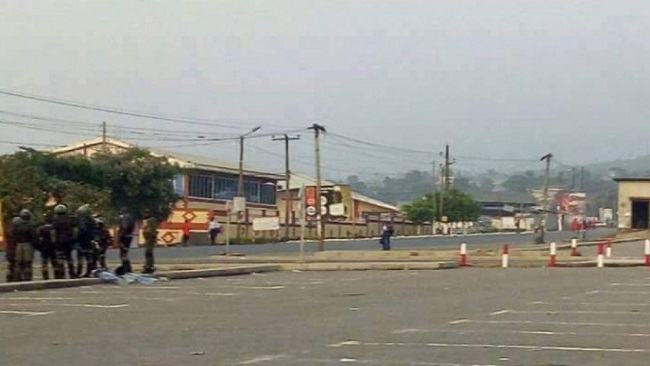
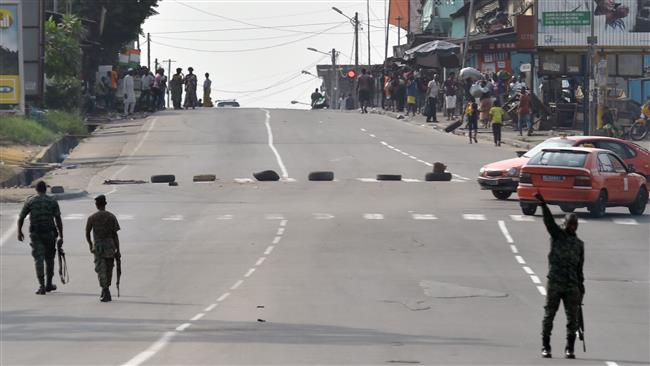
Troops have been deployed in Bamenda following a massive counter demonstration against the pro Francophone and one Cameroon rally to be led today by the Prime Minister. Cat calls have reportedly greeted the big men and women from Yaounde and soldiers have been put on high alert at Commercial Avenue where the anti CPDM mammoth crowd has assembled.
We are keeping an eye on this latest development and we will keep our readers posted. As we get it!! You will have it.
Russia to establish permanent naval base in Syria
The Russian government is about to finalize an agreement on the country’s establishment of a permanent naval base in Syria, a senior lawmaker says. Viktor Ozerov, the chairman of the Defense and Security Committee at the Federation Council, the Russian parliament’s upper house, made the announcement on Wednesday. “As far as I know, [it is] at the final stage,” he said concerning the procedure for the document’s preparation, which culminates in signing by the government.
In October, Russian Defense Minister Sergei Shoigu said Moscow planned to establish the base in the western Syrian port city of Tartus, where Russia has been keeping a support and maintenance facility for its naval forces since 1977. Upon signing by the government, the agreement on opening the permanent base will go to the legislature for approval.
Russia currently maintains a permanent airbase at the Hmeymim facility in the Syrian port city of Latakia, about 86 kilometers north of Tartus. The outpost was established on the back of an August 2015 Russo-Syrian agreement. Moscow has been lending its airpower to the Syrian military’s counterterrorism operations since last September. Thanks to the support, the Syrian military has managed to reclaim much of the country’s soil from the clutches of anti-Damascus militants, who have been brutalizing the nation since 2011.
Also on Wednesday, Russian President Vladimir Putin hailed the country’s successful experience of providing back-up firepower for the Arab country’s forces. Putin, who was addressing senior military and security officers at the Kremlin, said those in the top echelons of the Russian military had to so employ the experience to “equip the army and the navy with prospective weapons.”
Presstv
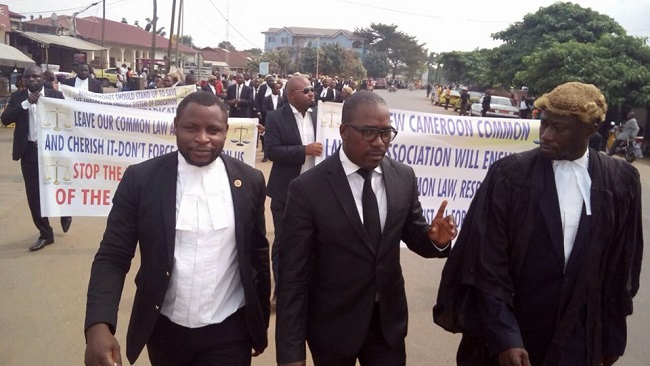
Anglophone teachers and lawyers strike to continue
Anglophone lawyers and teachers have announced a continuation of their strike action as talks between the Francophone government and the trade unions have failed to deliver any positive outcome. The December 6th meeting ended in fiasco as the actors of the negotiations separated from each other. Cameroon Intelligence Report learnt that the disappointment was visible on the faces of the government mediators in the city of Bamenda.
The actions of Prime Minister Philemon Yang who started the 24-26 November talks have been shameful, disgusting and disgraceful. The teachers and the lawyers have blamed the Head of Government for politicizing the crisis by holding pro Francophone political rallies in Southern Cameroons.
After four hours of in camera work at a high-rise hotel in Bamenda, Wilfred Tassang, the national executive secretary of the Cameroon Teachers’ Trade Union (Cattu), had bitter words for the Yang Philemon emissaries “The strike continues, the Government wants to play with us”.
Obviously, the Francophone teleguided talks could not reach any meaningful agreement because the plaintiffs could not have the minimum of their claims. The trade unions have made it clear that negotiators should debate and highlight by order of priority and then resolve according to a chronologically agreed schedule.
For their part, Anglophone teachers say no compromise will be gotten so long as the government does not proceed without delay with the withdrawal of French-speaking teachers who teach pupils in poor English from Southern Cameroons territory. Our much respected teachers and lawyers have demanded that parents should keep their children at home for their safety.
Common law lawyers have also announced a boycott of the 31st annual international conference of the Bar Councils to be held in Yaoundé from the 7th to 9th of December 2016.
By Chi Prudence Asong in Bamenda