
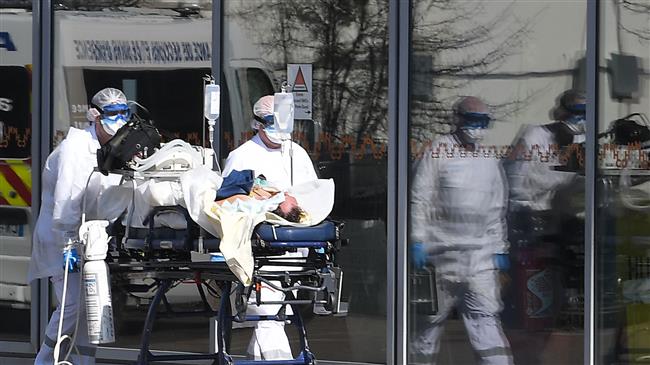
Lockdown measures in Italy extended until May 3
On Friday, Italian Prime Minister Giuseppe Conte issued a new decree that extends the country’s lockdown until May 3 as health officials have confirmed the Covid-19 curve continues to flatten.
Although Italy remains one of the countries with the highest number of infections in Europe, the number of patients hospitalized and those who are in intensive-care has fallen for the fifth straight day.
Officials are urging people not to ease up on the lockdown measures as the restrictions continue to show results. Only a small fraction of businesses that had been shuttered since March 12 will be allowed to re-open on a trial basis from Tuesday.
Also on Friday, Conte reiterated Italy had not given up on its drive for the European Union to issue joint debt to finance a shared response to the economic downturn caused by Covid-19.
But the idea of shared debt is strongly opposed by wealthy countries such as Germany, Austria and Holland.
According to latest polls, the Italian public opinion is increasingly turning against the European Union due to Brussels lack of solidarity.
Italian Prime Minister Giuseppe Conte has warned that the European Union’s existence would be under threat if it could not tackle the coronavirus pandemic and its socio-economic consequences. On April 23, EU leaders are slated to discuss which financial tools shall be adopted to deal with the bruising effects of the Covid-19 crisis.
Source: Presstv
EU finance ministers reach agreement on coronavirus rescue deal
EU finance ministers agreed a 500-billion-euro ($550-billion) rescue Thursday for European countries hit hard by the coronavirus epidemic, but sidelined a demand by Italy and France for pooled borrowing.
The breakthrough came after the Netherlands softened its position on the crucial question of making countries in need commit to economic reform and outside oversight in return for assistance.
The Hague blocked the talks two days earlier by insisting that Italy, or any other country in need, deliver on governance targets — which Rome saw as a shocking demand during a health crisis.
“Europe has decided and is ready to meet the gravity of the crisis,” French Finance Minister Bruno Le Maire tweeted after the talks.
As a compromise, the final statement clearly states that the rescue would be specifically earmarked for costs related to the COVID-19 crisis, which has killed more than 65,000 people in Europe.
The ministers, however, set to one side a proposal from Italy, Spain, and France for a joint borrowing instrument, sometimes dubbed a “coronabond”, that would have raised money towards a recovery after the outbreak.
Germany, the EU’s most powerful member, has refused the pooled debt proposal and ministers agreed only to “explore” the idea under the direction of EU leaders, who are set to meet later in the month.
The package agreed is worth about 500 billion euros ($546 billion), short of what many observers believe is necessary to restart the European economy when the health crisis recedes.
Data indicate that the economy across the continent is already in a historic meltdown, with everyday life paralysed to fight the spread of the virus.
Despite 19 EU countries sharing a common currency, member states have reacted unilaterally to save their economies, giving richer countries such as Germany a big advantage over those with less spending power.
‘Other ways’
The main component of the rescue plan involves the European Stability Mechanism, the EU’s bailout fund which would make 240 billion euros available to guarantee spending by indebted countries under pressure.
Italy and Spain had the backing of the majority of member states to keep the conditions for tapping the ESM to an absolute minimum, but the Netherlands fought hard for something tougher.
Putting conditions on support is seen as a humiliation in Rome and Madrid, evoking bad memories of the eurozone debt crisis when auditors from Brussels dictated policy to bailed out Greece, Portugal and Ireland.
But the mutualisation of debts was a bridge too far for Berlin and The Hague, which refuse to take on joint loans with highly indebted states such as Italy, France or Spain which they consider too lax in their public spending.
Repeating her well-known position, German Chancellor Angela Merkel on Thursday firmly rejected the notion of pooled debt in Europe.
“But there are so many other ways to show solidarity and I think we can find good solutions here,” she added.
In addition to the eurozone rescue fund, the EU ministers agreed 200 billion euros in guarantees from the European Investment Bank (EIB) and a European Commission project for national short-time working schemes.
Source: AFP
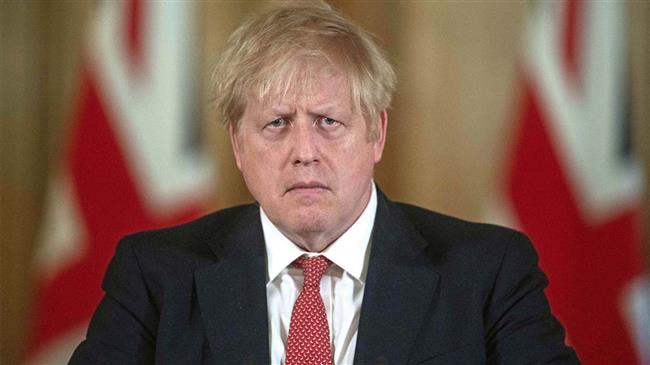
UK: Prime Minister Johnson stable after second night in intensive care battling COVID-19
British Prime Minister Boris Johnson spent a second night in intensive care and was in a stable condition on Wednesday after receiving oxygen support for COVID-19 complications while his foreign minister directs the battle against the outbreak.
Johnson, who tested positive nearly two weeks ago, was taken to St Thomas’ hospital on Sunday evening as he had a persistent high temperature and cough but his condition deteriorated on Monday and he was rushed into an intensive care unit.
The 55-year-old British leader received oxygen support but was not put on a ventilator and his designated deputy, Foreign Secretary Dominic Raab, said he would soon be back at the helm as the world faces its gravest public health crisis in a century.
“He is comfortable, he’s stable, he’s in good spirits,” Edward Argar, a junior health minister, said on Wednesday. “While he’s had oxygen, he hasn’t been on a ventilator.
As Johnson battled the novel coronavirus in hospital, the United Kingdom was entering what scientists said was the deadliest phase of the outbreak and grappling with the question of when to lift the lockdown.
Inside the government, ministers were debating how long the world’s fifth-largest economy could afford to be shut down, and the long-term implications of one of the most stringent set of emergency controls in peacetime history.

The United Kingdom’s total hospital deaths from COVID-19 rose by a record 786 to 6,159 as of 1600 GMT on April 6, the latest publicly available death toll, though just 213,181 people out of the population of around 68 million have been tested.
Britain was in no position to lift the shutdown as the peak of the outbreak was still over a week away, London Mayor Sadiq Khan said.
“We are nowhere near lifting the lockdown,” Khan said.
Acting PM Raab?
Johnson was breathing without any assistance and had not required respiratory support, said Raab, who insisted that Johnson remained the boss.
There are few precedents in British history of a prime minister being incapacitated at a time of major crisis, though Winston Churchill suffered a stroke while in office in 1953 and Tony Blair twice underwent heart treatment in the 2000s.
Johnson has delegated some authority to Raab, who was appointed foreign minister less than a year ago, though any major decisions – such as when to lift the lockdown – would in effect need the blessing of Johnson’s cabinet.
“He’s a fighter, and he’ll be back at the helm leading us through this crisis in short order,” Raab said on Tuesday. “His team will not blink, and we will not flinch from the task at hand at this crucial moment.”
Britain’s uncodified constitution – an unwieldy collection of sometimes ancient and contradictory precedents – offers no clear, formal “Plan B”. In essence, it is the prime minister’s call and, if he is incapacitated, then up to cabinet to decide.
Finance minister Rishi Sunak, a 39-year old former Goldman Sachs banker, would deputize should Raab become incapacitated.
(Source: Reuters)
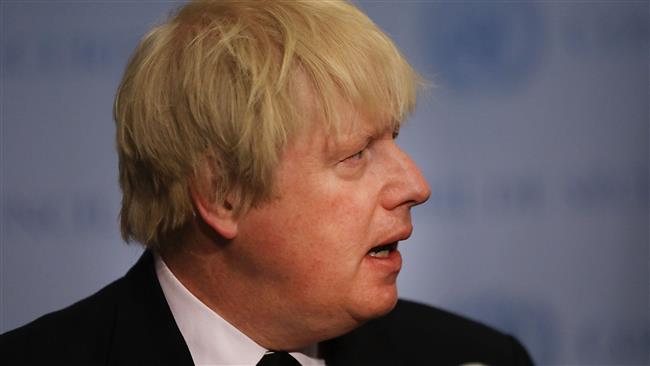
COVID-19: UK Prime Minister Boris Johnson taken to intensive care after health worsens
British Prime Minister Boris Johnson was moved to the intensive care unit of a London hospital after his coronavirus symptoms worsened Monday, just a day after he was admitted for what were said to be routine tests.
Johnson was admitted to St. Thomas’ Hospital late Sunday, 10 days after he was diagnosed with Covid-19.
Johnson had been suffering from persistent coronavirus symptoms, including a high temperature.
Downing Street had said he was in good spirits and still in charge, though his condition deteriorated in the early evening and he was transferred at about 1800 GMT to an intensive care unit – where the most serious cases are treated –at St Thomas’ hospital in central London. Johnson received oxygen, a source said.
“Over the course of this afternoon, the condition of the Prime Minister has worsened and, on the advice of his medical team, he has been moved to the Intensive Care Unit at the hospital,” his office said in a statement.
Downing St, said Johnson was conscious and does not require ventilation at the moment, but was in the intensive care unit in case he needed it later.
It said Johnson has asked Foreign Secretary Dominic Raab to deputise for him.
Routine tests
Earlier in the day, Johnson sent out a tweet thanking the National Health Service for taking care of him and others in this difficult time.
“On the advice of my doctor, I went into hospital for some routine tests as I’m still experiencing coronavirus symptoms,” Johnson said in the tweet. “I’m in good spirits and keeping in touch with my team, as we work together to fight this virus and keep everyone safe.”
Johnson’s spokesman, James Slack, refused to say what kind of tests Johnson was undergoing. He insisted that “the PM remains in charge of the government.”
“He is receiving updates in hospital and is continuing to receive a (ministerial red) box” of files and briefing papers, Slack said,
The 55-year-old leader had been quarantined in his Downing Street residence since being diagnosed with Covid-19 on March 26 — the first known head of government to fall ill with the virus.
He continued to preside at daily meetings on the outbreak until Sunday and has released several video messages during his 10 days in isolation. Raab chaired the meeting Monday. Britain has no official post of deputy prime minister, but Raab has been designated to take over should Johnson become incapacitated.
‘He’s in charge’
Speaking at the government’s daily coronavirus press briefing, Raab said Johnson was being “regularly updated,” but admitted he had not spoken to him since Saturday.
“He’s in charge, but he’ll continue to take doctors’ advice on what to do next,” Raab said.
Johnson was admitted to the hospital as a message to the nation from Queen Elizabeth II was being broadcast Sunday evening. The 93-year-old monarch urged the public to show resolve and follow advice to stay inside.
Concerns had been growing about Johnson’s welfare ever since he posted a message Friday saying that he was feeling better, though was still feverish.
The virus causes mild to moderate symptoms in most people, but for some, especially older adults and the infirm, it can cause pneumonia and lead to death.
The government said Monday that 51,608 people had been confirmed to have the coronavirus in Britain, 5,373 of whom have died.
Cases ‘not yet fully understood’
One of the advantages of being in the hospital is that it will allow doctors to directly monitor Johnson’s condition.
Derek Hill, a professor of medical imaging science at University College London said that since Covid-19 causes difficulty breathing, one test performed on people with the disease is lung imaging with ultrasound or CT scans to see how badly they might be affected.
“Some people are rapidly discharged,’’ he said. “Some others can quickly deteriorate and need help breathing. We have no reason to believe the PM needs such help.‘’
Hill said there are various types of breathing help, depending on the person and the difficulties.
“The reasons some people get seriously ill with Covid-19 while others have minor symptoms is not yet fully understood,″ Hill said.
“But doctors managing these patients report that more men than women have serious problems, and patients who are overweight or have previous health problems are at higher risk.”
(FRANCE 24 with AP)
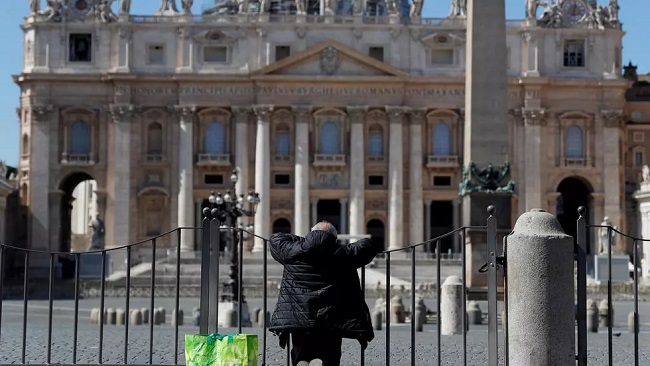
Italy reports first drop in number of coronavirus patients in intensive care
The number of coronavirus patients in intensive care in Italy fell for the first time, the civil protection authority said on Saturday, while the country’s death toll from the epidemic rose by 681 to 15,362, a somewhat lower rise than ones seen in recent days.
There were 3,994 people in intensive care in Italy, down from a previous 4,068, the first time the total had fallen since the outbreak of the epidemic in northern Italy on February 21.
“This is very important news,” civil protection authority chief Angelo Borrelli told reporters of the drop over the past 24 hours. “It allows our hospitals to breathe.”
The total number of confirmed cases rose to 124,632 from the 119,827 reported on Friday, an increase of 4,805, slightly higher than the numbers over recent days which have encouraged hopes that the spread of the coronavirus has reached a plateau.
Of those originally infected nationwide, 20,996 were declared recovered on Saturday, compared with 19,758 a day earlier.
(FRANCE 24 with AFP and REUTERS)

British press ignores role of ethnic minority doctors in coronavirus fight
As Britain enters deep crisis zone in the battle against the cornavirus pandemic, the country’s health workers are expected to be hit hard in the coming days and weeks.
Indeed, at least four doctors and two nurses have already perished whilst serving on the frontlines of the fight against COVID-19, the disease caused by coronavirus. Incredibly all four doctors are of ethnic minority backgrounds. Even more remarkably all four also happen to be Muslim. Similarly one of the two nurses, Areema Nasreen, was also a Muslim of ethnic minority background.
The four fallen doctors – Alfa Sa’adu; Amged el-Hawrani; Adil El Tayar and Habib Zaidi – were Muslim and hailed from diverse regions including Africa, Asia and the Middle East.
Not surprisingly the British press has tried to “whitewash” the narrative on the struggle against coronavirus by ignoring the central role and unique sacrifice of these four Muslim doctors.
Culled from Presstv
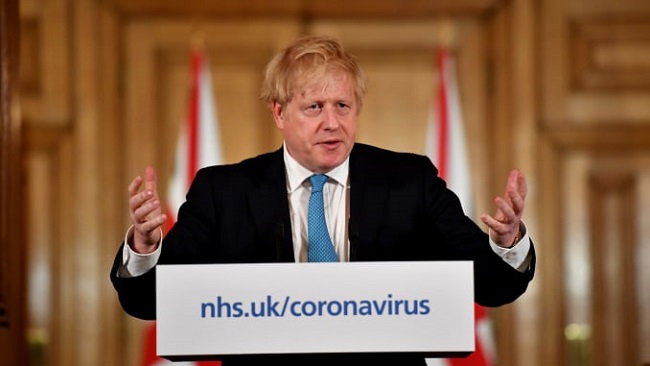
UK government accused of underestimating Covid-19 crisis
For the second time Britons have clapped in unison for doctors and nurses fighting to save Covid-19 victims. They also called for more people to be tested for the virus 3 weeks after the World Health Organization’s Director General spelt it out for everyone.
The UK government admits it did not enter into this crisis with a robust diagnostic industry. Health Secretary Matt Hanckock has promised 17.5 million antibody tests will be bought as soon as one is approved for use but some are proving unreliable.
At the moment around 10,000 people are being tested daily but Hankock has set an ambitious goal of 100,000 tests a day by the end of April. Unlike now, NHS staff and key workers as well as their families will be prioritized and then the wider public.
People are comparing the government’s handling of the crisis to the response of countries like Germany, which seems to be doing well despite having 2.5 times Britain’s confirmed cases.
Germany says it is testing half a million people displaying symptoms of coronavirus every week and has been monitoring the crisis and preparing for it since January, stocking up on testing kits and respirators.
Source: Presstv

Italy slams EU lack of unity as bloc offers apology over virus
Global coronavirus cases reached 1, 015,709 on Friday, along with 53,069 deaths, according to data collated by John Hopkins University.
The following is the latest on how the epidemic has been affecting Europe over the past 24 hours.
Italy severely criticizes EU for lack of unity after the bloc offers apology
Italian Prime Minister Giuseppe Conte on Friday extended his feud about coronavirus money with EU chief Commission Ursula von der Leyen in the pages of a Roman newspaper.
Conte wrote a letter to Italy’s La Repubblica in response to an apology that von der Leyen had published in the same paper on Thursday.
“I am sorry,” von der Leyen had told Italians. “The EU is with you now.”
Conte sounded unimpressed in his letter.
“Dear Ursula,” he wrote. “I hear ideas (from you) not worthy of Europe.”
He told her it was time for the EU “to show more ambition, more unity and more courage”.
At issue is billions of euros that Italy wants from the European Union to help fight the novel coronavirus pandemic that has killed nearly 14,000 people in Italy and shattered the country’s economy.
Conte wants the EU to start issuing lots of joint debt bonds — dubbed “coronabonds”— that could let countries such as Italy address the crisis more cheaply.
There has been widespread dismay in Italy over Europe’s response to the pandemic, starting with an initial failure to send medical aid, followed by a refusal by northern countries to endorse joint bonds to mitigate the cost of recovery.
The far-right League party has jumped on the discontent to call into question Italy’s continued membership of the 27-nation bloc, while even staunch pro-Europeans have expressed consternation at the lack of empathy and support by the EU.
 EU economy took record hit in March
Business activity in the 19-nation eurozone suffered a record fall in March and hit an historic low, according to the PMI index published on Friday by analysts IHS Markit.
The IHS purchasing managers index for the month was 29.7 — down from Markit’s first estimate for March of 31.4 and well below the level in February of 51.6 points, before the coronavirus epidemic crippled the European economy.
Spain
In hard-hit Spain, the death toll rose to more than 10,000 on Thursday after a record 950 people died overnight, but health officials were encouraged by a slowdown in daily increases in infections and deaths.
In hard-hit Spain, the death toll rose to more than 10,000 on Thursday after a record 950 people died overnight, but health officials were encouraged by a slowdown in daily increases in infections and deaths.
The total number infected people also reached 112,065 on Friday.
Germany
Germany has recorded 84,794 confirmed cases but has witnessed just 1,107 deaths, according to data from Johns Hopkins University.
The low mortality rate in Germany, at just over 1 percent, is far below its neighboring European countries.
France
The coronavirus death count in France surged to nearly 5,400 people on Thursday after the health ministry began including nursing home fatalities in its data.
The number of people diagnosed with COVID-19 also reached 59,929 on Friday.
 Britain
Britain’s health minister promised a tenfold increase in the number of daily tests, as a poll said more than a half of Britons think the government was too slow to order a lockdown.
The number of UK hospital deaths rose to 2,921 as a further 569 patients who tested positive for coronavirus lost their lives.
Russia
In Russia, President Vladimir Putin prolonged until April 30 a paid non-working period across the country, which has reported 3,548 cases and 30 deaths.
Russian army to send coronavirus help to Serbia
Russia will send 11 military planes carrying medical equipment to Serbia to help it fight the coronavirus outbreak, the Russian Ministry of Defense said on Friday.
Russia, which has so far recorded more than 3,500 cases of the virus, has already sent similar shipments to Italy and the United States.
 ADB: Global cost of coronavirus could top $4 trillion
The coronavirus pandemic could cost the global economy $4.1 trillion as it ravages United States, Europe and other major economies, the Asian Development Bank warned on Friday.
The estimated impact is equivalent to nearly five percent of worldwide output based on a range of scenarios, but the lender said losses from “the worst pandemic in a century” could be higher.
“The estimated impact could be an underestimate, as additional channels such as…possible social and financial crises, and long-term effects on health care and education are excluded from the analysis,” the ADB said.
The Manila-based bank said a shorter containment period could pare the losses to $2 trillion.
The crisis has sent equity markets spinning as traders fret over the long-term impact on the world economy, though governments and central banks have stepped in to ease the pain, pledging more than $5 trillion in stimulus and easing monetary policy.
(Source: Agencies)
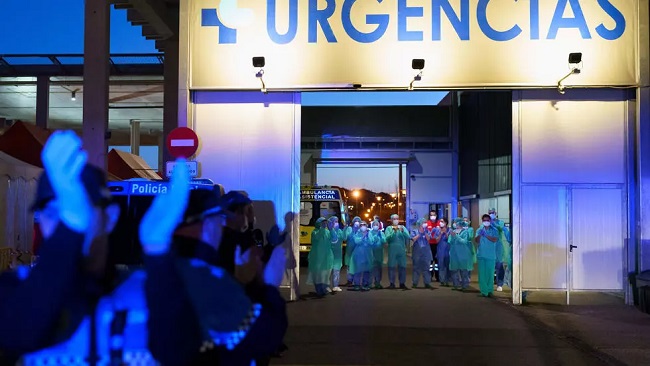
Spain’s health crisis chief tests positive for coronavirus as infections top China’s
Spain’s health emergency chief Fernando Simon tested positive for coronavirus, health officials said Monday, as the number of confirmed cases rose to 85,195, surpassing China’s infection tally.
Simon, who led the country’s response to the coronavirus epidemic and maintained regular contact with Spanish Prime Minister Pedro Sanchez, tested positive for the virus, health official Maria Jose Sierra told a news conference on Monday.
The announcement came as Spain on Monday became the third country to surpass China in infections after the United States and Italy.
Sierra announced she was replacing Simon as head of Spain’s centre for health emergencies and said some 12,298 health workers had tested positive for coronavirus in Spain, equivalent to around 14 percent of the country’s confirmed cases.
With a population of only 47 million to China’s 1.4 billion, Spain’s number of infections reached 85,195, a rise of 8 percent from the previous day. Spain also reported 812 new deaths in the last 24 hours, raising its overall fatalities from the virus to 7,340, according to health ministry figures.
It was the first decline in the number of deaths in a 24-hour period since Thursday in Spain, which has the world’s second-most-deadly outbreak after Italy. Spain recorded 838 virus deaths on Sunday.
Officials have pointed to a slower growth rate for both deaths and confirmed cases and expressed hope that the peak of the outbreak was approaching.
Sanchez on Saturday announced even stricter lockdown measures, forcing all non-essential workers to stay home for the next two weeks.
(FRANCE 24 with AP, AFP and REUTERS)
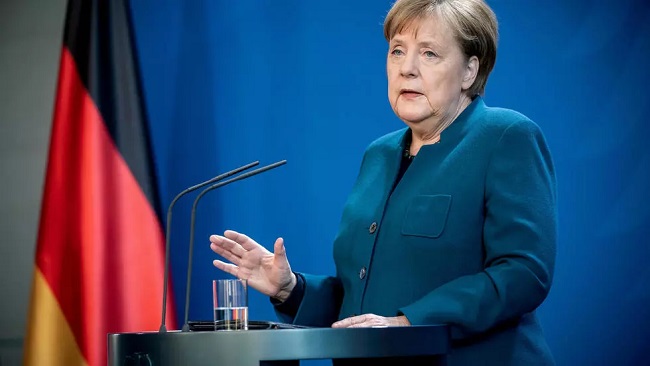
Merkel shines in handling of Germany’s coronavirus crisis
In her first address to the nation on the coronavirus pandemic, German Chancellor Angela Merkel calmly appealed to citizens’ reason and discipline to slow the spread of the virus, acknowledging as a woman who grew up in communist East Germany how difficult it is to give up freedoms, yet as a trained scientist emphasizing that the facts don’t lie.
Then, wearing the same blue pantsuit from the televised address, the 65-year-old popped into her local supermarket to pick up food, wine and toilet paper to take back to her Berlin apartment. For her, it was a regular shopping stop, but photos snapped by someone at the grocery store were shared worldwide as a reassuring sign of calm leadership amid a global crisis.
With the coronavirus outbreak, Merkel is reasserting her traditional strengths and putting her stamp firmly on domestic policy after two years in which her star seemed to be fading, with attention focused on constant bickering in her governing coalition and her own party’s troubled efforts to find a successor.
Merkel has run Germany for more than 14 years and has over a decade’s experience of managing crises. She reassured her compatriots in the 2008 financial crisis that their savings were safe, led a hard-nosed but domestically popular response to the eurozone debt crisis, and then took an initially welcoming — but divisive — approach to an influx of migrants in 2015.
In the twilight of her chancellorship, she faces her biggest crisis yet — a fact underlined by her decision last week to make her first television address to the nation other than her annual New Year’s message.
“This is serious — take it seriously,” she told her compatriots. “Since German unification — no, since World War II — there has been no challenge to our country in which our acting together in solidarity matters so much.”
With Germany largely shutting down public life, she alluded to her youth in communist East Germany as she spelled out the scale of the challenge and made clear how hard she found the prospect of clamping down on people’s movement.
“For someone like me, for whom freedom of travel and movement were a hard-won right, such restrictions can only be justified by absolute necessity,” she said. But they were, she said, “indispensable at the moment to save lives.”
The drama was evident in Merkel’s words, but the manner was familiar: Matter-of-fact and calm, reasoning rather than rousing, creating a message that hit home.
It is a style that has served the former physicist well in juggling Germany’s often-fractious coalitions and maintaining public support over the years.
“Merkel painted a picture of the greatest challenge since World War II, but she did not speak of war,” the influential Sueddeutsche Zeitung newspaper wrote. “She did not rely on martial words or gestures, but on people’s reason. … Nobody knows if that will be enough, but her tone will at least not lead the people to sink into uncertainty and fear.”
Merkel’s response to the coronavirus pandemic is still very much a work in progress, but a poll released Friday by ZDF television showed 89% of Germans thought the government was handling it well. The poll saw Merkel strengthen her lead as the country’s most important politician, and a strong 7% rise for her center-right Union bloc after months in which it was weighed down by questions over its future leadership.
The poll, done by Forschungsgruppe Wahlen, had a margin of error of plus or minus 3 percentage points.
The 65-year-old chancellor initially had Health Minister Jens Spahn be the public face of the government’s response, drawing some criticism but has taken center stage over the past two weeks.
She kept that up after going into quarantine on Sunday after a doctor who gave her a vaccination tested positive for the coronavirus. Since then she has twice tested negative for the virus herself but continues to work from home.
On Monday, she led a Cabinet meeting by phone from home and then issued an audio message setting out a huge government relief package to cushion the blow of the crisis to business — a format she said was “unusual, but it was important to me.”
Her vice chancellor, Olaf Scholz, who is also finance minister and a member of her coalition partner Social Democrats, has also had a chance to shine in the crisis, leading the way with the aid package that will allow Germany to offer businesses more than 1 trillion euros ($1.1 trillion) that he described as a “bazooka.”
The jury is still out on how the government’s approach will work, but after having run a budget surplus for a half-decade, Germany is well-prepared to offer the massive aid program. Its health care system has been in good enough shape to be taking in patients from overwhelmed Italy and France, with intensive care beds still available.
Although Germany has registered the third-highest number of coronavirus infections in Europe with 57,695, according to a tally by Johns Hopkins University, it has only seen 433 people die, placing it sixth in Europe behind Italy, Spain, France, Britain and even the Netherlands. Italy alone has over 10,000 dead.
Experts have attributed Germany’s success partially to widespread and early testing for the virus, among other things.
In an audio message Thursday night, Merkel cautioned, however, that it was far too early to declare victory over COVID-19, saying “now is not the time to talk about easing measures.”
No matter what the outcome of Germany’s virus-fighting efforts, it won’t change the fact that the Merkel era is drawing to a close. Merkel has never shown any signs of backing off her 2018 vow to leave politics at Germany’s next election, due next year.
But the crisis may burnish her government’s lackluster image and improve its chances of making it through to the fall of 2021, after persistent speculation that it wouldn’t last the full legislative term.
And it certainly could put her successor on a better footing —though just who that will be is also up in the air. Merkel stepped down as her party’s leader in 2018 but her heir apparent, Annegret Kramp-Karrenbauer, lasted just over a year before declaring that she would step down after failing to establish her authority.
The decision on who will take over the leadership of Merkel’s Christian Democratic Union party was supposed to be made in April, but has been put on hold due to the coronavirus pandemic.
Source: AP