Breaking News
Former president of South Africa among Nobel Prize laureates calling for a Southern Cameroons ceasefire
A group of Nobel Prize laureates has urged the government of Cameroon and separatist rebel forces to cease fighting and let health workers tackle the coronavirus pandemic.
The Global Campaign for Peace and Justice in Cameroon on Monday asked the African Union, the Commonwealth and La Francophonie to urge the government of Cameroon to call for a “COVID-19 ceasefire.”
Seven of the group’s Nobel Prize laureates and former heads of states include 2018 laureate Dr. Denis Mukwege, former president of South Africa FW de Klerk and three former United States ambassadors to Cameroon.
The declaration was made after the United Nations Secretary General Antonio Guterres called for global ceasefire in countries in conflict to tackle the coronavirus outbreak.
“It is one of the great neglected conflicts of our times,” said Dr. Simon Adams, Executive Director of The Global Centre for the Responsibility to Protect.
“The question of why now is something many people will be asking but I think there are many people in the world who don’t know about Cameroon,” Dr. Simon, also a signatory of the declaration, told DW.
“While people in West Africa and in Cameroon are very aware of the suffering and hardship that has been endured for such a long time, it’s to the discredit of the United Nations Security Council that it has not formally addressed the conflict there and it has not been covered widely in the media.”
“We signed the declaration because we want to see more international attention brought to what is one of the most devastating conflicts affecting Western Africa at the moment,” Dr. Simon added.
The conflict in Cameroon began in 2016 when activists in the two English-speaking regions complained of marginalization and called for independence. More than 3,000 people have been killed since clashes broke out between government forces and Anglophone separatist rebel forces. More than half a million people have fled their homes.
Cameroon has one of Africa’s highest rates of COVID-19 infection. Bamenda, the capital of Cameroon’s northwest region, has been at the heart of the three-year conflict. The separatists are fighting to create a state they call Ambazonia.
Attack on hospital workers
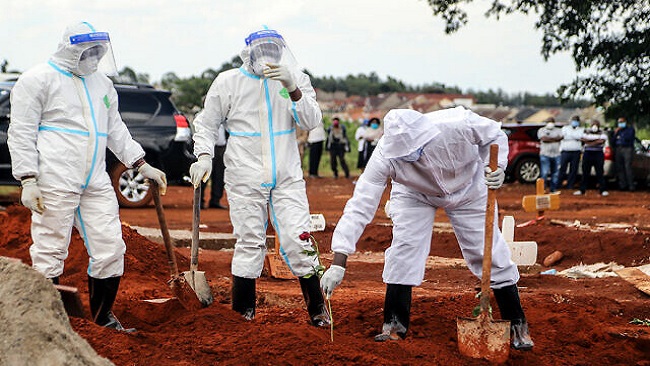
Frequent gun battles, lockdowns, road blocks and now the COVID-19 pandemic have made life difficult for the majority English-speaking population. Cameroon now has almost 12,000 confirmed cases of the coronavirus, with 303 deaths (as of June 22).
Several cases of attacks against doctors and nurses have been reported since the coronavirus outbreak began.
“On the May 29, seven of our health care workers were abducted and remained in the bushes for three days,” said Professor Pius Tih, director of the Cameroon Baptist Convention Churches Health Services.
“On June 4, again three others were taken to the bush but were released in the night. And as we talk, four of our workers that went into the field yesterday to do HIV/Aids and COVID-19 sensitization have also been abducted and are still at large,” Prof. Tih said.
According to the professor, many health workers are afraid when they see armed government and non-government troops. “We need to identify cases quickly, isolate them and treat those that you can treat while preventing more infections in the community. We are unable to reach out to the communities to do this.”
One treatment center
Health officials warn that if preventive measures — such as washing of hands, wearing masks and maintaining physical distance — are not observed, the number of infections could rise further.
The northwest region’s only COVID-19 treatment center is housed in a government-run hospital. It has a pre-isolation ward, quarantine center, diagnostic laboratory and other facilities for people infected with the coronavirus. Bamenda, Cameroon’s third-largest city, has amore than 500,000 inhabitants.
“Since we have more intense cases which are moderate or severe, the doctors see patients as often as need be,” Mercy Fundoh, head of the solidarity ward, told DW.
“We try to do a clinical evaluation of these intense cases at least on a daily basis and sometimes twice a day.”
Scot, a resident in Bamenda, said the Coronavirus pandemic brought more uncertainties than the Anglophone crisis. “With coronavirus, the risk is just so high. You might get into a public space and contract the disease,” Scot, who did not wish to give his second name for fear of reprisal, told DW.
“For the crisis, you know that there are some places that you are not supposed to go and certain things to do and not to do to avoid getting into trouble,” he added.
Call for foreign mediation
Some observers suggested foreign mediators should be used to find a solution. In March, separatist leader Sisiku AyukTabe told DW he was open to dialogue but on the condition that a UN mediator leads the process.
“It will be a shame for the international community to wait and come late, as was the case in Rwanda,” AyukTabe told DW.
A military court convicted and sentence AyukTabe and nine members of his de facto cabinet in August 2019 to life in prison for terrorism. In an interview with DW, opposition leader Kah Walla said no foreign nation should mediate in Cameroon’s domestic problems.
“To resolve the Anglophone crisis, we need a series of dialogues about different issues,” she said. “So it is less about the conflict with the state, and looking more into what the state of affairs today is. We do not want the future of Cameroon to be negotiated in Switzerland.”
Culled from Deutsche Welle
Southern Cameroons Crisis: Defense Minister Beti Assomo makes a fortune
A French Cameroun social media guru has released images of one of the properties linked to Cameroon’s Defense Minister, Joseph Beti Assomo, who is facing corruption allegations over his handling of the Southern Cameroons crisis.
Cameroon Concord News Group gathered that the house in Minister Beti Assomo’s village is one of the many penthouses and flats he and his family own in Yaoundé and Douala, worth hundreds of millions of US dollars.
Cameroon’s Anti-corruption investigators have constantly ignored incessant signals coming from whistle-blowers in the Ministry of Defense for fear of being targeted by the Beti Assomo gang in the army and in the secret service.

Some of the Beti Assomo buildings in Yaoundé are held by companies registered under his blood relations as a way of hiding his wealth, making it difficult to be targeted by investigators at the Special Criminal Court in Yaoundé.

The 60-year-old, who replaced his kinsman, Edgard Alain Mebo Ngo’o, currently detained at the Kondengui Maximum Security Prison for corruption, is reportedly using the war in Southern Cameroons to enrich himself and his criminal network.

More will be yours in the days ahead.
By Rita Akana in Yaounde
US: Trump says would consider meeting Venezuela’s Maduro
US President Donald Trump has said he would consider meeting Venezuelan President Nicolas Maduro and indicated that he is not entirely confident in the country’s opposition leader, according to an interview published Sunday.
A power struggle has been raging in Venezuela since Juan Guaido declared himself acting president in January 2019 in a bid to oust Maduro, who had started a second term following elections boycotted by the opposition and internationally dismissed as fraudulent.
Nearly 60 countries — including the United States — recognized Guaido, but China and Russia backed Maduro — whose regime has been hit by sanctions from Washington.
But despite tensions, Trump told news site Axios he would be open to a meeting.
“I would maybe think about that… Maduro would like to meet. And I’m never opposed to meetings — you know, rarely opposed to meetings,” the president said.
“I always say, you lose very little with meetings. But at this moment, I’ve turned them down.”
Ties between Washington and Maduro’s socialist government had frayed even further in May when Venezuela detained 52 alleged mercenaries, including two retired members of the US military, accusing them of orchestrating a maritime “invasion” with US support.
Washington denied any involvement.
But despite his government’s consistent backing of the opposition leader, Axios said that during the interview, Trump “indicated he doesn’t have much confidence in Guaido.”
The president said he was “firmly against what’s going on in Venezuela,” but — referring to the recognition of Guaido — added: “I was OK with it… I don’t think it was very meaningful one way or the other.”
The interview came as the White House was handling the fallout from explosive claims in a book by Trump’s former national security advisor John Bolton, who was a key player on many diplomatic fronts.
According to excerpts published by Axios, Bolton wrote that Trump “thought Guaido was ‘weak,’ as opposed to Maduro, who was ‘strong.'”
The president also called Guaido “the Beto O’Rourke of Venezuela,” according to the Bolton excerpt, referring to the Democratic presidential candidate who dropped out early in the race and was repeatedly mocked by Trump.
During the Axios interview, Trump slammed Bolton as a “nutjob” who may be the “dumbest human being on Earth” over his backing of the Iraq War.
Source: AFP
Brazil hits grim milestone of 50,000 Covid-19 deaths
Brazil, the world’s No. 2 coronavirus hot spot after the United States, officially passed 50,000 coronavirus deaths on Sunday, a blow for a country already grappling with more than 1 million cases, rising political instability and a crippled economy.
Brazil now has a total of 1,085,038 confirmed cases and 50,617 deaths, up from 49,976 on Saturday, the Health Ministry said. Experts say the true numbers are a lot higher because of a lack of widespread testing. Latin America’s largest country has typically recorded more than 1,000 deaths a day, but usually registers fewer on the weekends.
Brazil confirmed its first case of the novel coronavirus on Feb. 26 and passed 1 million cases on Friday. Since first arriving in the country, the virus’ rapid spread has eroded support for right-wing President Jair Bolsonaro and has raised fears of economic collapse after years of anemic growth.
Bolsonaro, sometimes called the “Tropical Trump,” has been widely criticized for his handling of the crisis. The country still has no permanent health minister after losing two since April, following clashes with the president.
Bolsonaro has shunned social distancing, calling it a job-killing measure more dangerous than the virus itself. He has also promoted two anti-malarial drugs as remedies, chloroquine and hydroxychloroquine, despite little evidence they work.
On Sunday, Bolsonaro said the military serves the will of the people and its mission is to defend democracy, adding fuel to a raging debate about the armed forces’ role amid rumbling fears of political fragility.
His comments came on the same day his supporters and detractors gathered in cities across the country, in a stark symbol of the polarization in Latin America’s largest country.
Source: REUTERS
Ambazonia: Secretary Tabenyang Brado asks French Cameroun surrogates to accelerate probe into death of Mamfe Mayor
Southern Cameroons Secretary of the Economy Hon. Tabenyang Brado has called on two La Republique du Cameroun surrogates, Chief George Tabetando and Minister Victor Mengot to stop the ‘juju” swearing comedy in Manyu and clarify the cause of death of the mayor of Mamfe, Ashu Prisley Ojong.
The Ambazonia Interim Government said in a statement that Secretary Brado Tabenyang will hand over an official note via the French Cameroun embassy in Washington demanding immediate action by the two so-called La Republique leaders in the Manyu County to announce to the people of Southern Cameroons the cause of death of the Mamfe mayor.
According to information Vice President Dabney Yerima received from Ambazonia intelligence services in Manyu, late mayor Ashu Ojong was killed inside a French Cameroun army vehicle accompanied by two Cameroon government army soldiers.
The circumstances around his death are still being hidden by the French Cameroun civil administrator in Manyu but reports from people in the know indicates that Ashu Prisley apparently wanted to be the traditional ruler of Eshobi village in order to enhance his political image and this prompted a ruling CPDM diabolic harsh ploy that took away his life.
During last week’s Interim Government cabinet meeting, Secretary Tabenyang Brado stressed that it was Yaounde’s full responsibility in ensuring the safety of the mayor, who had been under French Cameroun’s pay roll and surveillance.
Comrade Tabenyang Brado is also expected to drive home the importance of this case for Ambazonia public opinion and insist on the need to reveal the cause of death.
By Oke Akombi Ayukepi Akap in Glasgow with additional reporting from Chi Prudence Asong in London
Biya was certainly not a leader for the two Cameroons
Paul Biya never aspired to be involved in politics as a young Roman Catholic seminarian. And even after he was lured into the so-called dirty game by the late President Ahmadou Ahidjo, it was actually his kinsman, Ayissi Mvodo who was being groomed to become Ahidjo’s successor.
Biya was a common politician in Yaoundé and his name summoned images of a good man hunted by a Christian upbringing in the Seminary. Biya was also very popular and idolized by taxi drivers in the nation’s capital who often watched him riding his bicycle all over the city. It was only after the CNU Conference of Maturity that everyone became certain Biya would be the next president of Cameroon, after Ahmadou Ahidjo.
Compared to the then Minister of Territorial Administration, Ayissi Mvodo, Biya was not as charismatic or appealing figure. But after a physical confrontation between Biya and the late Ayissi Mvodo during a cabinet meeting and in the presence of Ahmadou Ahidjo, there was not a trace of Mvodo’s presence anywhere in Yaoundé.
Biya did not seek out recognition or popularity in the presence of his political boss, Ahmadou Ahidjo and the ruling CNU barons from the Northern provinces and he also had no interest in creating a political space for himself even after his appointment as Prime Minister in 1975. Ayissi Mvodo attempted all of the above!
In his early days as Secretary General at the Presidency of the Republic, Biya applied very skilful diplomacy in his dealings with all of the Ahidjo men and women from the North pushing them to perceive him as shy, reserved, weak French Cameroun political elite who was not interested in leadership. This was also the assumptions Biya fed the entire nation with but in one occasion he hinted Chief Emmanuel Tabi Egbe that power is in the presidency and not in the Prime Minister’s office.
On the 6th of November 1982, the invisible hand of history started to sweep away these perceptions and proved everyone wrong when Biya took office as Head of State. Unlike his dynamic kinsman, Ayissi Mvodo, French and English speaking Cameroonians started viewing Biya as someone without the instincts or the drive to lead a country.
Biya was certainly not a leader for the two Cameroons and as I write, after more than 40 years in authority, he cannot stand for anything. To me and many other Cameroon political commentators, Biya’s crossing the carpet from the Union Des Population du Cameroun, UPC to Ahidjo’s Cameroon National Union, CNU while in France was simply to look for a normal, peaceful, luxurious life somewhere in Europe with his late wife Jeanne Irene Biya. The billions of FCFA wasted by him and his family in the International Continental Hotel in Geneva over the last 36 years justify this assertion.
There was one small thing, small but great! While all the Ahidjo acolytes and the entire nation focused on the actions of Ayissi Mvodo and the relationship he was attempting to develop with General Pierre Semengue, Paul Biya was educating himself on the Cameroon political story learning “polite arrogance” from Dr Mrs Dorothy Njeuma and how to place Garoua against Maroua from Amadou Ali and fanning the North West/South West Divide via E.T.Egbe and Simon Achidi Achu and containing the Bamileke money power by establishing a new generation of Beti Ewondo businessmen after T-Bella.
Biya knew he had to always be in Ahidjo’s good books, so he pretended to be dedicated to the United Republic of Cameroon idea which he political calls today, the one and indivisible nation. But underneath his pro United Republic action was an ocean of activities that signaled he was more attracted to the Western style and of course he has been governing from France and Switzerland ever since he became President of the Republic.
When the late President Ahidjo made up his mind and started grooming Biya to become the next president, the former seminarian tactfully avoided the comfortable life in any luxurious home in Yaoundé and continued on as a deeply devoted Ahidjo student while adoring the anonymity that the powerful Ahidjo men such as Moussa Yaya and Maicano Abdoulaye including E.T.Egbe and Ayissi Mvodo offered him. Biya was not in the public eye but privately he was being trained in military affairs by General Pierre Semengue who was a classmate and a personal friend.
The Beti Ewondo hardliners staged a coup on 1984 and used it to transform Biya completely. They succeeded and even Biya’s low, soft, Christian-like voice became tougher, and his political stance and appointments became more confident and powerful. But though Biya changed on the surface, he never changed on the inside.
From the day he became president, Cameroon was reduced to a holiday resort for him. To be sure, he lives in Europe and only comes home to empty the state coffers and appoint new agents into his ruling CPDM crime syndicate. Western lifestyle is the only thing that occupies Biya’s mind.
In the beginning of his rule, he introduced rigour and moralization, which included some political reforms that would suit the Western-style changes he planned. But when he saw that the reaction to his political shake-up was endangering his own throne, he concocted new policies of encouraging corruption, mass repression and relying on CENER, the secret service and the army to enforce his commands.
Internal clashes and tensions between Biya and Ahidjo’s old guards were ruthlessly crushed and severely dealt with. Biya became aware of the discontent and used his power to retire many of the old guard, sweeping them from power to reduce the conflict he faced with the Grand Nord.
Biya’s acceptance of the IMF policies such as increase neo-liberal policies and privatization exaggerated the inequality between the poor and the rich in Cameroon while a small portion of his Francophone Beti Ewondo political elites and their business associates benefited from these policies.
Unable to control the wind of change that sparked an uprising against his CPDM government in 1990 the old guard members, who had been forced to retire, were brought back to power to address the situation. Name them; Gilbert Andze Tchougui, Jean Forchive, Ibrahim Mbombo Njoya, Joseph Charles Doumba and Robert Mbella Mbappe etc.
Did Biya’s idealistic vision of dividing Cameroon again by taking the nation back into the Francophonie and the Commonwealth — but still consolidating power at the top in Yaounde — play a role in the numerous crises that have rocked the country? Did Biya’s vast and failed economic and neo-liberal reforms, which in the end only benefited his gilded circle, have an impact on the current Southern Cameroons crisis? Perhaps the combination of all of these factors led to the rampant rebellion and mistrust of the people that Biya had been chosen to lead.
By Soter Tarh Agbaw-Ebai
IG-CARE calls for TOTAL LOCKDOWN of the Northern Zone of Ambazonia from 22 to 24 June 2020
Fellow Ambazonians,
The neo-colonial regime in Yaoundé will stop at nothing in its pursuit of genocide and deceit in Ambazonia. Despite the horrendous and cruel sufferings it is inflicting on our people, they intend to mislead the world that all is well in the Southern Cameroons.
In a communication signed 17 June 2020, LeleLafriqueAdolphe, is inviting people to attend an awareness and sensitization meeting on the Yaoundé Presidential Plan for the reconstruction of the North West region of Cameroun which happens to be the Northern Zone of Ambazonia. This public stunt is designed to conceal war crimes and lay a flawed and unlawful claim to our land.
After consultation with other frontline movements in the Ambazonia struggle and our self-defence commanders in Ground Zero, the Interim Government of Ambazonia is today calling for a TOTAL LOCKDOWN OF THE NORTHERN ZONE OF AMBAZONIA from Monday 22 to Wednesday 24 June 2020.
All businesses, social events, transport networks, community activities and non-vital services must remain sealed as the Interim Government of Ambazonia cannot guarantee the security of anyone found outside their place of residence, clinics and hospitals.Anyone, including French Cameroun colonial administrative officials, who attempt to violent this Interim Government of Ambazonia order shall be ruthlessly crushed and severely dealt with.
French Cameroun has blundered in its actions in Southern Cameroons over the last fifty-nine years and continues to blunder in calculating that a whitewash reconstruction plan is an answer to our just goals of justice, freedom and independence. We must not fall for this misguided propaganda. There can be no reconstruction from an enemy during an active campaign of genocide.
Truth and justice have always triumphed over hate, deceit and mass slaughter but the regime in Yaoundé is oblivious to the lessons of history. Our goals are freedom, justice and independence and no matter how long it takes, we shall attain these.
Thanks and God Bless the people of Southern Cameroons-Ambazonia
Dabney Yerima
Vice President
Federal Republic of Ambazonia
UK: Several people killed in stabbing spree in Reading
Three people were killed and three seriously hurt Saturday in a summer-evening stabbing attack in a park in the English town of Reading, police said. They said it was “not currently” being treated as a terrorism and the motive was unclear.
Thames Valley Police force said officers arrested a 25-year-old local man at the scene and they were not looking for anyone else.
“There is no intelligence to suggest that there is any further danger to the public,” said Detective Chief Superintendent Ian Hunter.
“This is not currently being treated as a terrorism incident; however, officers are keeping an open mind as to the motivation for the incident,” Hunter added. He said detectives from the counter-terrorism unit were supporting the investigation.
British media had earlier reported that police suspected a terrorist motive and that the man arrested was Libyan. Police did not confirm that or release the suspect’s name.
Prime Minister Boris Johnson said his “thoughts are with all of those affected by the appalling incident in Reading.”
The violence erupted around 7 p.m. as families and friends were enjoying a warm, sunny evening in the Forbury Gardens park in Reading, a town of about 200,000 residents 40 miles (64 kilometers) west of London.
Witnesses reported that police cars and helicopters descended on the park. Within minutes police had blocked off several roads, and two air ambulances landed nearby.
Personal trainer Lawrence Wort said the park was full of groups socializing on the grass when “one lone person walked through, suddenly shouted some unintelligible words and went around a large group of around 10, trying to stab them.”
“He stabbed three of them, severely in the neck, and under the arms, and then turned and started running towards me, and we turned and started running,” Wort said. “When he realized that he couldn’t catch us, he tried to stab another group. He got one person in the back of the neck and then when he realized everyone was starting to run, he ran out the park.”
Police said that “a number of people were injured and taken to hospital. Tragically, three of these people died, and another three sustained serious injuries.”
The Royal Berkshire Hospital in Reading said it was treating two casualties from the incident.
The incident came hours after a Black Lives Matter demonstration at Forbury Gardens, but police said there was no connection between the attack and the protest.
Nieema Hassan, one of the organizers of Saturday’s protest, said demonstrators had left by the time the violence occurred. In a social media post, she said she was “praying for the people that are affected. I hope they’re OK.”
Britain’s official terrorism threat level stands at “substantial,” the middle level on a five-rung scale, meaning an attack is likely.
It had previously stood a notch higher for several years. The country has been hit by a series of violent attacks in recent years, including a suicide bombing at an Ariana Grande concert in Manchester in 2017 that killed 22 people and two deadly vehicle and knife attacks in London the same year.
Airline worker Carlos Garcia Pascual was walking to his home near Forbury Gardens when emergency vehicles and police officers descended. He said it was “chaos” as police yelled at people to leave the area.
“We didn’t know if it was a situation like happened in London a few years ago, where the attackers were on the loose,” he said. “Forbury Gardens is a peaceful place, a lot of families go there with their kids to play, picnics. To realize that happened in Forbury Gardens is really hard to believe.”
(AP)
US Politics: Trump campaign raised $74 million in May, short of Biden’s haul
US President Donald Trump and the Republican National Committee raised $74 million in May, Trump’s re-election campaign said on Saturday, short of Democratic presidential candidate Joe Biden’s haul for the month.
The total, up from $61.7 million in April, was disclosed as Trump prepared for Saturday’s smaller-than-expected rally in Tulsa, Oklahoma, his first major campaign event since the coronavirus pandemic shut down most campaigning.
Former Vice President Biden has stepped up fundraising in recent months since becoming the Democratic Party’s de facto nominee for the Nov. 3 presidential election.
He has also built a lead over Trump in national opinion polls amid the twin crises of the pandemic and civil unrest over police brutality in many US cities.
In May, Biden and the Democratic National Committee raised $80.8 million, their largest single month of fundraising.
Trump, however, continued to have a cash advantage over Biden, according to disclosures filed separately by the two campaigns on Saturday.
The president has been campaigning for re-election since 2017 and his campaign had $108.1 million in cash on hand at the end of May. Biden, who launched his campaign in April, had $82.4 million.
Trump’s campaign also spent more than twice as much as Biden’s campaign did in May, shelling out $24.5 million with over half of that going to political advertising. Trump’s campaign also spent about a half million dollars on legal expenses during the month, slightly lower than its outlays on lawyers in April.
Biden’s campaign spent $11.7 million in May. The candidate only this week announced his first major advertising blitz, launching $15 million in TV and digital ads in the crucial states of Pennsylvania, Michigan, Wisconsin, Arizona, Florida and North Carolina, all states Trump won in 2016.
(Source: Reuters)