
Cameroon’s democracy at crossroads: Constitutional Council to make or mar
Democracy literally means “rule by the people.” it is the idea of popular sovereignty, where individuals participate in their society’s government. At its most efficient, this will involve the whole community meeting regularly to make decisions, with each citizen’s vote having an equal weighting. The institution of modern states is far too complex to be governed directly by the people. Citizens, on average, are too busy living their lives to become involved in the minutiae of government. This is why they empower politicians to rule on their behalf. In any form of democracy, however, the governor must remain accountable to the governed, and in the case of representative democracy this is principally achieved through regular elections. Each citizen should have an equal opportunity to vote for the candidate they feel will best serve their interests.
What more laws should be in place, and adhered to allowing free competition between individuals to win these votes. Freedom of speech, association, and assembly are all of paramount importance, as is the right to stand for office, a free press, and a separate ballot. With these guarantees, Citizens can collectively select representatives of their choice and, perhaps more importantly, have the opportunity to remove those officials who have disappointed. Abraham Lincoln’s ideal of” government of the people “by the people, for the people” sum up the concept of representative democracy well. In representative democracy, multiparty competition has become the accepted mechanism for delivering these typos democracy. Parties assist in the aggregation of differing views and interests found within society, and they also offer the electorate alternative public policy choices. In this connection, the ruling Cameroon people Democratic Party (CPDM) has wantonly failed in serving the people’s interests for more than four decades thus they can be voted out of office and replaced by a more popular party. Historically, it has been this multiparty competition that ha6s fostered the most productive examples of open, representative, and accountable government. The emphasis on multiparty competition, however, is not universally accepted as the most appropriate method of representing the people. The Marxist, for example, argues that there can be no true democracy without social justice. The equal political rights found in liberal or bourgeois democracies do not equate to equal economic rights. Indeed, Marxist regard access by the masses to multiparty competition as merely creating a false consciousness. Citizens are duped into supporting political structures that only serve to perpetuate the hegemony of the bourgeoisie and economic exploitation.
Cameroon is still far from being a bastion of representative democracy. Cynicism has returned to many Cameroonians who initially considered the events of the 1990s to be nothing short of a pluralist revolution. Today, the Cameroon state still has authoritarian reflexes and veers towards patronage (political clientelism) as a method of generating legitimacy after 43 years of Paul Biya iron fist rule. Competitive elections during Biya’s tenure have been a farce, this is because of illiberal forms of governance, ubiquitous corruption, and state captured. Public resources in Cameroon are misappropriated for private use, and some individuals are employed and promoted on the basis of clientelism rather than merit. In many cases, ordinary people who use public service s come to recognize only a minimal difference between bribes, gifts, and official fees.
October 12, 2025, the presidential election is a pointer to the people’s resolve for a change. For the first time in Cameroon Citizens of voting age had to queue for hours to collect their voter’s cards to exercise the civil responsibility. It should be worth noting that the constitutional council barred the Cameroonian firebrand opposition leader Professor Maurice kamto’s party, the Cameroon Renaissance Movement (MRC) from participating in the election. With this, they thought they had fragmented the opposition. The rise of Issa Tchiroma Bakary Front for the national salvation of Cameroon (FNSC), candidate for the union of change, was a game changer in the race for Etoudi. We watched how he criss-crossed the national territory, pulling mammoth crowds to his political rallies in Garoua, Maroua, Yaounde, Douala, Bamenda, Buea Ngaoundere and many other towns. The results trend of th election reveals overwhelming victory for candidate Issa Tchiroma of the FNSC both in Cameroon and the diplomatic missions. Another innovation in this year election is that the Cameroonian people voted and defended their votes. They stayed in all the polling stations to observe the vote counting.
Cameroon’s political chessboard has been yearning for change for 43 years. This change we believe has come. The country has experienced crises of accumulation, governance, and state collapse for several years. This time around, the most significant pressure for democratic change from the rejuvenated Cameroonian civil society, churches trade unions, “buyam sellam,”women’s organizations and professional bodies. The old governing formulae where the ruling CPDM regime could skillfully combine a mixture of accommodation and coercion is no longer effective. Elements of civil society are in a process of disengagement or, in some cases, violently rebelling against the ruling party, ELECAM, and other election stakeholders in Garoua, Douala, and Dschang. We call on ELECAM (Election Cameroon) the organ in charge of the elections and the constitution council to exercise republican values by doing the right thing by respecting the verdict of the Cameroonian people. The use of force cannot solve the political malaise of the country. Legitimate authority is built by governors, commanding the approval of their people through the provision of security, economic and social welfare, and good governance generally. Legitimate rulers are obeyed because citizens believe they received reciprocal benefits for doing this. Coercive authority, on the other hand, is secured through the threat of violence. Citizens comply with state demands for fear of what may happen if they do not. All government around the world uses a mixture of both persuasion and force (legitimacy and coercion to maintain their authority over society. A combination of these two powers underwrites political stability. In the case of Cameroon, the state legitimacy has declined. Thus, the regimes no longer command sufficient resources of coercion after an embattled nine-year armed conflict in the two English speaking regions to defeat the non-state armed groups. The state authority is threatened. This is exactly what happened in Niger, Mali, Burkina Faso, Guinea Conakry, and of recent in Madagascar. To this end, we urge the constitutional council to make history and save the country from the abyss of violence. Cameroon can’t go the Nepal way. The international community is watching.
All in all, it suffices us to reiterate that democracy always triumphs authoritarian rule. The third president of the United States of America Thomas Jefferson (1743-1826), who ruled America for two terms, march 4,1801-march 4,1809 once stated that “both criminal and government can be threat to the people, so it is important to restrain the government with constitutional limits to prevent abuse” He was best remembered for writing the Declaration of independence.
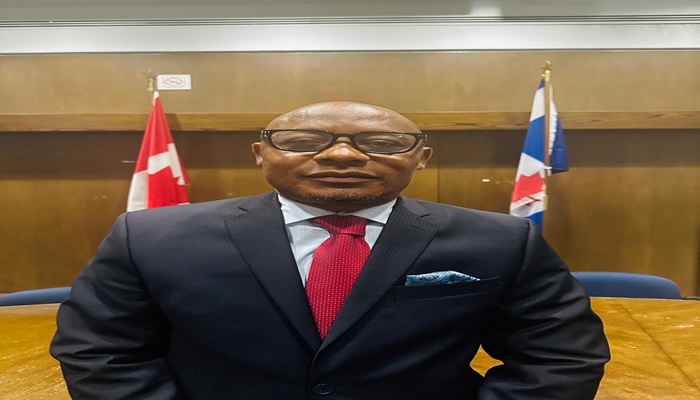
Dr Tarh Humphrey Ntantang


