
Yaoundé conference spotlights multi-billion CFA corruption losses
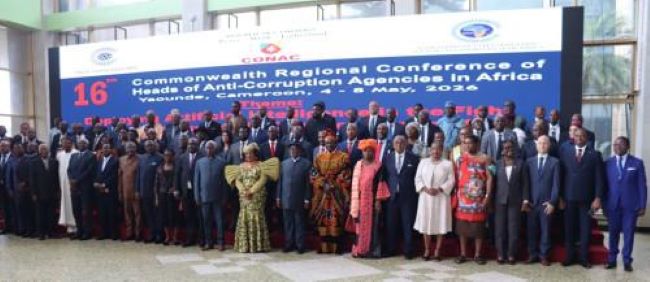
Twenty Commonwealth African nations convened in Yaounde for the 16th annual Conference of Heads of Anti-Corruption Agencies in Africa, as fresh figures revealed that corrupt practices cost the Cameroonian state alone more than four billion FCFA in 2024. The weeklong gathering, which started on April 4, 2026 is being held under the theme: “Deploying Artificial Intelligence in the Fight against Corruption in Commonwealth Africa.”
The conference, hosted by Cameroon’s National Anti-Corruption Commission (CONAC) at the Yaounde Conference Centre, brought together anti-corruption chiefs, members of government, diplomats and representatives of international organisations. It was opened on behalf of President Paul Biya by the Minister Delegate at the Presidency in charge of the Supreme State Audit, Mbah Acha Rose Fomundam.
The scale of the problem was laid bare by CONAC Chairman, Rev Dr Dieudonné Massi Gams, who disclosed that in 2024 alone, his commission received 10,520 reports of corrupt practices. The financial damage to the Cameroonian state was officially estimated at 4,061,806,711 CFA franc.
“Cameroon has high expectations from this conference. We hope the outcome will be innovative and practical solutions to enhance our capacity to fight corruption, thereby ensuring our country’s development and the well-being of our people,” Rev Dr Massi Gams told delegates.
The CONAC chief situated the Yaounde gathering within a broader institutional architecture that Cameroon has built over decades, including the Supreme State Audit Office, the Special Criminal Court, the Public Contracts Regulatory Board and the National Financial Investigation Agency. He noted that CONAC is a founding member of the Commonwealth anti-corruption association formed in Gaborone, Botswana, in 2011, and currently holds its vice-presidency.
Rev Dr Massi Gams made plain that institutional architecture alone has not been sufficient. “Despite concrete efforts made, corruption and similar offences continue to wreak havoc in our society,” he acknowledged, pointing to the 2024 statistics as evidence that the fight is far from won.
From deterrence to detection: the AI wager
The conference’s defining proposition is that artificial intelligence can deliver capabilities that conventional enforcement tools have not. The Head of Public Sector Governance at the Commonwealth Secretariat, Dr Roger Koranteng, argued that technology is actively reshaping governance and public accountability across the continent. He said AI offers new tools, insights and opportunities to identify and combat corrupt transactions at scale.
“We are on the same continent. We have the same challenges in fighting corruption. Countries have different experiences. Some are doing very well. Some are lagging behind. Some are in between. The best way to learn quickly is to come together,” Dr Koranteng told delegates.
On his part, Dr Windfred Mfuh Fuaye Kenji, National Coordinator of the Project for the Acceleration of Digital Transformation in Cameroon (PATNUC), elaborated on the practical architecture such cooperation could generate. He argued that AI systems require large databases to function effectively, and that harmonising data across Commonwealth countries would create a powerful analytical foundation. He called for a common AI platform, one on which each country maintains its own presence but shares intelligence to enable the level of analysis required to build predictive and preventive capacity across borders.
Minister Mbah Acha reinforced the governance case, detailing that Cameroon has prioritised digitalisation as a strategy to enhance transparency, efficiency and accountability across public administration. She said government has pursued digital transformation to modernise public services and strengthen anti-corruption mechanisms, while acknowledging that more remains to be done.
“Corruption is a transnational phenomenon that requires collective and coordinated responses. This conference provides a valuable platform to share best practices and innovative solutions,” the minister stated.
She added that Cameroon “stands ready to learn from others and to contribute in this collective endeavour,” signalling the country’s positioning as both a recipient and contributor of governance knowledge within the Commonwealth framework.
The conference runs through the week, with plenary sessions, technical working groups and knowledge-sharing exchanges among delegations. Its conclusions are expected to feed into the policy and operational frameworks of member states’ anti-corruption institutions institutions whose collective mandate covers economies spanning some of the continent’s most populous and resource-rich nations.
Source: Business in Cameroon


