
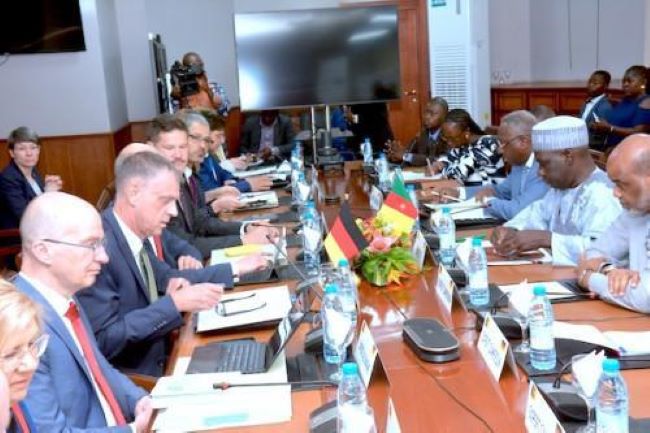
Germany helps Cameroon structure €32 Billion infrastructure project pipeline
Germany steps in as a facilitator for Cameroon in preparing the mobilization of financing for major infrastructure projects. This direction was reaffirmed on April 28, 2026, in Yaoundé, following intergovernmental discussions between the two countries.
The focus is on a portfolio of 27 structuring projects under public-private partnerships, including nine identified as priorities. These projects span transport, energy, agro-industry, ports, and housing. According to Cameroon Tribune, the total investment is estimated at about CFA21,000 billion, or nearly €32 billion.
It is important to clarify that this figure does not represent a financial commitment from Germany. Rather, it reflects the estimated cost of projects that Cameroon aims to make attractive to public, private, and multilateral financiers.
Projects still need to become bankable
For the German side, the priority is now to transform these identified projects into investment-ready opportunities. Philipp Knill, presented as head of the German delegation, emphasized the need to move from studies to bankable projects.
“We have been mandated to organize this roundtable to turn studies into bankable, investment-ready projects. We are here not just to discuss, but to act—finalize studies, test PPP financing models, and above all secure financing commitments,” he said.
This highlights that the process remains in a technical and financial structuring phase. Before any funds can be mobilized, the projects must be fully documented, costed, legally secured, and presented in a format that meets investor and lender requirements.
Partners approached, but no firm commitments yet
Germany says it has already conducted outreach to several financial institutions and international partners. These include the World Bank, the African Development Bank, the French Development Agency, the European Investment Bank, Proparco, and Gulf-based funds.
“We have conducted an international roadshow over the past three years, visiting several European capitals and the United Arab Emirates. We met institutions such as the World Bank, AfDB, AFD, EIB, Proparco, TFW, Abu Dhabi Fund, and Qatar Investment Fund,” Knill said.
At this stage, no breakdown by financier, disbursement timeline, or firm commitments has been disclosed. Expressions of interest or intent should therefore be distinguished from signed financing agreements.
Donor roundtable planned in Paris
The next step is expected to be a donor roundtable in Paris, aimed at gauging investor appetite for the proposed projects.
“I invite you to Paris in the coming months for a major PPP donor roundtable bringing together global financiers,” the German official said.
This meeting will serve as a test for Cameroon’s project pipeline, identifying those with sufficiently advanced studies, credible financial models, and reassuring legal frameworks.
Turning political momentum into investable projects
Germany’s involvement comes as Cameroon seeks to diversify its financing sources and rely more on PPPs for infrastructure development. The discussions also form part of broader bilateral cooperation, estimated by local media at over CFA320 billion. A new financing cycle of around CFA58.4–58.5 billion, largely composed of grants, is also under consideration.
For Cameroon, the challenge is twofold: finalize technical studies and present credible financial structures. For Germany, the role is to act as an intermediary between the Cameroonian government, development partners, and private investors.
The success of the initiative will depend less on the headline figure and more on the quality of the projects presented. To attract funding, Cameroon will need to deliver projects that are technically sound, legally secure, and financially viable.
Source: Business in Cameroon


