A man was shot and killed on November 4 by gendarmes trying to clear a path through heavy traffic for the president of Chad’s National Assembly, Haroun Kabadi. After the tragedy, many Chadians took to social media to express outrage at Kabadi’s security detail, particularly because this isn’t the first time they’ve been involved in a similar incident.
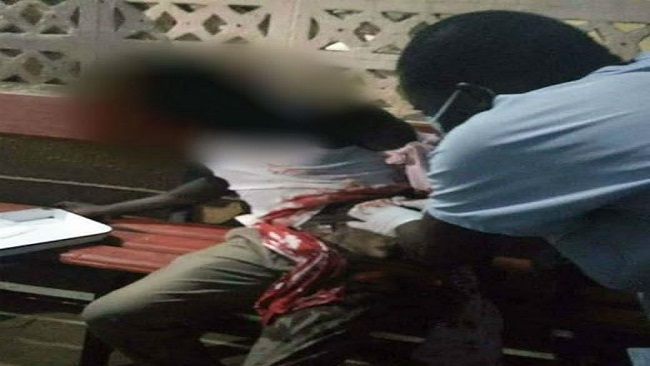
On November 6, the High Court of N’Djamena opened an investigation into the death of Bonheur Manayal Mateyan, a 34-year-old motorcyclist, who had been killed two days before by shots fired by Kabadi’s security detail on Pascal Yoadimnadji Avenue in N’Djamena. Four soldiers from Kabadi’s security detail have been arrested for “murder and complicity to murder”, according to the public prosecutor.
But what exactly happened? Emmanuel Béasngar, a close friend of Mateyan’s, wasn’t there when it happened. However, after his friend’s death, he spoke to many eyewitnesses.
“We need to make an example of these murderers”
Bonheur was my childhood friend — we’ve been friends for more than 20 years. He lived in the same neighbourhood as me. He drove a motorcycle taxi. On Monday, he gave a local girl a lift into town. Around 6pm, the president of the National Assembly’s convoy came down Pascal Yoadimnadj Avenue.
But it was rush hour and so there was a lot of traffic on the road. The convoy had sirens going, but they weren’t enough to free up the road, which is just barely large enough for traffic to go in two directions. So Kabadi’s security detail fired a few shots to frighten people off the road.
Even though Bonheur had stopped on the side of the road to let the convoy pass, he was hit by two of these gunshots. First, he was shot in the stomach and then in the back. When I heard what had happened, I came immediately. We rushed him to the hospital but he had lost too much blood already. He died from his wounds.
During a plenary session at parliament, Kabadi said that his security detail had to fire shots in the air because a vehicle “had tried to break into the convoy twice. Unfortunately, the bullet must have hit a [telephone] pole and come back to hit a passerby”.
Béasngar isn’t satisfied by this explanation.
I’m angry. Something like that shouldn’t happen in the middle of a town. If the gendarmes wanted target practice, it shouldn’t be on civilians. Bonheur has a wife and three children. The youngest is just two weeks old. Who is going to take care of them? We want real justice for Bonheur. We need to make an example of these murderers.
“Bonheur didn’t pose any danger to the convoy”
On social media, people expressed shock and outrage over Mateyan’s killing. Some Chadians spoke out against the culture of impunity surrounding the security forces. One local journalist, who asked to remain anonymous, explained:
This is the second time that Kabadi’s security detail has been involved in this kind of incident. Back in July 2018, security forces shot a man under similar circumstances. The man was hospitalised but, thankfully, he survived his injuries. Usually, soldiers only have the right to shoot if the president of the National Assembly’s life is in danger. But Bonheur wasn’t in any way a danger to the convoy.
In a statement published on November 5, the president of the National Assembly, who is a member of the ruling party the Patriotic Salvation Movement [‘Mouvement patriotique pour le salut’ or ‘MPS’ in French] admitted that his security detail had “in an attempt to clear a path caused the death of a citizen by gunshot wounds”. Kabadi said he “regretted the death” of a fellow citizen and extended his condolences to Mateyan’s friends and family.
Mustapha Youssouf Ramadan
L’Assemblée nationale du Tchad réagit après la mort à fleur d’âge du citoyen Matebaye Mayanel Bonheur dans la l’après midi du 04 Novembre en plein N’djaména.
Twitter user Mustapha Youssouf Ramadan tweeted (in French): Chad’s National Assembly reacts to the death of Matebaye Mayanel Bonheur [sic] in the prime of his life on the afternoon of November 4 in the middle of N’djaména.
Even though members of Kabadi’s security detail were arrested, Béasngar doesn’t think they will be held accountable for their actions. The journalist who spoke to the FRANCE 24 Observers team added: “We’re talking about soldiers here who have protection. They will simply pretend to punish them.”
“If we aren’t able to establish who fired the shot, the National Assembly will be considered responsible, the public prosecutor told French news agency Agence-France Presse. That’s what happened with the previous incident involving Kabadi’s bodyguards. That was settled amicably by the National Assembly in July 2018.
Congolese forces have said on Saturday they have killed 25 Takfiri militants since launching an offensive against them late last month in an eastern region also struggling with an Ebola outbreak.
Seven soldiers from the Democratic Republic of Congo had also died since the campaign to root out the Allied Democratic Forces (ADF) militia began on October 30, the general in charge of the operation, Jacques Nduru, told Reuters.
He said the army had seized four of the group’s positions around the eastern city of Beni in North Kivu province. Regular militia attacks have hampered efforts to contain Ebola across the area.
The ADF, originally a Ugandan rebel group, has been operating along the Congo/Uganda border for more than two decades. It is one of a number of armed factions active in east Congo long after the official end of a 1998-2003 war.
Several of ADF’s attacks have been claimed by the Daesh Takfiri terrorist group, but the extent of their relationship remains unclear.
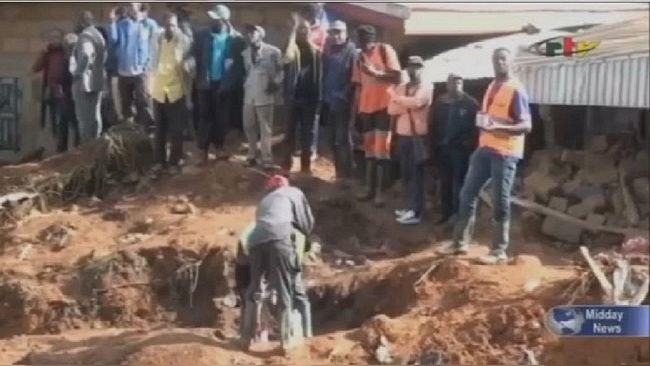
Cameroonian President Paul Biya on Friday declared a national day of mourning on Saturday to honor 43 people killed by a landslide in the western city of Bafoussam last week.
“Flags will be flown at half-mast throughout the country, as well as at Cameroonian embassies and consular offices abroad,” Biya said in a statement released Friday night.
Forty-three people were confirmed dead, over 150 families affected and several others reported still missing after the landslide caused by heavy downpour lashed Gouatchie 4 neighbourhood of Bafoussam on Oct. 28.
On a plantation in Tiko, in south-west Cameroon, Adeline rubs the gap in her right hand where her index finger used to be. She arrived in the town in July 2018, having fled Ekona, 15 miles away. In that village soldiers terrified civilians by burning houses and shooting indiscriminately as part of a crackdown on militias that want the primarily English-speaking areas of Cameroon to secede from the predominantly Francophone country. Adeline hoped Tiko would prove a sanctuary.
It was anything but. A year ago Adeline was tending to an oil palm in the plantation when about 20 members of a separatist militia grabbed her, stuffed leaves in her mouth and tied her to the tree. They whipped her and cut off her finger. Her apparent crime: working for the Cameroon Development Corporation (cdc), a state-run company. “As I close my eyes I see the boys coming to get me,” says Adeline. “The trauma is still there.”
Cameroon was until recently a stable country in a fragile region. Today it is battling the jihadists of Boko Haram in the north, dealing with an influx of refugees from the Central African Republic in the east—and, most devastatingly, the “Anglophone crisis” in the west. Adeline’s is one of hundreds of thousands of lives ravaged by this conflict over the past three years. Paul Biya, the authoritarian who has ruled Cameroon for 37 years, had hoped that the crisis would prove short-lived. So did foreign powers, which have been largely quiet. Yet the conflict shows no sign of ending.
The origins of the turmoil began a century ago. After the first world war Britain and France took over different parts of the German colony of Cameroon. Upon independence in 1960 and 1961 the larger French territory joined the southern part of the British one to make modern Cameroon.
It quickly became one of the most centralised countries in Africa. Today just 1% of public spending is devolved to local governments, versus more than 50% in Nigeria. The country is officially bilingual, but the roughly 20% of people (4-5m in a country of 24m) who mainly speak English claim decades of marginalisation. Promises of devolution have been broken.
In late 2016 frustrations boiled over. First lawyers went on strike against the erosion of the English-style common-law system. Teachers soon joined the protests, citing, among other things, the appointment of French-only speakers in classrooms. Protest groups organised “ghost towns”: weekly shutdowns of towns such as Buea, the capital of the south-west region, that continue to this day.
The government hit back hard. The internet was shut off for four months. Groups organising the protests were banned and their leaders arrested. In October 2017 separatists responded by proclaiming the independent state of “Ambazonia”, named after Ambas bay in the south-west.
This led to a massive, violent escalation. International ngos estimate that 3,000 people have been killed during the crisis. But aid workers think the true figure is several times higher. Both separatist militias and security forces have committed atrocities, but the Cameroonian army is believed to be behind most of the bloodshed.
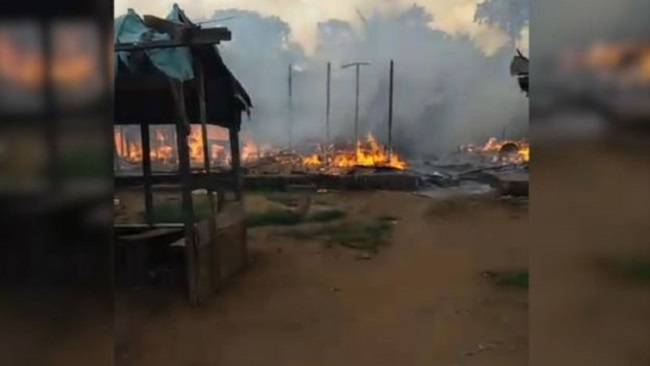
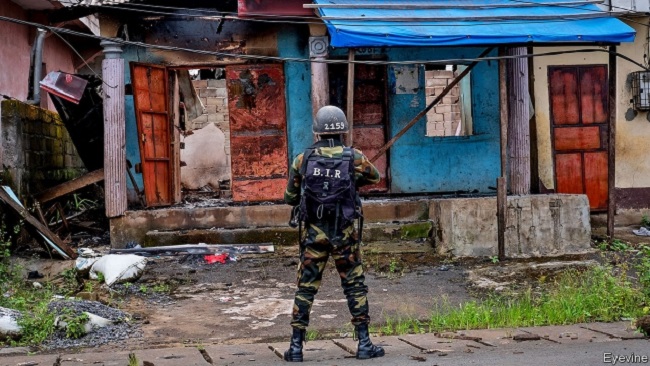
Security forces have burned more than 220 villages in the Anglophone region, according to the Centre for Human Rights and Democracy in Africa (chrda) in Buea. One was Ekona. Formerly the site of a bustling market, today it is an eerie place, where the walls of charred houses are pockmarked with bullets.
“It’s like ‘Full Metal Jacket’,” says one aid worker, in reference to trigger-happy soldiers in a film about the Vietnam war. Ayuk, who lived in Ekona for four years before fleeing in April, says he can recall hundreds of incidents where soldiers fired at villagers. In one case his neighbour and two others were shot in their car on their way back from sowing plantain. “We had to bury him quickly,” Ayuk recalls, in case the army shot them as well.
Tah Mai, a journalist, lost two brothers in separate incidents involving the army. In November last year his brother and his wife were shot outside their house in Buea. A few months later his other brother was shot in the back in his home village in the north-west. “Mine is just like the many stories that you haven’t heard,” says Mr Tah.
No refuge
At least 500,000 people have been forced to leave their homes. Tens of thousands have fled to Nigeria, but most are in the bush, making it hard to count them. Even in the forests displaced people can be found by the army. Frida, who was also forced to flee Ekona, describes how she watched soldiers enter her bush camp. They shot two women accused of cooking for separatist fighters. Then they killed the informer who brought them.
Mass displacement is having grave effects on public health. There are outbreaks of monkey pox and measles, partly because of plummeting vaccination rates. Before the crisis about 70% of women gave birth with medical help in the north-west region. Today 3% do so. The result is more women and babies dying in the course of childbirth. Cecilia Mah, the matron at Mount Mary Hospital in Buea, says that it is hard to run a hospital when soldiers threaten ambulance drivers and seize suspected separatists convalescing in the wards.
The state is, however, not solely responsible for the chaos; separatists share some of the blame. Most of the separatist political groups, such as the Interim Government of the Federal Republic of Ambazonia, and the Ambazonia Governing Council, are based abroad. Their leaders and donors are in America, Germany, Norway and other rich countries. In Cameroon their armed wings control swathes of rural territory. This can lead to surreal moments for aid workers. They may, for example, have to negotiate access to villages not with commanders on the ground but with middle-aged men sitting in living rooms in Washington, Oslo or Dortmund.
Many separatist attacks are aimed at the security forces. But some target Anglophone civilians. “If you disagree with them, they kill you,” says Cardinal Christian Tumi, the archbishop of Douala, Cameroon’s commercial capital. He says that a traditional chief from his home village was “slaughtered like a goat” for allegedly collaborating with the authorities. Like Adeline, many people employed by cdc have been maimed.
Brutality by separatists is likely to increase as armed groups in the country seek their own sources of funding to break away from the patronage of leaders in the diaspora. So-called Amba boys are turning to kidnapping and extortion for funds; other groups are increasingly criminal entities, not political ones. In March the football team of the University of Buea was taken hostage; many parents paid ransoms. Most of the aid groups working on the ground have had workers kidnapped. “I fear we are creating a generation of warlords,” says Felix Agbor Balla, the president of chrda.
While bandits raise cash by extorting, the economy is collapsing. The Anglophone regions contribute about 20% of the country’s gdp. cdc was the second-largest employer in Cameroon, after the state. But most of its rubber and palm-oil plantations, and all of its banana ones, have shut because of attacks. Most workers have lost their jobs. Revenue is 90% lower than before the crisis; cdc has not sold a banana since August 2018. Its leaders get death threats from separatists. Asked how he copes, Franklin Ngoni Njie, cdc’s general manager, says he follows a simple rule: “I pray more. I go out less.”
And yet an even bigger social and economic crisis is looming. Almost 90% of children in the Anglophone regions have not gone to school for three years, a result of forced displacements and the enforcement of a boycott called by separatists who see schools as arms of the state. (According to this twisted logic a six-year-old keen to learn subtraction is a collaborator.) At home-schools set up by brave educators children arrive with homework hidden in their trouser legs, in case they are spotted by Amba boys.
The sabotage of education is one reason why many Anglophones are growing angry at the separatists. Ernest Molua notes that people used to refer to them as “our boys”; now they say “those boys”. The professor at the University of Buea believes that most Anglophones want more autonomy, ideally within a federal Cameroon, not independence. “There remains a strong sense of ‘Cameroonianess’,” he says, emphasising that Anglophones’ grievances are with the government, not their French-speaking compatriots. But Mr Molua worries that “the space for moderates is shrinking”.
Loaded language
Signs of compromise are scant. Separatist groups do not even have a common position among themselves, despite efforts by the Centre for Humanitarian Dialogue, a Swiss ngo, to help them find one. For his part, President Biya in September raised hopes by announcing a “National Dialogue”. Yet it was a sham. The meeting was not just about the crisis; it gave Cameroonian leaders from all regions a chance to air complaints (and collect per-diems). Many important Anglophones were either not invited or left in prison. “It was not a sincere effort,” says Alice Nkom, a lawyer.
Mr Biya has been aided by a muted international response. Donors have provided just 18% of the funding requested by the un for humanitarian operations in Cameroon’s Anglophone regions for 2019. (The only countries for which the un receives lower shares of support are Venezuela and North Korea.) Diplomatic pressure has been meagre, too. Nigeria wants Mr Biya’s help with Boko Haram and does not want to encourage the hopes of Biafran separatists in its own south-east. China is focused on its economic interests. British diplomats have offered gentle criticism in private but do not want to slam Mr Biya in public. Most importantly of all, France has done little but urge cosmetic concessions.
The only influential country willing to speak out is America. On October 31st it removed Cameroon from a list of African countries that get preferential trade terms, citing “gross violations” of human rights by the government. American diplomats hope the move will send a signal to Mr Biya that he needs to find a political solution.
For now there is only a bloody equilibrium. Separatist militias cannot take the towns; the army cannot take the bush. In the middle are people like Adeline. She says that she feels trapped between the two warring parties. And without a job any more she has no means to escape. So she waits, too weary to talk much about politics. “I just need my peace,” she says.
An International Monetary Fund (IMF) team, led by Mr. Amadou Sy, visited Yaoundé during October 28—November 8, 2019 to discuss the fifth review of the program supported by the ECF that was approved in June 2017 .
At the conclusion of this visit, Mr. Sy issued the following statement:
“The IMF team reached staff-level agreement with the authorities on economic and financial policies that could support approval of the fifth review of their three-year program under the ECF. The IMF Executive Board could consider the fifth review in mid-December 2019. The completion of the fifth review would enable a sixth disbursement of SDR 55.2 million (about US$ 76.5 million).
“Overall economic growth is estimated to reach 3.9 percent in 2019, from 4.1 percent in 2018. The strong rebound of the oil and gas sector will help contain the lower than anticipated expansion in the non-oil sector. While the oil and gas sector is expected to grow by 6.0 percent after three years of deceleration, security challenges and the suspension of SONARA’s production since June 2019 is weighing on short-term growth prospects. Non-oil activity is estimated to soften at 3.8 percent in 2019 from 4.4 percent in 2018. Inflation remains low but is trending up from 1.1 percent in 2018 to 2.3 percent in September 2019, (y/y) mainly owing to higher food prices and with strong regional variations.
“Fiscal performance in 2019 faces increased headwinds due to security challenges, the delayed implementation of new tax measures, and SONARA’s financial difficulties. Structural reforms are moving ahead, albeit with slow progress. The authorities are considering expanding the non-oil revenue base, including by reducing tax exemptions, raising VAT efficiency, and improving tax and customs administration. They are committed to addressing risks from contingent liabilities, including from SONARA and other state-owned enterprises, and safeguarding debt sustainability including by continuing to increase the share of concessional loans in new borrowing.”
“The medium-term outlook remains positive, with non-oil growth expected to gradually rise thanks to the completion of the investments in infrastructure and energy projects and a gradual resolution of the security crisis. Fiscal consolidation over 2020-21, together with enhanced foreign exchange repatriation will support a continued rebuilding of BEAC reserves. Structural reforms to increase public investment efficiency, strengthen public enterprises and support private sector development will support the growth outlook going forward.”
“The team wishes to thank the Cameroonian authorities for their hospitality, cooperation, and the constructive dialogue.”
The team met with Prime Minister Joseph Dion Ngute, Minister of State Secretary General at the Presidency Ferdinand Ngoh Ngoh, Minister of Finance Louis Paul Motaze, Minister of Economy, Planning, and Regional Development Alamine Ousmane Mey, BEAC National Director Eugene Blaise Nsom, and other senior officials. The mission also met representatives of the diplomatic and donor communities as well of the private sector.
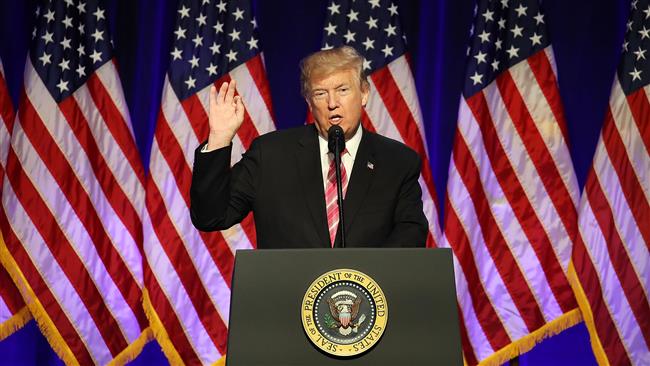
US President Donald Trump has once again blasted the rapidly progressing impeachment inquiry against him after Democrats in the House of Representatives released more damaging details of two testimonies as part of the probe.
On Friday, House investigators leading the impeachment probe released the testimony of Alexander Vindman, a US Army officer and Ukraine expert on the National Security Council, and Fiona Hill, a former White House adviser on Russia.
Both testified about their concerns that Trump pushed Ukrainian officials to investigate former US Vice President Joe Biden and his son.
Democrats in the lower chamber of Congress launched an impeachment inquiry against Trump in September after a whistleblower alleged the Republican president pressured Ukrainian President Volodymyr Zelensky to investigate former Vice President Joe Biden and his son Hunter, who had served as a director for Ukrainian energy company Burisma.
Democrats have been releasing transcripts of the closed-door impeachment investigation as they prepare for public hearings in Congress next week.
According to the transcript of his testimony, Vindman said the US Ambassador to the European Union, Gordon Sondland, said at a White House meeting on July 10 that Ukrainian officials would have to open an investigation of the Bidens and Burisma for Zelenskiy to get an Oval Office meeting with Trump.
“He was calling for something, calling for an investigation that didn’t exist into the Bidens and Burisma,” Vindman said. “The Ukrainians would have to deliver an investigation into the Bidens.”
Vindman was among the US officials in the White House monitoring Trump’s call two weeks later on July 25 with Zelenskiy, a main focus of the impeachment probe.
His account of the meeting at the White House was supported by Fiona Hill, the former senior director for European and Russian affairs on the National Security Council.
His comments provide Democrats more information in their probe to determine if Trump exploited US foreign policy to pressure Ukraine into carrying out a corruption investigation into Biden, a potential rival in the 2020 presidential election.
The impeachment inquiry enters a critical phase next week when House committees hold impeachment hearings in public. Former US ambassador to Ukraine Marie Yovanovitch, who was abruptly recalled by Trump in May, will testify on November 15.
Trump has lashed out at Democrats for leading the impeachment inquiry that now threatens his presidency.
On Friday, he continued to rail against the probe, saying there is no need to hold public hearings because he did nothing wrong.
“They shouldn’t be having public hearings,” Trump told reporters at the White House. “This is a hoax. This is just like the Russian witch hunt.”
The “brutal” prison conditions of Egypt’s former president, Mohamed Morsi, may have directly led to his death, according to a report by UN experts.
“Dr. Morsi was held in conditions that can only be described as brutal, particularly during his five-year detention in the Tora prison complex,” a panel of UN experts – including Agnes Callamard, special rapporteur on extrajudicial, summary or arbitrary executions – and the UN Working Group on Arbitrary Detention reported on Friday.
“Dr. Morsi’s death after enduring those conditions could amount to a state-sanctioned arbitrary killing.”
“The authorities were warned repeatedly that Dr. Morsi’s prison conditions would gradually undermine his health to the point of killing him. There is no evidence they acted to address these concerns, even though the consequences were foreseeable,” the experts said.
In a joint statement on Friday, Egypt’s former minister of Planning and International Cooperation, Amr Darrag, called the report “a significant step forward in holding such regimes accountable for their actions”.
Senior members of Morsi’s former government also welcomed the report, calling on the UN to extend its investigation to include the ‘suspicious circumstances’ surrounding the death of Morsi’s son, Abdullah, who reportedly died of a heart attack on September 4.
Abdullah Morsi, 25, had been in touch with the UN to formally complain about his father’s death just before he died.
The UN experts warned that thousands more prisoners in Egypt were enduring similar conditions, and their ‘health and lives’ may also be at severe risk.
“We have received credible evidence from various sources that thousands more detainees across Egypt may be suffering gross violations of their human rights, many of whom may be at high risk of death,” the statement said. “This appears to be a consistent, intentional practice by the current Government of President Abdel-Fattah El-Sisi to silence dissenters.”
Egypt’s former President Morsi
The UN experts further called on the Egyptian government to put an end to state-sponsored practices that violate “the right to life, the right not to be subjected to arbitrary detention, the right not to be subjected to torture or ill-treatment, the right to due process and a fair trial, and adequate medical care”.
Morsi, a senior figure in the Muslim Brotherhood organization, was Egypt’s first democratically-elected president after the 2011 revolution, but he was deposed following a military coup led by Abdel Fattah el-Sisi in July 2013.
He had been serving a 20-year prison term on charges of ordering the arrest and torture of protesters, a 25-year jail term on charges of passing intelligence to Qatar and a three-year term for insulting the judiciary.
Morsi suffered from medical neglect during his incarceration as well as poor jail conditions.
The 67-year-old former president fainted during a court session on June 17 and died afterwards.
The Muslim Brotherhood has labeled Morsi’s death a full-fledged murder.
Last year, a report by a panel of UK legislators and attorneys warned that the lack of medical treatment could result in Morsi’s “premature death.”
The panel said that Morsi was being kept in solitary confinement for 23 hours a day, which under UN guidelines, would qualify as torture.
During the past few years, Sisi has faced growing criticism about his way of treating dissidents, especially those linked to the Muslim Brotherhood movement.
In February the U.S. president cut off his country’s military aid to the central African country of Cameroon because of its appalling human rights record.
Sometimes Donald Trump gets it right. In February the U.S. president cut off his country’s military aid to the central African country of Cameroon because of its appalling human rights record. Last Friday he acted again, dropping Cameroon from a pact that promotes trade between sub-Saharan African countries and the U.S.
Cameroon’s main claim to fame until recently was its ruler, Paul Biya, the oldest and longest-ruling dictator in the world (86 years old and in power for the past 42 years).
Biya wasn’t all that bad, apart from the usual corruption and the occasional political murder, until Cameroon’s downtrodden English-speakers started protesting seriously about two years ago in the majority French-speaking country.
The anglophones have been pushed into a corner because they don’t fit the mould. A century ago hardly anybody in the region spoke either English or French, but the vagaries of colonial policy put some of the locals into the British empire and some into the French – and then independence brought some of them back together again.
Only one-fifths of the 25 million Cameroonians live in the anglophone region, but that region is right up against the border with Nigeria, where around 190 million people use English as their lingua franca.
That shouldn’t have been a problem if Cameroon had respected the rights of its English-speakers, but having giant Nigeria right next-door made the country’s francophone ruling elite uneasy. Predictably, but very stupidly, Biya and his cronies saw separate institutions for the anglophones as a potential cause for division and started eliminating them.
They unilaterally changed the country’s federal structure into a unitary one, ending anglo self-government. They replaced English-speaking judges and English common law with francophone judges and French law. Government jobs automatically went to “loyal” francophones even in anglophone areas.
Every step they took to erase the differences between anglos and francos only deepened the divisions between them.
Finally the anglophones began publicly protesting – and when their representatives were all jailed, more radical protesters began demanding independence for the anglophone region, which they dubbed Ambazonia. They got arrested too, and the next wave of protesters turned to violence.
The original blame for the breakdown rests almost entirely with the Biya regime, but the rebels are catching up quickly in the stupidity stakes. It has become a classic guerrilla war, in the worst sense of the word, and it could blight the lives of an entire generation.
What makes it even more bizarre is that it’s not even about genuine ethnic, religious or linguistic differences. Cameroon has enough of those: many different tribes, Muslims in the north and Christians in the south, and around 250 different languages, some spoken by only a few thousand people. This war is about which foreign language people speak.
It is a mercifully rare problem in Africa, because while most African states contain many languages, they have kept the borders that the colonialists imposed. Everybody living inside those borders has therefore inherited the same colonial language, usually French, English or Portuguese, and uses it to communicate with fellow-citizens whose native language is different.
It’s an arbitrary solution with its roots in tyrannical oppression by foreigners, but there’s no other way that large numbers of Africans could share a modern state together. Most of the linguistic groups are too small. And Cameroon shows what is all too likely to happen – human beings being what they are – if that situation does not prevail.
For 37 years one man has ruled Cameroon, a staggeringly corrupt, oil-rich state in central Africa. President Paul Biya is an old-fashioned autocrat. When democracy swept across Africa after the cold war ended, he called it a “distasteful passing fetish”. Then he realised he would attract less foreign criticism if he quietly intimidated opponents and rigged elections instead of banning them. He has done so ever since, and kept on good terms with Western powers by posing as a champion of stability in a fissile region. His troops, trained and equipped by France, Israel and America, battle the jihadists of Boko Haram and Islamic State around Lake Chad. They also regularly don blue helmets to keep peace in countries such as the Central African Republic. Yet Mr Biya cannot keep the peace at home.
Instead, a country that was once seen as an exporter of security is now being wrenched apart. A secession struggle rages in its English-speaking regions. Government forces are burning villages, shooting young men and raping women. The conflict has killed thousands and forced more than 500,000 people from their homes.
The strife began as a series of peaceful protests in 2016. Anglophones were aggrieved at their marginalisation in a country dominated by French-speakers. Cameroon is too rigidly centralised to satisfy minorities: only 1% of government spending is locally controlled, compared with more than 50% in neighbouring Nigeria. Strikes and demonstrations over the erosion of English-style common law and the dominance of Francophone officials have since mutated into what looks like a civil war. It could get much worse, as chaos grows, armed separatists kill and soldiers inflict horrors on civilians.
The outside world has barely noticed this disaster unfolding. Appeals for emergency assistance have attracted less than one-fifth of their target: less than half the people who have lost their homes have been given the two pieces of plastic and rope that make up the un’s shelter kit. Cameroon’s main backers have looked away, hoping Mr Biya’s government would quell the rebellion and get back to fighting jihadists in the Sahel. Instead of corralling the warring parties, the African Union and un Security Council have stood aside, rousing themselves only to “welcome” and “praise” Mr Biya’s “national dialogue”, a sham to which key separatist leaders were not invited.
This is a disgrace. The conflict, although bloody, is not intractable. Most people in Cameroon’s two English-speaking regions are probably moderate and would be happy with some more autonomy and an end to the fighting. They could find common ground with those on the government side who might be willing to give a bit more power to the regions.
The longer the fighting persists, the harder it will be to resolve. With the army and separatists in stalemate on the battlefield, peace can come only through talks. For those to happen, both sides need to build trust. The separatists should start by lifting the ruinous ban they enforce on children going to government schools in the areas they control, which threatens to create a lost generation of illiterates. Rebel leaders abroad should tone down their inflammatory talk of secession. The government should release political prisoners and prosecute soldiers responsible for abuses.
Outsiders should press Mr Biya to make peace. President Donald Trump has rightly scaled back military assistance because of atrocities committed by the army. He has also kicked Cameroon out of a programme which grants duty-free access to the us market to African countries that respect human rights. European governments should also turn the screws, especially France, Mr Biya’s closest ally. The ageing strongman once said that only one-party rule could hold Cameroon together. In fact, his overcentralised autocracy has created pressures that could blow it apart. Only dialogue and devolution can save it.
Symbolic half-measures like revoking preferential trade status are not enough to force the repressive regime of Paul Biya to change. Canceling IMF loans and military aid would show that the White House is serious.
On Oct. 31, the Trump administration notified Congress that Cameroon would lose its eligibility status under the African Growth and Opportunity Act (AGOA) in 2020. “Cameroon has failed to address concerns regarding persistent human rights violations being committed by Cameroonian security forces,” the White House statement explained, in what is the toughest executive branch language issued about escalating crises in Cameroon, building on a congressional resolution agreed to in July.
The announcement quickly caught fire on social media, a sign of hope for Cameroonians and others who have long called for more external pressure on the country’s octogenarian president, Paul Biya, who has been in power since 1982.
But taking away Cameroon’s AGOA privileges—primarily duty-free access for designated products exported from eligible African countries to the United States, including textiles—will not cause much pain. It will not compel Biya to undertake much-needed political and economic reforms to solve the crisis in the country’s Anglophone region and the related violence driving a humanitarian catastrophe, the deep-rooted governance crisis that includes mass arrests of political opponents and journalists, and an economic meltdown that has been partly concealed by oil-related revenue and ongoing bailouts by international lenders.
The humanitarian crisis gets worse by the month: The Norwegian Refugee Council calls Cameroon the world’s most neglected displacement crisis, while UNICEF reports there has been a “15-fold increase” in the humanitarian emergency there since 2017. The real test of the Trump administration’s resolve on Cameroon will be whether it acts to curtail all military assistance, imposes targeted travel and economic sanctions on individuals, and uses its considerable leverage to punish the Biya regime through international financial institutions and at the United Nations.
Members of the Biya government know that removal from AGOA won’t do much damage. Indeed, CNN recently interviewed an official at Cameroon’s Ministry of External Relations, who pointed out that the country barely benefits from AGOA and that the Trump administration is only trying to punish Cameroon because of its growing ties to China. Indeed, Washington’s move could push Cameroon and other African states further into the waiting arms of China and Russia—countries that do not ask questions about human rights.
This raises the question of why the Trump administration, which is preoccupied with much bigger domestic and foreign-policy challenges, decided to take a high-profile but symbolic stance now and if it is truly seeking to take a tougher line against Biya.
Unlike most reciprocal trade agreements or international financial institution regulations, AGOA includes economic, political, and human rights criteria that make it easier for the U.S. government to find justifications for change in status. These criteria include progress toward establishing “the rule of law, political pluralism, and the right to due process, a fair trial, and equal protection under the law” and that a country “does not engage in gross violations of internationally recognized human rights.” Other countries whose beneficiary status has been withdrawn include Burundi (since 2016), Mauritania (since 2019), and South Sudan (since 2014).
Unlike many other African countries, Cameroon never cultivated the AGOA preferences to drive private sector development, investment, employment, and exports. Today, the United States just squeaks into the list of its top 10 trading partners. Total AGOA-eligible exports reached $63 million in 2018, mostly crude oil, and had already dropped to just $8 million in the first six months of 2019.
Shortly after AGOA was signed into law in 2000, construction started on the Chad-Cameroon pipeline, part of a massive project spearheaded by ExxonMobil to export crude oil from southern Chad. Today, Cameroon’s government receives a $1.32 transit fee for every barrel that flows from Chad through to the export port of Kribi. It also benefits directly from its own modest offshore oil and natural gas production, and further reserves await development.
The nature of governance in Cameroon has always relied on rentier (or gatekeeper) state opportunities—including tropical agriculture, timber, oil, and, more recently, soccer stadiums— over establishing the complex foundations for internationally competitive, value-added industry. There is no desire by the regime to break from its resource curse. It is not a surprise, then, that Cameroon sits near the bottom of Transparency International’s Corruption Perceptions Index or the World Bank’s Doing Business rankings, and it does not come close to passing the governance thresholds of the Millennium Challenge Corporation.


 Mustapha Youssouf Ramadan