
Breaking News
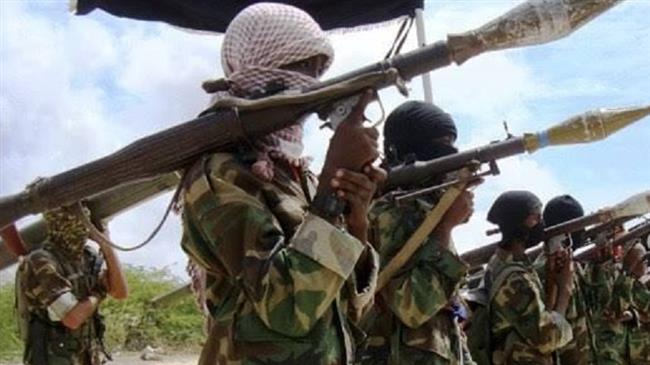
Nigeria: Boko Haram attacks military base, kills seven people
The Boko Haram Takfiri militants have attacked a military base and set fire to shelters for those displaced by the conflict in northeastern Nigeria, leaving seven people dead.
A military source said the attack was carried out in Rann, some 175 kilometers (110 miles) northeast of Maiduguri, the capital of Borno state, late on Monday afternoon.
He said that poor visibility due to seasonal Harmattan winds obstructed the deployment of air force jets, and soldiers were forced to withdraw.
“So far we have three soldiers killed and two others are still unaccounted for,” the source said.
“The base was burned by the terrorists, who took away weapons and vehicles left by the troops when they withdrew,” he said, adding that the militants also set fire to camps and shelters, forcing locals and internally displaced people (IDPs) to flee.
An aid worker in Maiduguri said colleagues in Rann blamed the attack on the Islamic State West Africa Province (ISWAP) faction of Boko Haram, adding that people fled towards Bulale, on the Cameroon side of the border.
“Four IDPs were killed. Two were shot dead while two were slaughtered by the attackers. Several shelters were burned. They also looted food supplies in the town,” the source said, noting that reinforcements arrived in the town on Tuesday morning.
Rann is currently sheltering some 35,000 IDPs, according to the International Organization for Migration.
A local community leader said a similar attempt was made to seize a military base in Magumeri, 50 kilometers northwest of Maiduguri, on Sunday.
The United Nations last week warned about growing violence by Boko Haram militants in northeastern Nigeria, saying more than 30,000 people — mostly women and children — have fled their homes in the conflict-ridden area over the past weeks.
Boko Haram’s nine-year militancy is estimated to have killed more than 27,000 people and forced 1.8 million others to flee their homes, also triggering a humanitarian crisis in Nigeria. In 2015, Boko Haram pledged allegiance to the Takfiri Daesh terrorist group.
Source: Presstv
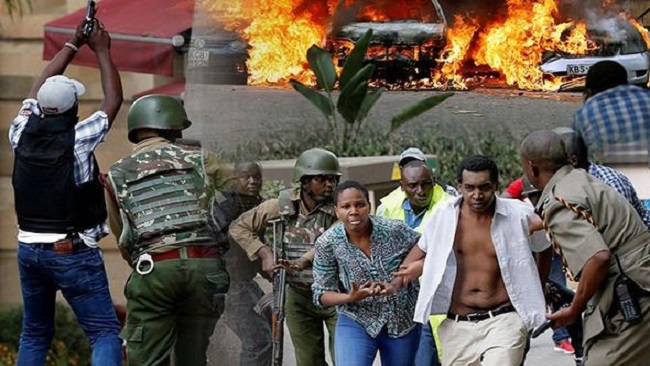
Kenya: Blast, gunfire reported at upscale hotel complex in Nairobi
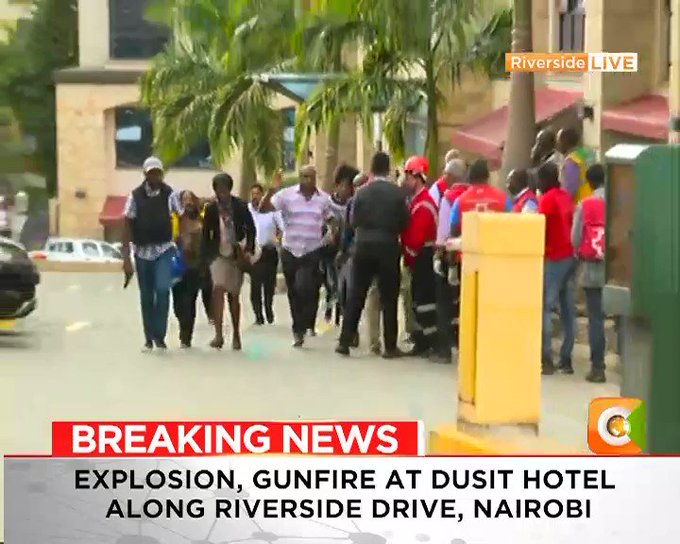
Gunmen attacked an upscale hotel complex in Kenya’s capital Nairobi on Tuesday, sending people fleeing in panic as explosions and heavy gunfire reverberated through the neighbourhood.
At least one person was killed and eight others were injured in the attack, hospital officials said. An AFP reporter said the death toll was at least five.
Al Shabaab – the Somalia-based extremist group that carried out the 2013 Westgate Mall attack in Nairobi that left 67 people dead – claimed responsibility for the assault and said its members were still fighting inside.
Kenya police chief Joseph Boinnet told reporters armed assailants could still be in the building and the police operation was ongoing.
The complex in Nairobi’s Westlands neighborhood includes a large hotel known as DusitD2, along with banks and offices.
Several vehicles burned. People were rushed, some carried, from the scene. At least one was on a stretcher. Some ducked behind cars, screaming. Others appeared to take cover behind fountains and other features in the lush outdoor complex.
“It is terrible. What I have seen is terrible. I have seen a human as I ran out and there is what looks like minced meat all over,” said one man who said he ran from the scene, Charles Njenga.
Another man, who did not give his name, said he hid in an office.
“I have been hiding. My colleagues were running everywhere,” he said, breathing heavily.
Another witness, Robert Murire, said he saw at least two bodies at the scene, along with attackers wearing green and wrapped in ammunition.
It was not clear how many attackers took part.
Gunfire continued several minutes after the first reports as ambulances, security forces and firefighters rushed to the scene. Black smoke rose from the complex. A bomb disposal unit arrived, and vehicles were cordoned off for fear they contained explosives.
Police said they detonated a car that had explosives inside. An unexploded grenade was also seen in a hallway at the complex.
What appeared to be plainclothes security forces inched their way toward the scene, guns in hand.
“We have sent officers to the scene, including from the anti-terrorism unit, but so far we have no more information,” police spokesman Charles Owino said.
A large group of women were hurried out by security forces, one woman still in curlers. Dozens of others were hurried away as plainclothes officers went shop to shop in the complex. Some people held up their hands to show they were unarmed.
Al Shabaab has vowed retribution against Kenya for sending troops to Somalia since 2011. The al Qaeda-linked group has killed hundreds of people in Kenya, which has been targeted more than any other of the six countries providing troops to an African Union force in Somalia.
The attack immediately reminded many Kenyans of the Westgate Mall attack, when al Shabaab extremists burst into the luxury shopping center, hurling grenades and starting a days-long siege.
The hotel complex under attack is less than 2 kilometers from Westgate Mall and is in what is considered one of the most secure areas of the city. It lies on a relatively quiet, tree-lined road near a main avenue. Its website says it is “cocooned away from the hustle and bustle in a secure and peaceful haven.”
The attack came three years to the day after al Shabaab extremists attacked a Kenyan military base in Somalia, killing scores of people.
(FRANCE 24 with AP)
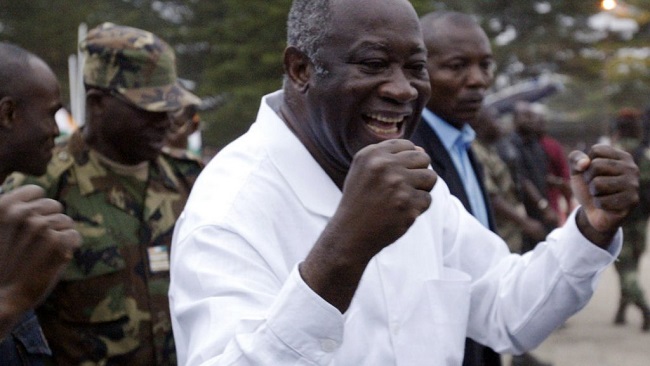
International Criminal Court: Laurent Gbagbo, the strongman who refused to let go
The International Criminal Court on Tuesday acquitted former Ivory Coast president Laurent Gbagbo of crimes against humanity, marking the latest dramatic twist in the career of one of West Africa’s most divisive politicians.
After seven years behind bars in The Hague, Gbagbo, 73, was cleared of crimes committed following a disputed presidential election in 2010. More than 3,000 people were killed in the cocoa-producing nation after he refused to accept defeat by his rival Alassane Ouattara, Ivory Coast’s current president.
Gbagbo, a onetime socialist and labour activist, was the first former head of state to stand trial at the ICC. The judges’ ruling means he will now be released from jail – a familiar routine for a man who spent decades battling power-hungry strongmen, only to become one himself.
The opponent
Gbagbo, then a university lecturer with a PhD in history, was first jailed for “subversive” teaching in 1971, during the rule of Ivory Coast’s independence leader, president Houphouet-Boigny. The man nicknamed “Cicero”, because of his taste for Latin, would be among the first to defy Houphouet-Boigny, first as a trade union activist and then as a left-wing politician.
A skilled orator whose affable manners concealed a ferocious determination, Gbagbo sought exile in Paris in 1982, cultivating ties with prominent socialist figures in France – ties that would endure during later crises with the former colonial power. He founded the Ivorian Popular Front (FPI) in exile, returning only in 1988 to attend its founding congress. Further stints in jail would soon follow.

His first shot at the presidency, in 1990, ended in crushing defeat to Houphouet-Boigny, then in his seventh term, though it cemented Gbagbo’s position as opposition leader. Two years later he was again jailed for his part in student protests against the government of prime minister Alassane Ouattara. The two would meet again.
In 1993, the rise to power of Henri Konan Bédié coincided with mounting xenophobia in Ivory Coast, instigated by the notion of “Ivoirité” (Ivorianness), and Gbagbo was accused of jumping on the nationalist bandwagon too. Ivoirité paid dividends in 2000 when Gbagbo won a disputed presidential election in which Ouattara, a Muslim whose nationality was disputed, was barred from running.

Civil war
Gbagbo’s decade in power was marked by years of civil war, triggered by a failed coup in October 2002 that resulted in rebels seizing the country’s mainly Muslim north. His supporters, notably the Young Patriots that policed the streets, were accused of carrying out xenophobic attacks against northerners and foreigners.
As the war dragged on, Gbagbo’s camp became increasingly frustrated with a peacekeeping force deployed by France, which it accused of undermining the country’s unity. The anger boiled over in 2004 after nine French soldiers were killed in an Ivorian air strike against rebels, prompting France to destroy the country’s air force in retaliatory attacks. Gbagbo supporters vented their fury at French expatriates, forcing Paris to hurriedly evacuate some 8,000 people.

As Gbagbo’s first term drew to a close in 2005, elections were repeatedly delayed, with postponements blamed on logistical failings and a row over eligibility to vote, centered on the question of who was and who wasn’t Ivorian.
Unable to recapture the north militarily, Gbagbo signed a peace and power-sharing arrangement in March 2007 with rebel leader Guillaume Soro, who later became his prime minister. Three years later, the president and opposition leaders finally agreed to hold elections, which soon shaped up into a showdown between old rivals Gbagbo and Ouattara.

A bloody denouement
In December 2010, Ouattara was declared the winner of a run-off vote, only for the Constitutional Court, controlled by Gbagbo supporters, to overturn the verdict 24 hours later. The ensuing power struggle would bring further bloodshed to the war-scarred nation, until Ouattara’s forces, backed by French troops, stormed the president’s compound in April 2011.

Later that year, the ICC opened an investigation into the violence and charged Gbagbo with four crimes against humanity, including murder, persecution and rape. He adamantly denied the charges, saying: “All my life, I fought for democracy.”
Gbagbo maintained a strong following even while in jail, and news of his acquittal prompted celebrations in his Ivorian hometown of Gagnoa and other former bastions. His release comes just months after his wife Simone also walked free. Sentenced to 20 years in jail by a local court, the former “Iron Lady” of Ivory Coast was granted an amnesty by Ouattara after seven years in detention.
Source: France24
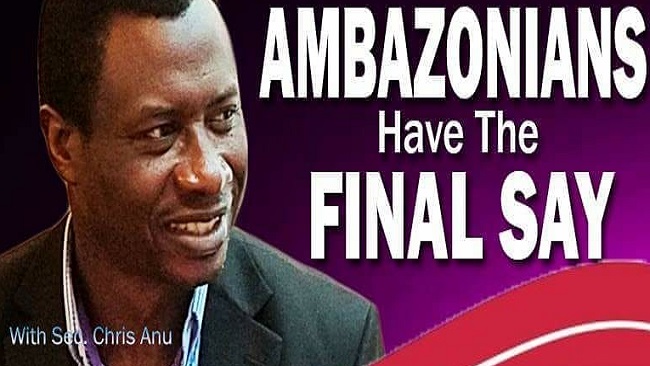
Ambazonia and the Nsalai Law Firm: Extending the frontiers of genocide
Cameroon Concord News and Cameroon Intelligence Report have seen an alleged complaint filed against Cameroon Concord Person of the Year Communication Secretary of the Ambazonian Interim Government (IG) Chris Anu by a front for the genocidal regime of French Cameroun so-called Nsalai Law Firm, of 3250 Wilshire Blvd Ste 1500 Los Angeles, CA 90010. The so-called complaint is nothing but another attempt by French Cameroun to extend the frontiers of its genocidal Campaign against Ambazonia and persons of Ambazonia origin residing in foreign countries based on their Ambazonia nationality, or ethnicity.
The determination by French Cameroun to extend the frontiers of its preplanned genocidal campaign was obvious from the abduction of the President of the Interim Government of the Federal Republic of Ambazonia His Excellency Sisiku Ayuk Tabe, members of the Interim Government followed by the abduction of 36 other Ambazonia refugees in Taraba state of Nigeria and 8 others in Calabar. Hundreds, perhaps thousands of others have died or massacred in cross-border attacks in their places of refuge in Nigeria. These cross-border massacres have been facilitated by a cartel of corrupt deal makers in the immediate intelligence and political entourage of President Mohammadu Buhari of Nigeria.
Cameroon Concord News Group can authoritatively assert with proof that Hon Chris Anu is targeted because of his ferocious opposition to the genocide, crimes against humanity, war crimes and international conspiracies by criminal networks to launder these crimes across international borders. By this act of blackmail, the Nsalai Law Firm has emerged as one of the kingpins of this international conspiracy. The action of the Nsalai Law Firm comes on the hills of repeated failed international warrants of arrests issued by Martin Mbarga Nguele, the Delegate General of National Security of French Cameroun for the arrest of Secretary Chris Anu and Southern Cameroons-Ambazonians who are standing between the criminal conduct of French Cameroun and the genocide of Ambazonians. The successful campaign against these international crimes led by Secretary Chris Anu and the international reaction is eliciting and has alarmed and overwhelmed the genocidal regime. The crime syndicate has awoken to the reality that at long last, its many criminal tentacles notwithstanding, its days of accountability for the impunity and international criminality are near, hence the desperate resort to blackmail using infantile antics and tactics such as the so-called complaint brought Nsalai Law Firm to a US congressman.
The so-called Law Firm pompously style “International Law Firm” whatever that means, is nothing but a sham, a fey man’s scheme intended to blackmail and distract the attention of Secretary Chris Anu, the Interim Government of the Federal Republic of Ambazonia and Ambazonians engaged in the struggle to defend the civilian population of Ambazonia, from defending and protecting the people of Ambazonia. Pursuing accountability by the criminal regime of French Cameroun for the impunity and criminality of its criminal conduct is a nightmare to the crime syndicate. The resort to blackmail through smear campaigners such as the Nsalai Law Firm, abductions, assassination plots and even corruption are desperate attempts to subvert the efforts by campaigners for self-defense, accountability and international justice and an end to impunity. Hon Chris Anu has distinguished himself as an advocate of true American values of fighting international criminality. Thanks to his efforts and that of many Southern Cameroons leaders and activists, the voices of the victims of genocide are being heard world-wide, in the parliaments of democratic countries such as the USA, Britain, Canada, Germany etc. For this purpose, only a demented lawyer can urge a Congressman to interfere with the constitutionally protected rights of a US victims’ rights advocate through blackmail that benefits the perpetrator of the crimes against which his campaign is targeting. This desperate attempt by Paul Biya and his crime syndicate to attain their target in the US and other parts of the civilized world through these dire failed tactics must fail.
The Nsalai Law Firm is retained for this blackmail with money stolen from the rape of the natural and petroleum resources of the Southern Cameroons- Ambazonia. Money obtained from the plunder of the resources of Ambazonia has been used to commit sordid crimes such as abductions and the blackmail and threats against Ambazonia activists residing in the USA and other countries. A close reading of the so-called complaint establishes that it is not meant to succeed or be acted upon. It is a scheme to justify further criminal activities by French Cameroun which the lobbyists it retained could not accept to carryout for fear of violating US law.
The so-called Nsalai Law Firm, as its address portray, is based in Los Angeles, California. What mandate does this so-called firm have apart from blackmail in requesting a congressman in New Hampshire to investigate one of his constituents for alleged federal crimes when the congress man is not a law enforcement agent? The complainant must have inherited the criminal mindset of his deceased father who as a member of the Biya crime syndicate spied on and betrayed Southern Cameroonians. Many were tracked down and detained or killed for agitating for their freedom from the grips of the genocidal regime. His father like his son in this action did not require legitimate law enforcement to satisfy his pecuniary interests through criminal services to his master and god Paul Biya. He used every means including blackmail, extra-judicial abductions, detentions and disappearances. Unfortunately for his adventurous son, he is in a different world where the rule of law is alive. The American Constitution stands as a shield against the actions of the crime syndicate through the Nsalai Law Firm and the lobbyists retained by Biya to propagate the blackmail hoping to shift the focus on the international crimes committed by Paul Biya which have been denounced by the USA and other Governments and International Organizations.
The quality of legal practice of this individual must be called to question even by laymen whom we are in law. Some years back, he brought a frivolous case against SONEL for unidentified clients in a California Court. That case was a scam on the public and some gullible people who believed that a US court in California could entertain such a frivolous litigation without jurisdiction. The case died off and no one has heard about it ever. This did not deter this law firm from bringing a similar frivolous law suit against Tapang Ivo in California where he does not reside and for alleged acts which were neither committed within the jurisdiction of the said court, nor against identifiable US citizens residing within the jurisdiction of the said court. The complaint against the Hon Chris Anu to a US congressman in New Hampshire by this law firm authorized to practice law in California warrants investigation of the law firm for competency to practice law at all.
It is an open secret known to the Hon US Congressman that the genocide, crimes against humanity, war crimes and multiple violations against Southern Cameroons have been subject of US Congressional hearings. Politicians, activists, experts and officials of the US State Department have testified before the US Congress about the monstrous violations committed by the genocidal regime of French Cameroun in and out of the territory of Ambazonia. The US Congressman to whom he filed his blackmailing complaint may have watched thousands of Ambazonians in the US take to the streets of Washington DC and New York to protest and appeal and ask for urgent US and UN intervention to halt the genocide and bring the perpetrators to account for their crimes. The Congressman may have listened to the UN Security Council debate urging French Cameroun to abate the crimes and for full accountability for their crimes. The UN Congressman may be aware of the towering and commendable effort made by the Hon Chris Anu, the Interim Government and multiple, individual and collective efforts by Ambazonians the world over and at home to defend the people against the genocide and to assist hundreds of thousands of refugees in neighbouring countries and internally displaced. He may have seen reports of hundreds of civilian settlements torched by French Cameroun soldiers and the use of chemical weapons to exterminate Southern Cameroons-Ambazonian citizens. He may have read reports of the rape of girls in the University of Buea, the use of rape as weapons of war to humiliate and dehumanize Southern Cameroons women and girls by Cameroun soldiers on the orders of their superiors. He must have learnt of the abduction, detention and forceful deportation of Americans of Southern Cameroons origin who arrived Cameroun with valid visas on the sole basis of their Southern Cameroons-Ambazonia citizenship or affinity.
The government of French Cameroun has not denied any of these crimes and indeed one of its generals Brigadier Melingui confessed that soldiers under his command torched civilian settlements on a widespread and systematic basis and rather than punish the soldiers, he was relieved of his command. Also, the Senior Divisional Officer for Manyu, one UM II signed a deportation order forcing hundreds of thousands of Ambazonia citizens from their ancestral lands to Nigeria and then ordered a systematic looting and torching of the civilian settlements. One George Tabetando boasted to an audience in Buea that he and Mafany Musonge approached Paul Biya to impose an internet ban in the territory of Ambazonia which lasted three months. Mafany Musonge denied his involvement in this criminal act. The US Congressman may have read reports of this internet ban of three months, the longest in the world. This criminal conduct which was facilitated by internet providers among them MTN which is listed in the New York Stock Exchange and thus subject to US law, was intended to conceal international media scrutiny of the elaborate crimes that are perpetrated by the genocidal regime of French Cameroun. The US Congressman may be aware that thousands of Southern Cameroons-Ambazonia citizens are abducted from their homes and carried to detention and concentration centres in French Cameroun and subjected to a Beti-Bulu ethnic constituted court-martial.
The efforts of Secretary Chris Anu in denouncing these crimes and mobilizing the civilized world to urgently intervene and to hold the criminals to account earned him the Cameroon Concord News Group Man of the Year Award. Cameroon Concord News and the Cameroon Intelligence Report stand by him against the smear campaign and blackmail by the crime syndicate this time using its front the Nsalai Law Firm. This blackmail must be countered by advocates of the international rule of law and all international victims’ organizations out to confront the ongoing genocide in the Southern Cameroons- Amabazonia. Cameroon Concord News Group calls on the California bar association to urgently conduct an investigation on the potentially unprofessional, unethical and criminal activities of this law firm and mete out the appropriate sanctions provided by the ethical code of conduct of the bar.
Cameroon Concord News Group strongly urge victims’ rights association worldwide to stand with the Ambazonia people. They should harken to the call by Hon Chris Anu, the Interim Government of Ambazonia, Ambazonia Rights Activists and all Ambazonians for the immediate and unconditional freedom of the President of the Interim Government of the Federal Republic of Ambazonia Sisiku Ayuk Tabe, members of the IG and thousands of Ambazonians held in captivity. They should support the call for the disbanding of the ethnically composed legal wing established to enforce the genocide so-called court-martial. The international community and victims’ rights organisations worldwide should strongly support the fight against genocide, impunity and international criminality committed by the government of French Cameroun against the territory and people of Ambazonia. This struggle must be fought and won and the criminal bands committing the genocide must vacate the territory of an independent and free Ambazonia. Cameroon Concord News Group once more congratulate Hon Secretary Chris Anu for winning the Cameroon Concord Person of the Year Award based on his distinguished efforts at alerting the conscience of the free world to the genocide in the Southern Cameroons-Ambazonia and his crusade for accountability and an end to impunity of French Cameroun.
By Soter Tarh Agbaw-Ebai
Chairman/Editor-in-Chief
‘Military deal with Sudan paves way for Russia to build base on Red Sea’
A senior Sudanese parliamentarian says a draft military deal with Russia on mutual navy port visits could pave the way for Moscow to build a permanent military base on the Red Sea coast.
Major General Al-Hadi Adam, the head of Sudan’s parliamentary defense committee, told Russia’s Sputnik news agency on Saturday that the agreement set the guidelines for the entry of Russian and Sudanese warships to the ports of the two countries, hailing it as a step towards establishing strategic relations.
“The date of the requested port call is being discussed. It will be approved if the two countries make an agreement. This deal will pave the way for more agreements and greater cooperation…possibly a Russian base on the Red Sea,” the official said.
Musa pointed out that several regional states had already allowed foreign countries to build military bases in their territories, adding that Sudan, just like those countries, reserved the right to allow Russia to establish a military base on its territory.
Last week, Russia’s legal information portal website reported that Prime Minister Dmitry Medvedev had approved the draft agreement on port calls with Sudan.
According to the draft agreement, “the entry of warships shall be made after notification has been given not later than seven working days prior to the scheduled date of entry.”
The draft document stressed that “within the framework of the Agreement, no more than seven warships can be present simultaneously, in the territorial sea, inland waters and ports of the receiving State.”
It does not, however, provide for the building of a military base in Sudan.
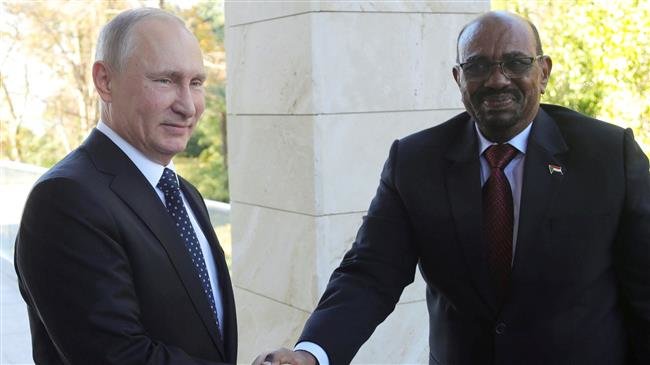
In November 2017, Sudanese President Omar al-Bashir met with his Russian counterpart, Vladimir Putin, in the Russian city of Sochi, where both leaders expressed their desire to enhance military ties.
During the visit to Russia, Bashir even offered to build an airbase for Russia on its Red Sea coast.

He also suggested re-equipping the Sudanese army with Russian-built airplanes and military arsenal including surface-to-air missiles.
The Sudanese president also asked Putin to help protect his country from the “aggressive” United States.
Russia is considered as a key ally of the Sudanese government against Western pressure.
Source: Presstv
Cameroon tops list for internet disruptions and holds the record for Africa’s longest internet shutdown
Autocratic leaders in Africa are increasingly relying on internet blackouts to silence young people who use social media to mobilise against post-colonial political structures across the continent.
Imagine being charged for every tweet or having no access to the internet for months on end. These are just some of the challenges that millions of young Africans face regularly.
Authoritarian leaders from every part of the continent have realised it is not enough to blacken TV screens or hand in headlines to the press anymore. They also need to shut down social media – where young people engage with the world and express anti-establishment views.
Berhan Taye, leading the #KeepItOn campaign from Access Now, an advocacy group which defends the digital rights of users, believes internet shutdowns are an extension of traditional censorship.
“With a few exceptions, many countries that shut down the internet restrict the free press and violate human rights,” Taye told TRT World, “So the internet and social media shutdowns are an extension of these traditional means of censorship.”
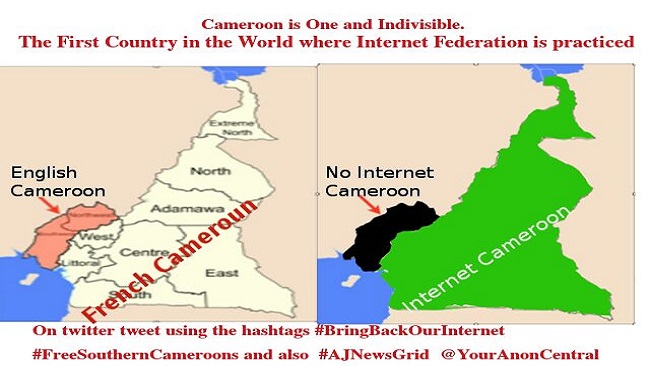
Cameroon tops the list for internet disruptions in Facebook’s 2018 Transparency report and holds the record for Africa’s longest internet shutdown. Following protests in the Anglophone southwest and northwest regions against systematic social, political and economic discrimination, the Francophone-dominated government either completely shut down, or significantly slowed down, the internet to silence dissidents.
To maintain his 37-year-old regime Cameroonian president Paul Biya shut down the internet for more than 40 weeks, intermittently, between January 2017 and June 2018.
“This is the first crisis in Cameroon wherein the internet has played a major role. The youths who mostly use the internet have raised awareness… brought the attention of the international community to the situation in Cameroon,” barrister Agbor Nkongho, President of the Centre for Human Rights and Democracy in Africa (CHRDA), told TRT World.
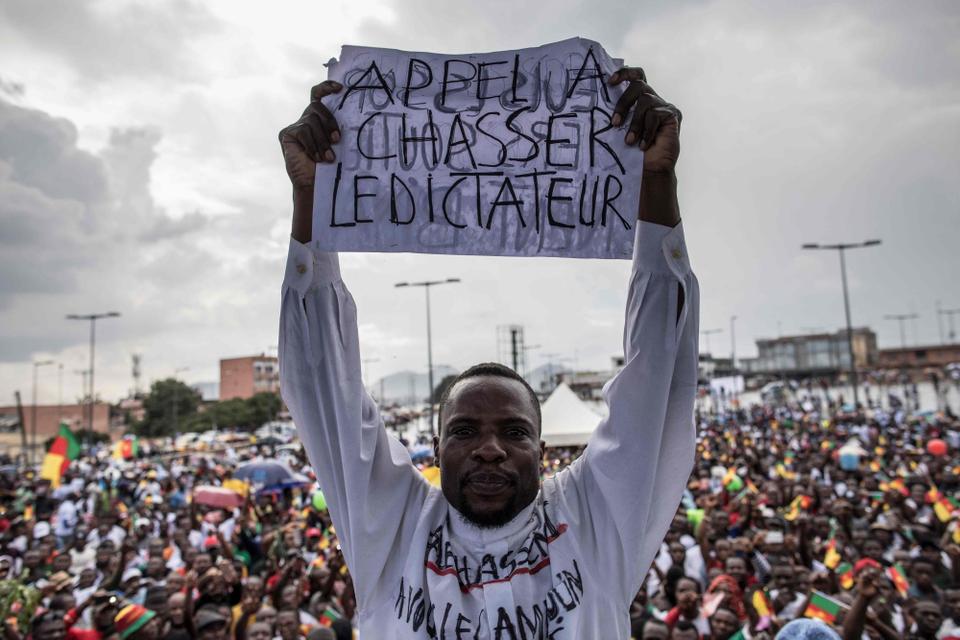
Recently in Sudan, when the rise in bread and fuel prices triggered nationwide protests across the country, 75-year-old Omar Al Bashir blocked access to popular social media platforms used to organise anti-government protests to protect his 29-year rule.
In a country where the state tightly controls traditional media, the internet has become a key information battleground for the Sudanese youth. Of Sudan’s 40 million people, some 13 million frequently use the internet and more than 28 million own mobile phones.
In the Democratic Republic of Congo, outgoing President Joseph Kabila—who delayed elections for two years to stay in power—has frequently used the shutdown of internet and SMS services as a tool to suppress anti-government protests.
Last May, Uganda implemented a tax on 58 different social media platforms, including WhatsApp, Twitter, Facebook and Skype. The tax is designed to charge Ugandans 200 shillings ($0.05) per day, a significant amount of money in a country where 25 percent of the population lives below the poverty line ($1.25 a day, or around 4,500 shillings).
The ban was the latest attempt by 74-year-old President Yoweri Museveni, who defended the tax saying “social media use is definitely a luxury item”.
But it backfired, and the backlash was fierce. Young Ugandans, who organised online under #NoSocialMediaTax and #ThisTaxMustGo hashtags, poured into the streets of the capital city Kampala to express their anger against the government. Following the public outcry, the government announced its decision to review the tax in July last year. People are currently still being charged the tax.
However, the social media tax controversy shed light on the deep clash of generations between the old authoritarian rulers and the younger generation.
Generational clash
Uganda is one of the youngest nations in the world, where 78 percent of its population is under 30. For most Ugandans, Museveni is the only president they’ve ever known. This vast group of young people, suffering from high unemployment and political exclusion, see a government that does not represent them nor understand the challenges they face.
As a result, instead of consuming traditional media, such as state-controlled TV or newspapers, they turn to the internet and social media to grow their businesses, get educated and informed about the latest trends, and express their frustration with the government.
The clash of generations in Uganda is a microcosm of what has been happening across the world’s youngest continent, where 60 percent of the population is under 25 years old.
Africa’s largest country, Nigeria, ruled by the 75-year-old Muhammadu Buhari, has a median age of just 18.4 years, while 84-year-old Paul Biya has been ruling Cameroon for 36 years, where the median age is 18.5 years old, meaning a gap of 65.5 years.
Tradition and technology is not a zero-sum game
Far from being understood and having their socio-economic struggles recognised by the state as a priority, young Africans raise their critical voices online and form anti-establishment political movements over the internet.
By demanding more comprehensive democratic reforms, inclusive economic models and quality education and infrastructure, they challenge old-fashioned, elite-controlled, post-colonial political systems in Sub-Saharan Africa.
Taye said: “In countries where censorship is extreme, the internet and social media have given many young people that are fighting injustice the ability to reach many people and rally folks for change.”
She continued: “Even though traditional media houses were heavily censored, many used social media to show the world the injustice perpetrated by federal and regional forces, and provide momentum when the movement was fading from the international press.”
The pop-star-turned-parliamentarian Bobi Wine raises his anti-establishment voice in the Ugandan parliament and his digital activism also has an enormous impact on young Ugandans.
Boniface Mwangi, a Kenyan human rights activist, rising from the digital world, has been a critical voice against police brutality and post-election violence in Kenya. In Nigeria, the collective youth movement #NotTooYoungToRun aims to change the age-dominated political scene and push for an inclusive political structure for young people.
Taye said: “Young activists… are the vanguards that are using social media to challenge the structures that have instilled fear, injustice, and poverty in the African continent. And they are a threat to the all that want to continue to perpetuate fear and injustice.”
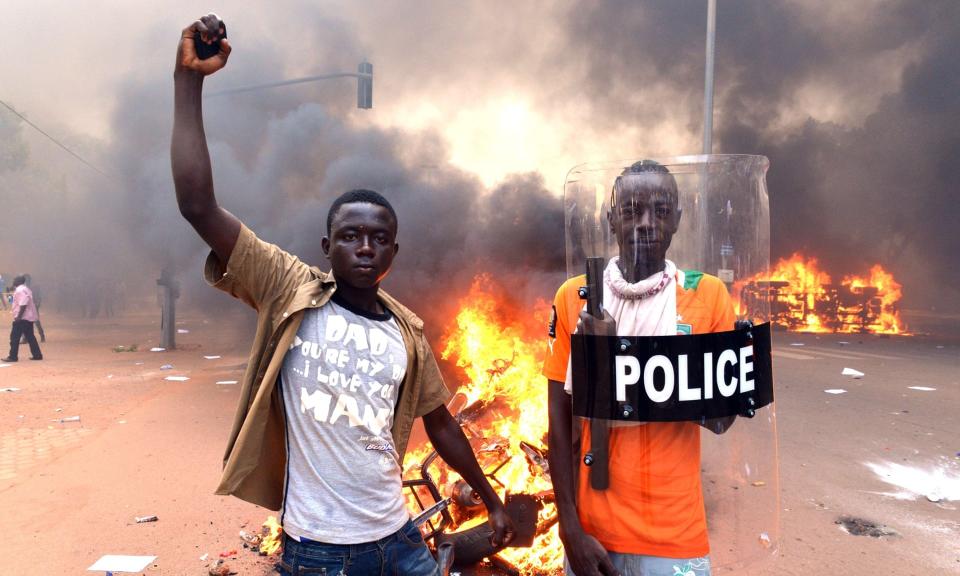
Many autocrats on the continent have witnessed what youth movements, which mobilise and organise on social media, are capable of. Their extensive use of the internet and frustration toward established political structures have brought considerable changes over the past years in West Africa.
When then-president of Burkina Faso, Blaise Compaore – who had ruled the country since 1987 – decided to run for the 2015 general elections, despite the constitutional two-term limit, no one could have guessed that his decision would trigger a massive protest movement that eventually led to the “Burkinabe Spring”.
Huge protests spread across the country and put an end to the 27 years of Compaore rule. Behind the nationwide protests that overthrew Compaore, lay a youth movement, Balai Citoyen (English: Citizens Broom), which was founded by a few musicians and grew through social media, driving thousands of young people to the streets.
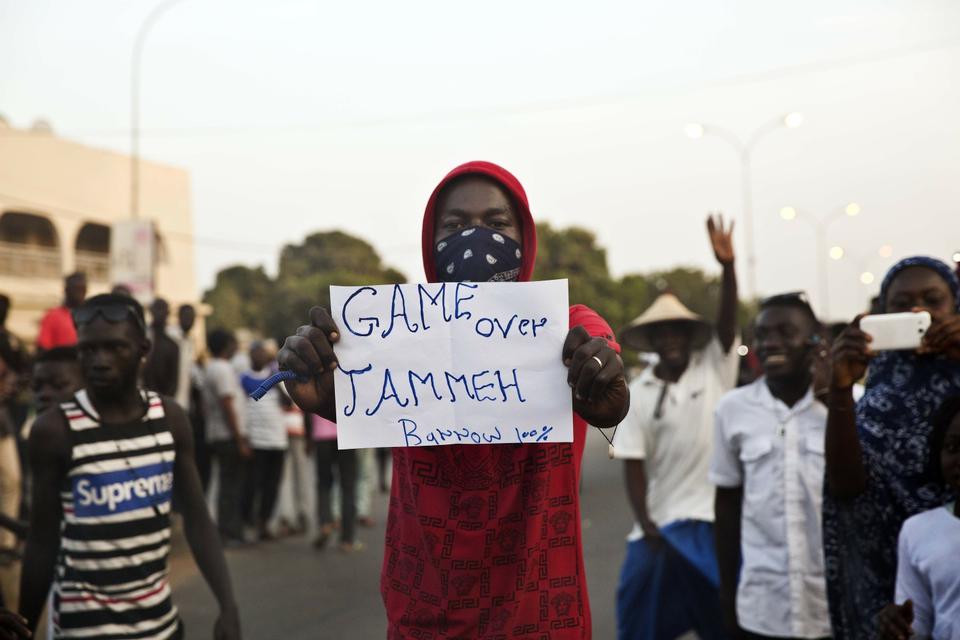
When Gambia ’s then-president Yahya Jammeh did not recognise election results and refused to hand over power in 2016, a hashtag campaign #GambiaHasDecided spread and brought regional and international attention to the brutal 22-year regime in the Gambia.
“Social media has forever changed the dynamics of politics in Africa,” said Raffie Diab, one of the founding leaders of the #GambiaHasDecided movement.
Leaders like Museveni strictly control and censor the internet in a bid to stop any possible opposition through social media. However, autocrats across the continent have seen that the strategy can backfire – and as the internet continues to empower African youth, leaders will need to find new strategies to win them over, or risk losing their grip on power.
Culled from Trtworld.com
Nigeria: President Buhari names new police chief
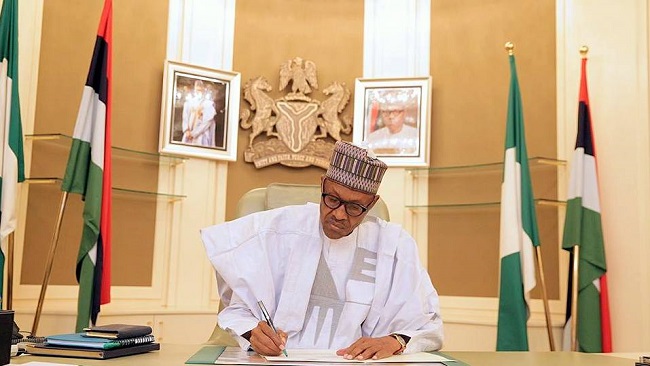
President Buhari has appointed an acting police chief for Nigeria, local media portals reported on Monday. Abubakar Adama until his appointment was the head of the National Institute for Policy and Strategic Studies (NIPSS).
His appointment as Acting Inspector General of police, A-IGP, comes in the wake of the retirement of his predecessor, Ibrahim Idris. Idris has attained the age of 60 and must therefore retire from service.
Idris assumed the role of police chief in mid-2016 after predecessor Solomon Arase left the post. At the time Idris was an Assistant IGP in charge of federal operations.
The new man in the seat is from northern Nasarawa State, a situation which will reinforce claims by critics that Buhari continues to appoint predominantly northerners to head the security sectors.
Nigerian police have a high reputation of being corrupt with successive administrations pledging to oversee an image clean up. The police also has the task of maintaining internal security in most states in the country.
Nigeria’s complicated security situation as a result of insurgency has led to the military undertaking security duties especially in the three northern states affected by the Boko Haram insurgency.
The police recently announced a big deployment of special forces meant to join the fight against terrorism. The police force will also be crucial for general elections slated for middle of February.
Source: Africa News
How Dr Kwameh Nkrumah’s 1959 visit proves that the one and indivisible Cameroon mantra is a hoax
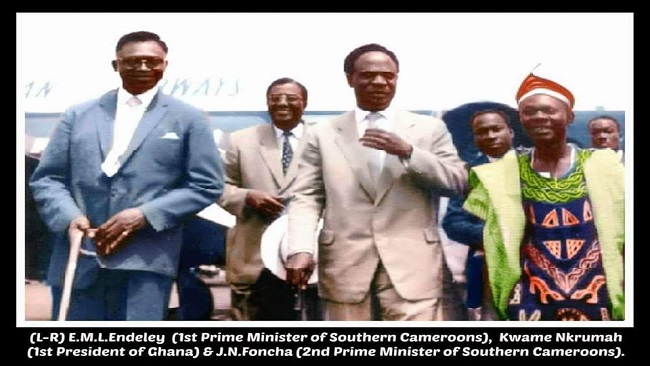
In 1959, at the invitation of the government of Southern Cameroons, Ghanaian President Kwameh Nkrumah visited Southern Cameroon and was welcome at the Tiko International airport by then out-going Premier, Dr. EML Endeley and the incoming Prime Minister-elect, JN Foncha, after the 1959 general election victory of the KNDP.
Dr Nkrumah left Tiko and flew back to Accra; he did not go to Yaounde or Dschang or Nkongsamba. CPDM regime sycophants and apologists of monolithic hangover can now see that the one, united and indivisible Cameroon mantra is a hoax.
Southern Cameroons was a country of its own, with all the appurtenances of a nation state – a government, its own police force, Parliament and a Senate called House of Chiefs. Southern Cameroons was never part of French Cameroun and Nkrumah’s visit proved this historic fact beyond reasonable doubt.
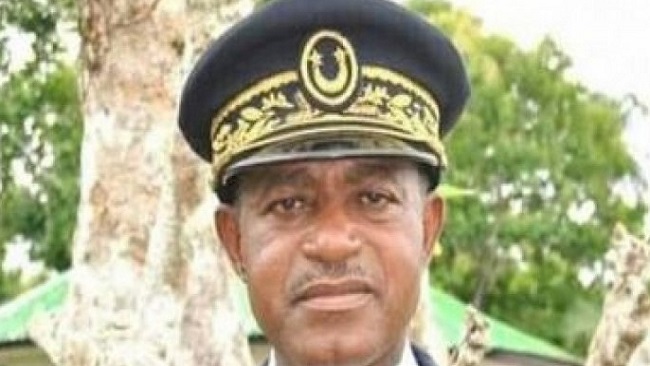
French Cameroun: SDO of Upper Plateau dies under mysterious circumstances
Bilonougou Felix the senior divisional officer for Upper Plateau Division in the West region is no more! The civil administrator passed away on Sunday night amid political tension in the region.
Awa Fonka Augustine, the governor of the West Region, confirmed the prefect’s death in a press release in which he stated that, “The Governor of the West region announces with regrets the death of the Prefect of the Upper Plateau Division; he died on Sunday, January 13, 2019 in Bafoussam.”
A lot of tongues have been waging ever since Governor Awa Fonka made public the news of the prefect’s demise. The governor’s press release did not provide any details of what killed the prefect who reportedly died near his command post. What we do know is that the prefect’s body has been kept in a private mortuary in Bafoussam, the chief city in the West region.
By Rita Akana