
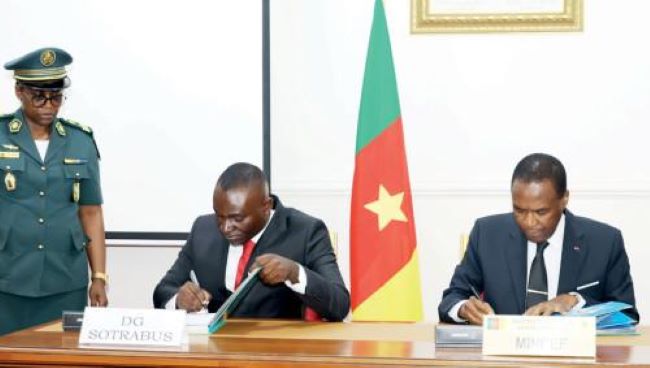
Biya regime signs defense agreements to expand local production and cut imports
The government of Cameroon has signed three agreements with national private sector partners to develop local manufacturing capacity in the defence sector, with projects covering armoured vehicles, ballistic protection equipment and mechanical spare parts. The deals were signed in Yaounde on April 8, under the authority of the Minister Delegate at the Presidency in charge of Defence, Joseph Beti Assomo, as part of efforts to strengthen strategic autonomy and reduce reliance on imports. According to authorities, the move aligns with the country’s industrialisation agenda under the National Development Strategy, NDS30, and reflects a policy shift towards import substitution in defence procurement.
Under the first agreement, Sotrabus, a company with established expertise in Cameroon’s automotive sector will convert new Toyota Land Cruiser single-cab vehicles into armoured combat vehicles fitted with integrated fighting equipment. Assembly will take place at the company’s base in Douala, with the converted vehicles deployed to support troop mobility across various operational theatres. The project is structured in four phases and is expected to be completed within 11 months.
The second agreement provides for the construction of a modern industrial facility dedicated to the production of ballistic protection equipment, including bullet-proof vests and helmets. The plant is expected to be completed within 24 months, with projected annual output reaching 25,000 vests from the third year of operation.
The third project involves the establishment of another factory, also within a 24-month timeline, focused on manufacturing mechanical spare parts for military vehicles. This is expected to improve technical availability and maintenance capacity through local production. All three projects incorporate provisions for technology transfer to personnel of the Ministry of Defence, while the industrial complexes will include multiple specialised production units across different stages of manufacturing.
The Minister Delegate at the Presidency in charge of Defence highlighted the strategic importance of the agreements, linking them to broader national objectives.
“We are laying the foundations of a national defence industry built on public-private partnership. These projects are significant building blocks in the progressive construction of our strategic and industrial autonomy. We are not merely signing documents; we are laying the stones of our country’s industrial sovereignty,” Beti Assomo stated in his address.
He also called on stakeholders to ensure effective implementation.
“I urge all parties involved to demonstrate determination, rigour and professionalism to guarantee the full success of these agreements,” Beti Assomo added.
The agreements come amid evolving security challenges and global supply uncertainties, which have increased the importance of domestic production capabilities in defence. By prioritising local firms over competing offers from Europe and Asia, the government is reinforcing national preference in strategic sectors.
The initiative builds on earlier projects, including the inauguration of the Central Workshop for Army and Gendarmerie Clothing in Ekounou in September 2025, and ongoing construction of a military footwear factory. Collectively, these investments indicate a broader effort to develop an integrated defence industrial base, with potential implications for job creation, skills development and reduced foreign exchange outflows linked to defence imports.
Source: Business in Cameroon


