
Monthly Archives: February 2019

Ambazonia refugees in Nigeria: Beware of French Cameroun death squads
Cameroon Concord News Group has received a reliable intelligence briefing that French Cameroun has deployed members of its Special Operations Forces to Nigeria to infiltrate, abduct and massacre some Ambazonian refugees. These operatives have been deployed to states with high concentration of Ambazonia refugees. In some cases, they will cause chaos within the camps and then kill some refugees for the blame to be placed on some Ambazonians within the refugee communities, inviting the Nigeria Police. Some of these operatives have taken up different forms of identities and profiles to deceive the unsuspecting refugee population to gain their confidence and integrate them into their communities. The refugees are therefore advised to establish internal vetting mechanisms to fish out and denounce these criminal elements before they cause harm to them.
The Special Operational Forces is a secretive armed unit within the Presidency of French Cameroun which was created by Paul Biya on ascending power. The unit had a mandate to disengage from and replace the secretive operational units that through terror, sustained Ahidjo in power for twenty-two years. The Biya Special Operational Unit has sustained him in power for thirty-seven years so far.
This unit has a mandate to eliminate political opponents, real or perceived enemies of Paul Biya. Paul Biya has relied on these official terrorist operatives, to eliminate, massacred or disappear thousands of people with impunity. The victims included persons from all walks of life; among whom were members of the clergy.
The gullibility of some members of the Cameroun Catholic clergy made them supporters and allies of Paul Biya. Some of the victims were beneficiaries of the regime but also preferential preys. Professing Christ and serving the Devil placed them on a collision course with the faithful. The assassination of clergy men and women from Jeanne Irene Biya’s Reverend Sisters confidantes to the Catholic Bishop of Bafia, Bishop Balla, was blamed on this unit. The regime has never disputed these accusations nor accounted for the assassinations. Instead, the assassinations are continuing unabated. The escape to Canada, of Martin Belinga who oversaw the special operations on behalf of Paul Biya has not affected the unit nor its mandate. The regime has a large deployment of operatives of the Directorate of External Research to infiltrate, spy and eliminate Ambazonians in the diaspora in different countries. These professional assassins sent to harass, abduct and kill Ambazonia refugees must be promptly identified and arrested before they inflict further harm on Ambazonia refugees.
The mandate of this terror operative network was widened from when Paul Biya declared war and embarked on a genocide of Ambazonians. Some of the most egregious violations, massacres, rapes, abductions and disappearances that occurred during the internet ban were committed by members of this special unit deployed with other criminal actors in the army, BIR, the gendarmerie and the police. By himself and through his surrogates, Paul Biya personally laid out the elaborate plan of the genocide, war crimes and crimes against humanity in Ambazonia and neighbouring countries. The cutting of the internet supply to the territory and the imposition of an economic blockade to facilitate the genocide of Ambazonia were announced by the Minister of Post and Telecommunications one Pauline Likeng. One member of the CPDM crime syndicate publicly took credit for the imposition of this elaborate plan of systemic criminality and genocide. George Tabetando boasted in a widely publicised interview over CRTV that he and Mafany Musonge appealed to Paul Biya to impose the internet ban. Mafany Musonge promptly denied his participation in this criminal scheme. Through apologists and the executioners of the genocide such as Owona Nguini, Enoh Meyomesse, Theodore Obama of Television 4, CRTV, Isa Tchiroma, Laurent Esso, Fame Ndongo, AtangaNji, Ekema Patrick, Beti Assomo, Okalia Bikai, Lele L’Afrique, Rene Sadi, Pauline Likeng, among many others, the world now has a gruesome record of an unfolding genocide engulfing the Gulf of Guinea.
French Cameroun General Melingui confessed publicly that Ambazonia civilians and civilian settlements were targeted for attacks by forces under his command. Last week Rene Sadi, the Government Spokesman of French Cameroun issued a press release again reiterating the same confession. He stated that French Cameroun forces burn locations housing Ambazonia separatists. Separatists is rotational name Paul Biya has given Ambazonia self-defence forces, doubling down from terrorists. The confession by Rene Sadi was another official policy of French Cameroun of the elaborate and extensive burning of close to two hundred Ambazonian civilian settlements, burning to death the inhabitants. This confession finally came to clarify French Cameroun’s targeting and burning hospitals because they believed Ambazonia fighters were admitted in those hospitals to undergo medical treatment.
Coupled with a deliberate policy of targeting Ambazonia civilians, children, women and men for murder based on their Ambazonia nationality, the deployment to Nigeria of a death squad to pursue the genocide, calls for an immediate international response to abate the genocide and hold Paul Biya and his genocidal gang of terrorists to account. Cameroon Concord News Group calls on Nigeria to respect international law and its treaty obligations by providing adequate security to Ambazonia refugees and civilians lawfully in Nigeria under the protection of international law.
By Soter Tarh Agbaw-Ebai
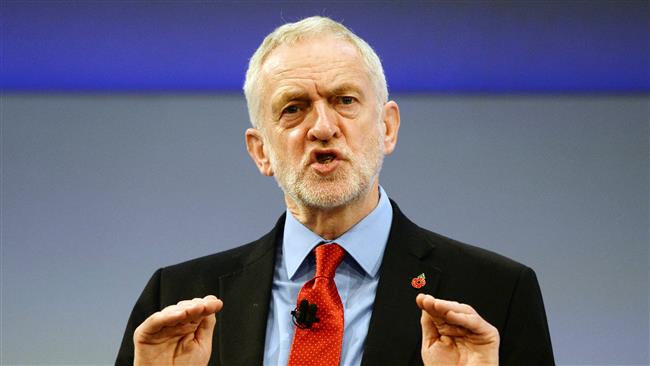
UK: Labour Party to push for second Brexit referendum
Britain’s main opposition Labour Party has announced that it will push for a second Brexit referendum if its demands are not met in parliament.
“If parliament rejects our plan, then Labour will deliver on the promise we made at our annual conference and support a public vote,” Labour’s Brexit spokesman Keir Starmer announced on Twitter on Monday.
The Labour Party has said it will be putting forward an amendment calling on the government to adopt its Brexit proposals, which push for close alignment with the European Union’s single market and specifically seek a permanent customs union with the bloc.
Labour also seeks to force UK Prime Minister Theresa May to delay Brexit beyond the scheduled exit date of March 29 by extending the Article 50 negotiating period.
Labour leader Jeremy Corbyn’s office announced on Monday that the opposition leader was due to tell a meeting of his lawmakers that the party “will do everything in our power to prevent no deal”.
“We are committed to also putting forward or supporting an amendment in favor of a public vote to prevent a damaging Tory (Conservative) Brexit being forced on the country,” Corbyn was due to announce in the meeting.
Lawmakers in the House of Commons rejected May’s deal with the EU on January 15 and forced her to gain concessions from Brussels that could make the agreement acceptable to the chamber.
However, the EU has hardly budged on its position, insisting that a controversial mechanism to ensure there would be no border on the island of Ireland after Brexit would not change.
Earlier in the day, European Council President Donald Tusk suggested that delaying Brexit would be a “rational solution”, claiming that there is no majority in the British parliament to approve a divorce deal.
Speaking at a press conference on Monday, May, nonetheless, stressed that Britain will under no circumstances delay the planned departure,
“An extension to article 50, a delay in this process, doesn’t deliver a decision in parliament, it doesn’t deliver a deal,” May said, adding that “it’s within our grasp to leave with a deal on 29 March and that’s where all of my energies are going to be focused.”
On Sunday, May announced that the final parliament vote on the deal will be delayed until March 12, only little more than two weeks before the Brexit deadline.
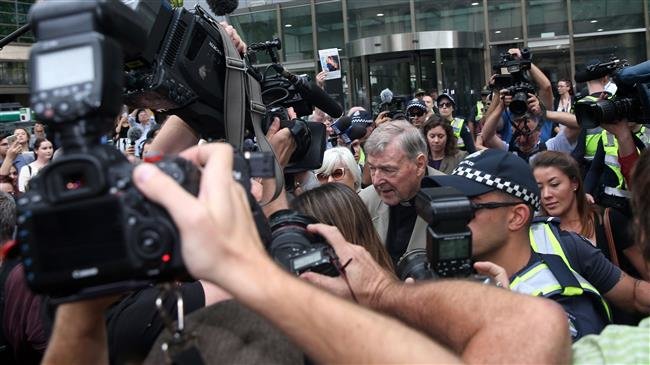
Senior Catholic cardinal convicted of abuse in Australia
Disgraced Australian Cardinal George Pell — the third-most senior Catholic Church official in the world — has been convicted of child sex abuse.
A jury in Melbourne in December last year found Pell guilty of abusing two boys — aged 12 and 13 — in the rooms of Saint Patrick’s Cathedral in the city in 1996.
The verdict could not be reported until now due to a gag order imposed on the case.
A statement from George Pell’s only living victim. The other died some years ago.
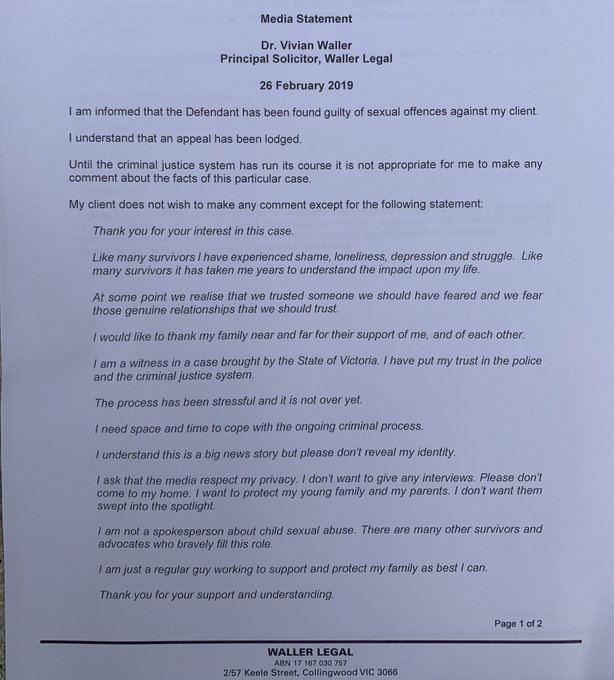
The cardinal, who is free on bail, had pleaded not guilty.
The cardinal, formerly one of the closest advisors to Pope Francis, is due to face sentencing hearings from Wednesday.
Just two days after the unreported verdict in December, Pell and two other cardinals were removed from the Pope’s council of advisors.
The pontiff had previously praised Pell for his honesty and response to child sexual abuse. He has not yet reacted to the verdict.
The Roman Catholic Church has been hit by numerous scandals in the past few years, involving allegations of covering up the sexual abuse of children by priests to protect pedophiles and the reputation of the Church.
Pope Francis himself came under fire last year for not responding decisively to the Church’s sex abuse crisis after it was revealed that children, mostly boys, were being abused by clergymen in their congregations across the world.
He summoned key bishops from around the world to a summit held earlier at the Vatican to discuss the issue and find a solution to protect children from sexual abuse in the Church.
Approximately 6,900 US Roman Catholic priests were accused of sexual abuse with at least 16,900 young victims between 1950 and 2011, according to data from the US Conference of Catholic Bishops.
Presstv
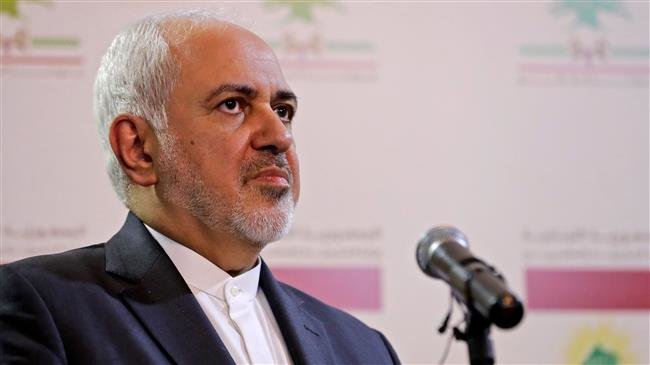
Iran: Foreign Minister Zarif announces resignation on Instagram
Iranian Foreign Minister Mohammad Javad Zarif, who was the lead negotiator in the 2015 nuclear deal, announced his resignation on Instagram on Monday, which can only take effect once President Hassan Rouhani accepts it.
“I apologise for my inability to continue serving and for all the shortcomings during my term in office,” Zarif said in a message posted on his verified Instagram account. Zarif thanked Iranians and “respected officials” for their support “in the last 67 months”.
The resignation of Iran’s top diplomat was confirmed by an informed source, however Rouhani’s chief of staff strongly denied reports that the president had accepted Zarif’s resignation in a tweet.
The resignations happened hours after a surprise visit by Syrian President Bashar Al-Assad to Tehran. However, according to the semi-official ISNA News Agency, Zarif was not present at any of Assad’s meetings with Iran’s supreme leader Ayatollah Ali Khamanei and Rouhani.
Prominent members of parliaments immediately called for Rouhani not to accept the resignation.
“Undoubtedly the Iranian people, government and state will not benefit from this resignation,” said Mostafa Kavakebian, a reformist MP. “A great majority of MPs demand that the president never accept this resignation,” he said in a tweet.
The head of parliament’s influential national security and foreign policy commission told ISNA how a planned trip to Geneva with Zarif on Monday afternoon had been cancelled at the last minute with no explanation.
Under pressure
“I suddenly got a text message saying the trip has been cancelled,” Heshmatollah Falahatpisheh told ISNA, adding that this was not the first time Zarif had resigned but “that he has done so publicly this time means that he wants the president to accept it this time.”
Zarif, 59, has served as Rouhani’s foreign minister since August 2013 and has been under constant pressure and criticism by hardliners who opposed his policy of détente with the west. His standing within Iran’s political establishment took a hit when the US withdrew from the nuclear deal in May 2018 and the deal’s achievements became less and less clear as Iran’s economy nosedived.
Zarif was blamed by ultra-conservatives for negotiating a bad deal that had not gained anything meaningful for Iran for all the concessions it had made in its nuclear program. The faceoff between the minister and his critics only intensified as time passed, with Zarif saying his main worry throughout the nuclear talks had been from pressure from inside Iran.
“We were more worried by the daggers that were struck from behind than the negotiations,” he told a local newspaper on February 2. “The other side never managed to wear me down during the negotiations… but internal pressure wore me down both during and after the talks,” he said.
The latest point of contention between Zarif and hardliners was the implementation of the Financial Action Task Force’s requirements regarding money laundering in Iran. The rift on the issue pitched the government and the parliament against supervisory councils.
On Sunday, ISNA reported that Zarif had warned the Expediency Council, an arbitration body tasked with solving such impasses, that it should “understand the consequences of its decision.” He was immediately attacked by the ultra-conservatives who deemed what Zarif had said as a threat.
(AFP)
Southern Cameroons Crisis: UN agencies are recruiting in Buea and Bamenda
As the United Nations continues to mobilize resources to get its staff on the ground in Southern Cameroons, it is also looking to employ many local staff who will have to play a huge role in its humanitarian work. According to an inside source, United Nations bodies are already on the ground and their international staff are also in the region to lay the groundwork for its activities.
The number of international staff is gradually increasing as hostilities and targeted killings decline. The global body already has offices in Buea and Bamenda, but their office in Buea is more active and there are recruitments currently taking place. The UN office in the Southwest is an uncompleted building located in the Southwest regional capital of Buea and it is believed that the office will require more than 50 local staff, with thousands to be deployed in various towns to deliver humanitarian assistance to those who need it the most.
Our source, who elected anonymity, said that people with a solid background in conflict management and resolution will surely get recruited, as the global body needs their skills. He added that those with a background in law and mediation should also send in their CVs as their knowledge will come in handy.
He also said that even UN staff will require a lot of local labour. Drivers, security guards, cooks, domestic workers and others. It is estimated that the United Nations presence in the two regions will result in the creation of more than 4,000 indirect jobs. As the regions stabilize, so too will reconstruction and rehabilitation take off in the two regions. War has never been a good thing. It comes with a lot of pain and suffering. However, it also has its own beauty. Post-war reconstruction is usually a boom time for local businesses and it offers great opportunities for those with the right skills and experience, our source said.
He stressed that bodies like UNICEF will surely need people with child protection, counselling and education skills which are the skills UNICEF needs to achieve its goals in the two regions. He also pointed out that for these organization’s achievements and efforts to be known, it will also require communication specialists and journalists.
“It would like the world to know that it is achieving results on the ground and this will imply having people to tell its story in the best possible way. This is where journalists and communications officers come into play. The UN is a global body and its resource mobilization programs will only be successful when donors understand that it is achieving results. Since it uses many language, it will also want those stories to be translated into the various languages it uses. This will imply hiring translators, and within the organization, we know Cameroon has a huge and professional crop of translators, especially as it has a good translation school in Buea. This may be a good time for people living in and around the two English-speaking regions,” he said.
“Our salaries are not bad. The UN will surely be paying in dollars and earning USD 3,000 in a town like Buea or Bamenda will surely not be a bad deal for those with the right skills set. I hope people in the two regions with the right skills will do their best to get a place within the UN. This is the time to help those in need. There is a lot of work to be done in the regions. Many people are in pain and they need counseling. Many are homeless and are even living far away from home. They need to be stabilized and possibly sent back to their homes. The United Nations has also achieved a lot in this regard in other conflict zones and will be using that experience to stabilize the North West and South West regions of the country,” he pointed out.
It should, however, be stressed that the UN’s job for now is not about peacekeeping, but strictly humanitarian. The global body is still in talks with the government of Cameroon for it to expand its role, especially with regard to peace-building and peace-keeping.
Though the government is still very wary of the UN, its collapsing finances and greater international pressure mean that it may waver in its opposition to the deployment of troops in the two English-speaking regions of the country.
Meanwhile, the fighting in the two regions is reducing, making it easy for the UN to carry out limited humanitarian work. Though government forces are still targeting young males in the region, sources on the ground indicate that the killings are gradually reducing, although the burning of homes by government forces has continued on a large scale.
It should also be pointed out that a report by the global body released on January 31, 2019, has slammed the government and armed groups in the country’s two English-speaking regions for the deteriorating humanitarian situation in the two regions. Produced in collaboration with humanitarian partners, the United Nations Office for the Coordination of Humanitarian Affairs (https://www.unocha.org/) report states that the global body is seeking US$ 15.2 million to start humanitarian operations in the Northwest and Southwest regions.
“As of 7 January, donors had provided 35 per cent of the US$15.2 million required as per the emergency response plan, according to the Financial Tracking Service (FTS). This amount constitutes the $5.1 million CERF allocation under the rapid response window. Additional contributions were received by other donors but not yet reported on FTS,” the report underscores.
The reports points out that the socio-political issues in and concerning the two English-speaking regions of the country have been a matter of contention throughout the post-colonial period. Political protests against perceived marginalization intensified in 2016 and in late 2017 violence erupted in North-West and South-West regions prompting violent clampdowns by security forces. With the increased deployment of defense forces and proliferation of non-state armed groups, the crisis has increasingly become characterized as one of armed conflict. Increased insecurity, violence and consequent widespread injury and civilian loss of life have forced thousands of families to flee their homes. Displacement continues to have serious consequences on the livelihoods and living conditions of the affected populations, the report says.
It stresses that “vulnerability has been further compounded by lack of access to farmland, by deterioration in medical and water facilities and limited access to education for children due to a violently enforced ban on schooling called for by armed groups.”
The report also points out that “little political progress has been made to resolve the conflict. The ‘Anglophone General Conference’ had been set to discuss the crisis on 21 November 2018 however it was postponed with no new date yet to be announced. Efforts continue at regional and national level and with the diaspora. The stay-home ‘Ghost Town’ protest continues to be observed every Monday across the two regions. There were heightened tensions on the 10th of January as the second day of the trial of the ex-leadership of the opposition movement was held in Yaounde. Numerous incidences of violence took place across the region. In some areas, particularly the Buea-Kumba axis, an effective ghost-town was observed between Monday 7th and Thursday 10th. The trial was adjourned until the 7th of February.
The global body is also concerned about the country’s political situation. “Escalating tensions in Francophone Cameroon including protests in Douala and Yaounde included the Anglophone Crisis in their discourse. Maurice Kamto leader of the main opposition party, the MRC, was arrested on 30 January in connection with these tensions. Tensions increased as the month of February approached with the stated intention of some armed groups to declare a ‘lockdown’ for the month which would prohibit movement similar to ‘Ghost Town’ Mondays. This was subsequently reduced to a ten-day period from 4th to 14th during which significant days for the opposition forces would fall. Namely the trial of the leadership, National Youth Day and the anniversary of the plebiscite which joined Southern Cameroons and Cameroon.
Regarding insecurity, the UN stresses that “Insecurity in the affected regions remains high, with continuing armed attacks and confrontations between the military and armed groups. The crisis further worsened from mid-2018 onward due to increased hostilities ahead of the presidential election. Movements continue to be restricted in the two regions due to a curfew in the North-West, a “No Movement” declaration by non-state actors and the increase of both official and informal checkpoints.”
“In the South West, on 3 January CDC workers of the Rubber Plantation in Tiko, Fako Division while at work were attacked by Non-state armed men (NSAG). They were tortured, and their toes and fingers cut off for working in the Plantation against the policy of armed groups. In January, troops clashed with armed groups across the two regions with ensuing fatalities and destroyed properties and vehicles. Military operations increased in both regions to counter armed group plans for February ‘lockdown’. Preventive displacement and stockpiling was ongoing at the time of writing of this report. Declining security situation during the month is expected,” the report says.
Hostilities have continued to claim civilian lives, from indirect fire and from disturbing reports of targeted killings. Urban attacks have resulted in deaths from cross-fire and civilian casualties have been reported as a result of raids on villages. In late January, large scale military operations were launched in the Bafut area resulting in numerous casualties for both combatants and civilians. On 25 January, the military killed 11 people they suspected of being armed separatists in Mpundu-Balong in the Southwest region. Incidents were also reported taking place in Marumba and Tiko amongst others. Abductions continue to be an ongoing concern.
The violence has uprooted 437,500 people from their homes and forced over 32,000 to seek refuge in neighbouring Nigeria. Humanitarian organizations are striving to scale-up their presence in the conflict-hit regions. Shelters, NFI and Education have been identified in the North-West and South-West regions as the most urgent needs. Almost 50 per cent of the displaced have settled in rural areas and have an increased need for shelter and non-food items. More than 80% of girls and boys no longer have access to schooling on a continuous basis because of the crisis, the report says.
The outlook for 2019 is one of emergency response as displacement continues due to the ongoing conflict. Vulnerability is compounded as services deteriorate and resilience is eroded. Access remains challenging as poor levels of understanding of humanitarian action persist and infrastructure is damaged in armed conflict related operations to deny mobility to opposing forces. Armed fighting and insecurity continue to be the principal impediment to the provision of assistance as well as a barrier to those in need in terms of reaching areas where they can receive aid, the report says.
The majority of those displaced are women and children. Protection is the principal humanitarian concern as the ongoing conflict is the main cause of human suffering. Food and shelter are also of concern as displacement continues apace. Needs across all sectors are high and are being further compounded as the conflict deepens. Of particular concern is access to water for areas requiring water transportation during days when movement is limited. Many of the conflict-affected populations are growing more vulnerable as the violence persists and humanitarian assistance remains inadequate, the report stresses.
The deployment of humanitarian actors to the field continues. A further allocation of CERF to Cameroon will in part support humanitarian activities in the North-West and South-West regions. As of 7 January, donors had provided 35 per cent of the US$15.2 million required as per the emergency response plan, according to the Financial Tracking Service (FTS). This amount constitutes the US$5.1 million CERF allocation under the rapid response window. Additional contributions were received by other donors but have not yet reported on FTS.
By Kingsley Betek in Yaounde
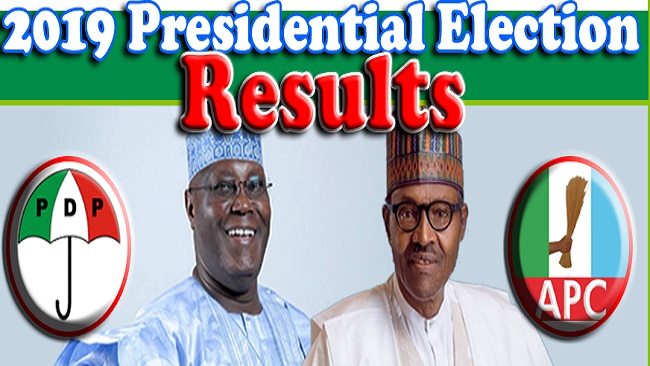
Nigeria: Election ‘too close to call’ as contenders tussle
Official results from the Presidential and National Assembly elections across Nigeria, announced by the Independent National Electoral Commission (INEC), has started coming in from different wards and Local Government Areas (LGAs) in the country, with most Nigerians anxiously waiting to know who is winning.
Naija News reports that INEC commenced the Presidential and National Assembly elections at exactly 8 am on Saturday, February 23, amidst tight security. Nigerians voted from a list of seventy-two (72) Presidential candidates and 6,584 National Assembly candidates.
Ninety-one (91) political parties are participating in the 2019 general elections, however, some would not be fielding candidate for the position of the president, while others endorsed candidates of the PDP and APC. According to the figures recently released by INEC, there are currently 84,004,084 registered voters compared to 67,422,005 in the 2015 elections.
In the build-up to the elections, Incumbent President Muhammadu Buhari of the All Progressives Congress (APC), Nigeria’s ruling party and Atiku Abubakar of the Peoples Democratic Party (PDP), Nigeria’s main opposition party, have popped up clearly as top contenders for the office of the president.
We understand that Atiku is winning in some part of the country. Buhari is winning also in some places where elections took place. Cameroon Concord News Group will publish the official Presidential and National Assembly election results as announced by INEC, the only body recognised by law to declare election result in the Federal Republic of Nigeria.
Spain: Catalonians protest Spanish king’s visit to Barcelona
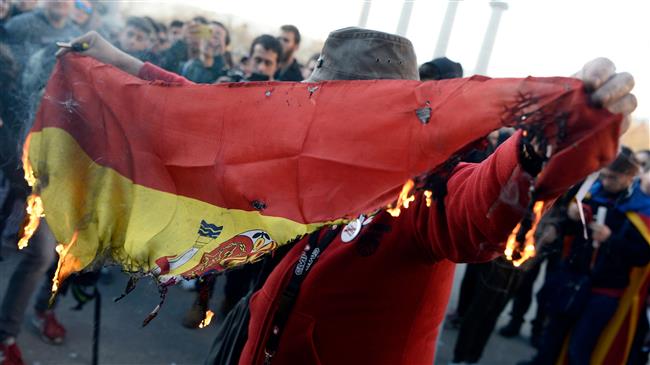
Hundreds of pro-independence Catalonians took to the streets in Barcelona on Sunday in protest of Spanish King Felipe VI during his visit to the Mobile World Congress.

Protesters rallied in front of the National Art Museum of Catalonia, with some burning Spanish flags and images of the monarch.
King Felipe became a polarizing figure in Spain when he called separatist leaders ‘irresponsible’ on the eve of the 2017 Catalan independence referendum.
Presstv
Cameroon Slowly Moving To A War Zone
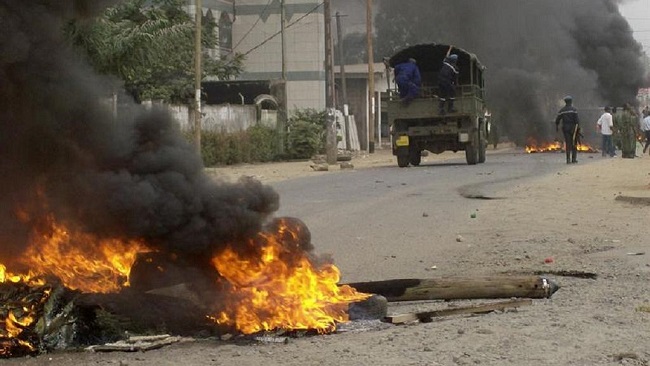
In recent years, Cameroon – a peaceful country in Central Africa ruled by President Paul Biya – has transitioned from a tranquil harbor to a site of horror. The Cameroonian army has been battling with Boko Haram militants on the northern border alongside security forces from Nigeria, Niger, and Chad. The conflict has registered over 20,000 dead and 2.4 million people displaced. The former French colony has also been struggling with a secessionist uprising in the English- speaking Northwest and Southwest Regions since 2016, with hundreds of deaths over the course of the confrontation. Furthermore, clashes with rebels from the Central African Republic in Bertoua and a very tense political atmosphere have plunged the country into an unending crisis.
Many of these crises are attributed to the unlawful arrest of Professor Maurice Kamto, the main opposition leader in Cameroon, after his organization of peaceful protests in the towns of Douala and Yaoundé on 28 January, 2019. Kamto was arrested at the home of a leading supporter, Albert Dzongang, before Dzongang and other supporters such as Christian Penda Ekoka, Alain Fogue, and Celetine Djamen were also arrested for participating in the organization of these peaceful protests.
It was clear from the evidence Kamto brought forward to the Constitutional Council before the announcement of the winner of the 2018 presidential election in Cameroon that Paul Biya supporters affected the results of the election in favour of his party, the ruling Cameroon People Democratic Movement (CPDM).
While protests went viral in Cameroon under Kanto’s leadership of the Movement for the Rebirth of Cameron (MRC), some fifty protesters opposed to Biya broke into the country’s Paris embassy, vandalizing portraits of him. The demonstrators filmed themselves invading the empty offices in the French Capital’s 16th district around 7: 00 PM on Saturday, broadcasting the protest live on Facebook. However, French law enforcement agents forced them out of the building and onto the street two hours later, where they continued their protest outside the embassy. Daniel Essissima, one of the protesters, stated: “The Cameroon administrators are taking Cameroonians for idiots… …They cannot bring people to rock-bottom like this. In the anglophone regions the army is killing people; in Douala, they are firing with real bullets.”
Because the attack on the Cameroonian Embassy in Paris took place on the same day as the protest organized in Cameroon, the Cameroonian authorities have since linked both demonstrations without providing any proof of this conclusion. Kamto vehemently denies these claims, separating himself from any violent attack perpetrated at Cameroon’s diplomatic mission abroad.
Following Kamto’s arrest, around 300 people gathered outside Dzongang’s house, and on Saturday 117 people were arrested during protest marches in several towns. Kamto has continued to claim he was the rightful winner of last October’s presidential election, which saw veteran leader Paul Biya win a seventh consecutive presidential term. The MRC has blasted this election as an “electoral hold-up.” Paul Biya has been ruling Cameroon since 1982 with the support of the army, government administrations, and the CPDM.
International Condemnation of Kamto’s Arrest
Last month, human rights groups condemned Kamto’s arrest and called for his immediate release, orders which fell on deaf ears. The European Union this month accused Cameroon of a “disproportionate use of force” in dispersing the protests. “Finding a solution to the challenges faced by the country can only be achieved through dialogue in a calm and inclusive atmosphere where fundamental rights and the rule of law are respected,” stated EU spokesman Maja Kocijancic. Amnesty International said the arrest of Kamto and his staff “signals an escalating crackdown on opposition leaders, human rights defenders and activists in Cameroon.” Amnesty International’s West and Central Africa director Samira Daoud claimed that “instead of taking steps towards improving the country’s human rights record, we are witnessing the authorities becoming less and less tolerant of criticism. This must stop.”
Professor Kamto Post-Arrest
After being taken to the Groupement Special d’Opération (GSO) in Yaoundé, Kamto appeared before judges in the Military tribunal on Friday 1 February, 2019 and charges against him were made known to the public. Kamto is being charged with insurrection, hostility against the fatherland, group rebellion, and public disorder. Just last week, Kamto and fellow party members Albert Dzongang, Clestine Djamen, Christian Penda Ekoka, and Paul Eric Kingue were all transferred to the Principal Prison in Kondengui while investigations are ongoing. This action by the government goes a long way to instill fear and repression in the heart of any group that wants to take to the street for any type of demonstration. Minister Atangana Nji in the Ministry of Territorial Administration and Decentralization threatened to withdraw the MRC’s party licence, while Minister of Communication Rene Emmanuel said that because Kamto protest disrupted public order and perpetrated various assaults he will face the court’s judgement.
It is very clear that after President Biya and his supporters fixed the election in their favour it will be difficult for the people of Cameroon to express their dissatisfaction, even when their fundamental human rights have been violated by the present administration. The only means by which the Cameroonian people can express gross dissatisfaction, through peaceful streets protests dubbed “white marches,” has been taken away from them and led to unending new forms of crisis.
Source: Organisation For World Peace
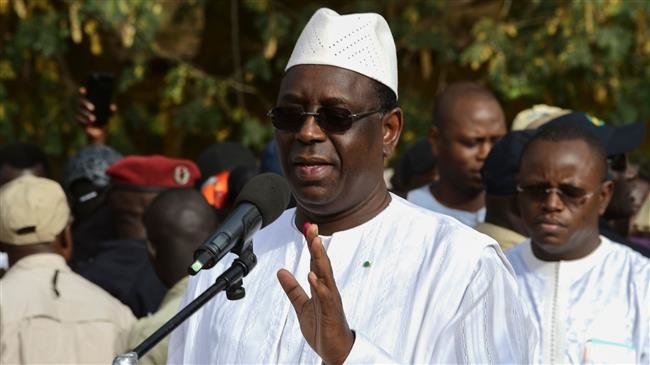
Senegal president’s camp claims re-election, opposition objects
Senegal’s prime minister has claimed that President Macky Sall was re-elected in a first round vote on Sunday, hours after the opposition suggested that no candidate had won an outright majority.
Prime Minister Mahammed Boun Abdallah Dionne, a Sall ally, claimed at midnight that president had won 13 out of 14 regions with “at least 57 percent” of the vote.
“The results allow us to say that we should congratulate President Macky Sall on his re-election,” he said.
Opposition candidates Ousmane Sonko and Idrissa Seck had said that a second round of voting was possible based on preliminary results.
“At the current state of the vote count, no candidate, I say no candidate, including myself, can claim to have won the presidential election,” Sonko said.

Sall had been favored to win the election on the back of strong economic growth. The 57-year-old had pledged to introduce universal health care and expand education in the West African country.
However, critics have accused Sall of sidelining political opponents.
His strongest rivals, Khalifa Sall and Abdoulaye Wade, were banned from running in the presidential race after being accused of corruption. Both have dismissed the charges as politically motivated.
Senegal has been considered the most stable democracy in the region since it became independent in 1960.
Official results are due by Friday at the latest. If no candidate wins outright, a second round of voting is scheduled to take place on March 24.
Presstv