
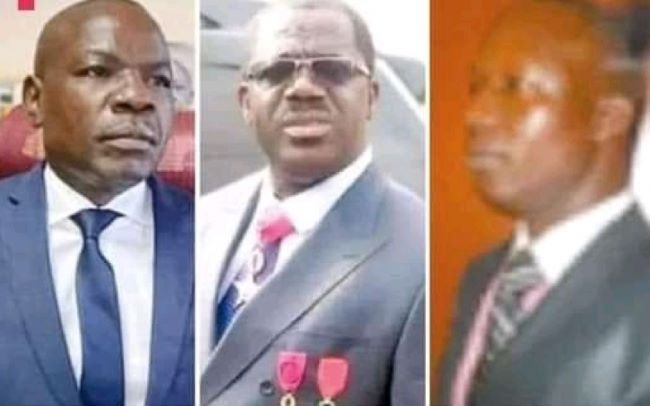
Revealed: Colonel Danwe admits ordering Martinez Zogo operation
Lieutenant Colonel Justin Danwe has acknowledged that he led the operation against journalist Martinez Zogo and gave orders to the men involved, but he denies ordering his death. His defense also maintains that Danwe himself received instructions from higher levels within Cameroon’s external intelligence service, the DGRE.
That position was again presented before the Yaoundé Military Court on September 14, 2026, during the continued examination of Colonel Jean-Pierre Otoulou.
According to Jacques Mbuny, Danwe’s lawyer, the former director of operations at the Directorate General for External Research (DGRE) “fully accepted responsibility, in light of the mission assigned to his men.”
The defense therefore does not dispute that the men involved in the operation acted under Danwe’s authority. It draws a distinction, however, between the violence allegedly ordered against Zogo and the journalist’s death. At the same time, it seeks to establish whether responsibility for the operation extended further up the DGRE chain of command.
“As their superior, he said that his men acted under his orders,” Mbuny said. “Just as he gives orders as a superior and director of operations, he also receives orders.”
The case now centers partly on two separate questions: how far Danwe’s instructions to the commando went and from whom he says he received his own orders.
Danwe Denies Ordering Martinez Zogo’s Death
On the first question, Danwe’s defense has maintained its position that the operation was not intended to kill the journalist. “There was one part that he never accepted responsibility for,” Mbuny said. “Even his men have consistently stated that there was never any question […] of taking the life of the late Martinez Zogo.”
Under the defense’s account, the mission called for violence against Zogo, but some members of the group exceeded the instructions they had received. The court must weigh that argument against the circumstances of the journalist’s death and determine the individual responsibility of the commando members.
The defense has cited statements that some participants made during the investigation. Ebo’o Clément, identified in the case as one of the members of the group assigned to the “treatment” of Zogo, had described a mission to “rough him up” and inflict injuries.
Those statements do not resolve the central legal questions. The court must determine who ordered the violence, whether the acts that caused Zogo’s death fell within the original instructions and what criminal responsibility each defendant bears. No verdict has been issued.
Danwe Points to the DGRE Chain of Command
Danwe’s defense also argues that the operation was not his initiative alone and seeks to place it within the DGRE’s broader chain of command.
According to Mbuny, his client maintains that the operation was prepared within the intelligence service and that senior officials could not have been unaware of it. “He is also demanding […] that those above him accept their responsibilities,” the lawyer said.
During his exchange with Colonel Jean-Pierre Otoulou, Danwe said he had received an order for an operation against Zogo before his December 29, 2022 meeting with businessman Jean-Pierre Amougou Belinga.
That timeline forms an important part of his defense. It supports his argument that the decision to conduct an operation against Zogo preceded the meeting and did not originate from an initiative taken on that occasion.
Danwe also maintains that his superiors knew about the operation. Lawyers for Léopold Maxime Eko Eko, then director general of the DGRE and also a defendant in the case, dispute that account.
Mbuny has also cited testimony about where the operation was allegedly prepared. According to the lawyer, Otoulou indicated that the planning took place in the DGRE operations directorate’s “situation room.”
Danwe’s defense argues that the room was under video surveillance and that footage could be accessed from the director general’s office. His lawyers cite this point to challenge the idea that such an operation could have been planned inside the DGRE without senior officials’ knowledge.
That remains a defense argument, and the court must assess it alongside other testimony and evidence in the case.
Calvin Job, a lawyer for Zogo’s family, takes a different view of the testimony presented during the hearings. He argues that statements from commando members support the civil party’s position that the operation had been organized in advance rather than carried out as an improvised or isolated initiative.
According to Job, testimony before the court supports the view that the operation was “planned” and “organized.” The parties continue to disagree over what the evidence establishes about Eko Eko and other officials implicated in the case. The Yaoundé Military Court has yet to determine the criminal responsibility of each defendant.
Otoulou’s examination, which has extended across several hearings, has therefore brought the chain of command to the center of the proceedings. Beyond identifying those who physically participated in the operation against Zogo, the court must determine who authorized it, who knew about it and what instructions were given to those who carried it out.
Source: Sbbc


