
Biya’s hand: a source of glory and shame
President Paul Biya’s return to Cameroon after more than two months abroad should have been a moment of reassurance. Instead, it has once again placed the question of presidential visibility at the centre of public debate.
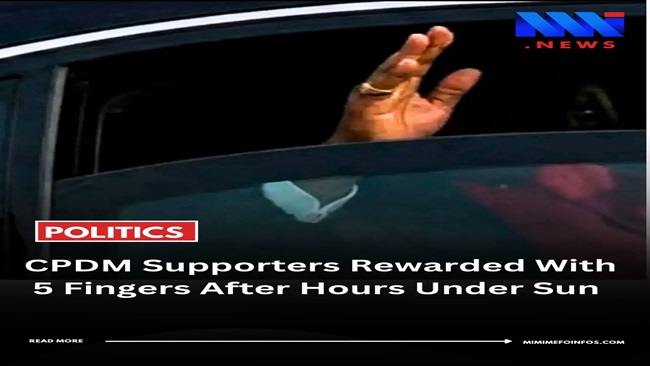
At Yaoundé-Nsimalen International Airport, Cameroonians were not given the familiar image of a president stepping out before the cameras, greeting the nation and demonstrating that he was firmly in command. Television images instead showed the presidential convoy leaving the airport, while a hand was briefly seen waving from inside the vehicle believed to be carrying the 93-year-old president.
That Biya’s hand has become more than a hand. It has become a symbol. For Biya’s supporters, the gesture can be read as a sign of resilience: the hand of a president who, despite his age and long absences, has returned to the country and continues to exercise the authority of the state. His subsequent reception of the Cameroon female national football team at the State House reinforced the message that he remains present and engaged in the affairs of the nation.
But for many Cameroonians, the same hand evokes an uncomfortable question: why must the country repeatedly search for evidence of its president’s presence?
A presidential hand waving through a car window may appear harmless, even reassuring. Yet when such a gesture becomes the clearest public image of a head of state, it also exposes the deeper problem of presidential communication. A country of nearly 30 million people deserves more than glimpses and speculation. It deserves clarity.
The hand is therefore both a source of glory and shame.
It is a source of glory because it represents survival, endurance and the remarkable longevity of a political career. Few leaders anywhere have occupied the presidency for as long as Biya has. To his admirers, his continued presence is evidence of political strength and stability.
But it is also a source of shame because it symbolises the extraordinary distance that has developed between the presidency and the people. When citizens must scrutinise television footage to determine whether their president is physically present and well, something has gone fundamentally wrong with the relationship between public office and public accountability.
The issue is not whether President Biya waved his hand. The issue is why that hand has been left to carry such an enormous political burden.
A modern presidency cannot be reduced to rumours, convoys, carefully controlled images and fleeting gestures. Leadership requires visibility, communication and confidence-building. Citizens should not have to interpret a movement of the hand as a political message.
Biya’s return should therefore be an opportunity for more than ceremony. It should be an opportunity to restore transparency around the presidency and to demonstrate, unmistakably, that the head of state is capable of communicating directly with the nation.
The hand that waved from inside that vehicle may have been intended as a simple greeting. Yet it has become a mirror reflecting Cameroon itself: proud of its endurance, but uneasy about its leadership; respectful of the office, but hungry for openness.
For nearly four decades, Paul Biya’s presidency has shaped modern Cameroon. His latest return should not merely answer the question of whether he is back. It should provoke a larger question: what kind of presidency does Cameroon want to see going forward? The answer cannot be found in a waving hand alone.
That hand may still command glory. But after so many years, it also carries the weight of shame.
By Soter Tarh Agbaw-Ebai


