
Martinez Zogo Trial: New lead prosecutor at a critical stage
The Martinez Zogo trial was not at a standstill on the day André Éric Atemengue Omgba was appointed. On Aug. 31, 2026, at the Yaoundé Military Court, Col. Jean-Pierre Otoulou, one of the investigators involved from the early stages of the case, continued his testimony under questioning from the defense. That same day, a presidential decree appointed Lt. Col. Atemengue Omgba as government commissioner at the court, effectively placing him at the head of the military prosecutor’s office.
Nothing in the official decree links the two events. Their timing nevertheless underscores the significance of the position Atemengue Omgba has inherited: he takes charge of the prosecution while one of the most sensitive judicial cases in Cameroon’s recent history remains before the court.
A second presidential decree signed the same day sets out what happens to his predecessor. Cerlin Belinga was not transferred to another prosecutor’s office. He was appointed vice president of the Maroua Military Court and, concurrently, an investigating judge. He therefore moves from the prosecution to the bench.
The presidential decrees provide no explanation for the reshuffle. The absence of an official reason leaves room for two interpretations. One is that the presidency wants to reassert control over a prosecutor’s office weakened by controversies that emerged during recent hearings. The other is that the appointments are simply part of an administrative reshuffle within the military justice system. No publicly available evidence currently makes it possible to determine which interpretation is correct.
From the Air Force to military justice
Atemengue Omgba is not a civilian magistrate who later joined the military establishment. His career developed in the opposite direction.
According to biographical information gathered by the author from former colleagues, he began as an Air Force officer and trained at Cameroon’s Combined Services Military Academy, known by its French acronym EMIA. He is believed to belong to the same graduating class as Cerlin Belinga, the man he now replaces.
The two officers later pursued careers in military justice. Lists of candidates who passed the preliminary and final stages of the 2015 entrance examination for Cameroon’s National School of Administration and Magistracy (ENAM), reviewed by SBBC, identify Atemengue Omgba André Éric in Cycle A of the Magistracy and Court Registry Division. That route is open to officers put forward by the Ministry of Defense for training as military magistrates.
Information gathered about the beginning of his judicial career places him first in Yaoundé as a deputy government commissioner, a position equivalent to a deputy military prosecutor. At the time, he shared an office with Cerlin Belinga.
Atemengue Omgba was subsequently assigned to Douala, where he served as an investigating judge. Those stages of his career do not appear in appointment decrees available online and are based on professional accounts collected for this profile.
The first publicly available administrative record of his career dates to Dec. 13, 2023. Atemengue Omgba, then a major serving as a military magistrate, was appointed government commissioner at the Buea Military Court. According to the same career information, he had been promoted to major in 2020 after previously holding the rank of captain.
That appointment came 12 days after confusion surrounding an order attributed to investigating judge Florent Aimé Sikati II Kamwo.
The document, made public on Dec. 1, 2023, ordered the release of businessman Jean-Pierre Amougou Belinga and Léopold Maxime Eko Eko. The judge subsequently disputed the document’s authenticity, and both men remained in detention. The Dec. 13 decree also appointed Pierrot Narcisse Nzie as the new investigating judge in Yaoundé.
The proximity of the dates placed Atemengue Omgba’s arrival in Buea within a broader reorganization of the military justice system. It does not, however, establish that his appointment was a direct response to the controversy over the release order.
Fourteen months later, on Feb. 21, 2025, he took charge of the military prosecutor’s office in Ebolowa. By the end of August 2026, the decree transferring him to Yaoundé identified him as a lieutenant colonel.
In less than three years, Atemengue Omgba has therefore headed three military prosecutor’s offices. Little about his working style has emerged publicly from the courts where he has served. One colleague describes him as “a self-assured man, bordering on arrogant.”
That assessment is necessarily subjective and says more about his internal reputation than it does about how he will conduct himself in court. In the Martinez Zogo case, where exchanges among magistrates, lawyers, witnesses and defendants are regularly tense, his self-confidence will quickly be tested.
The powers of a military prosecutor
The title “government commissioner” can be misleading. It does not refer to a political representative attached to the court. The government commissioner is the head of the military prosecutor’s office.
Under Cameroon’s Dec. 29, 2008, law governing the organization of military justice, once criminal proceedings have been initiated, the government commissioner has the same powers as a public prosecutor. The law also states that the commissioner acts under the authority of the minister responsible for military justice.
At the trial stage, his responsibilities include presenting the prosecution’s position, questioning witnesses, responding to arguments from the parties and making submissions on behalf of the prosecution.
Atemengue Omgba therefore does not enter the Martinez Zogo case as a judge, nor does he arrive as an investigator tasked with starting the case over. He inherits proceedings in which the investigation has already been completed, a prosecution strategy is already in place and dozens of witness statements have already been examined in court.
That position is particularly delicate because the case remains subject to conflicting interpretations. Each piece of evidence, expert assessment and statement has become the subject of competing arguments among prosecutors, civil parties and defense lawyers.
A trial underway since March 2024
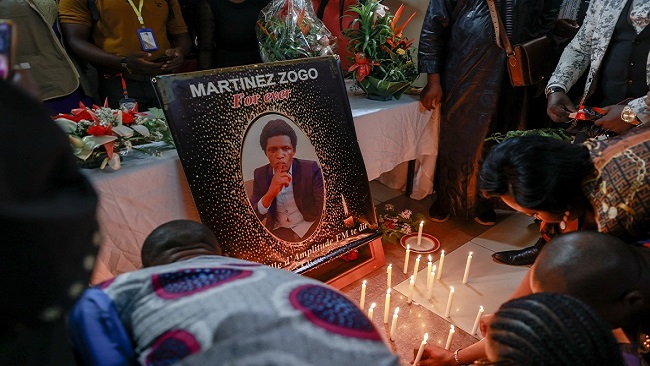
Martinez Zogo, the station manager of Amplitude FM radio, was abducted on Jan. 17, 2023. His body was discovered five days later on the outskirts of Yaoundé.
The judicial investigation was closed on Feb. 29, 2024, according to court documents reviewed by the Committee to Protect Journalists.
The trial opened on March 25, 2024, with 17 defendants. They include Jean-Pierre Amougou Belinga; Léopold Maxime Eko Eko, the former director-general of Cameroon’s General Directorate for External Research; and Justin Danwe, the intelligence agency’s former director of operations. All remain presumed innocent until a final court ruling.
Nearly two and a half years after the first hearing, the court is still examining prosecution witnesses. In June 2026, proceedings focused on a digital forensic examination conducted by Georges Bell Bitjoka, including the review of phones, messages and files recovered from several devices. Subsequent hearings centered on Col. Otoulou and the circumstances under which the preliminary investigation was conducted.
On Aug. 31 and Sept. 1, his cross-examination continued to focus on the seizure of phones, geolocation data and the evidentiary value of information gathered during the investigation.
It is at this stage that Atemengue Omgba enters the case. He inherits a prosecution that has already been built but continues to face challenges from defense lawyers over how evidence was collected and interpreted.
A prosecution already under scrutiny
During hearings in June, the prosecution’s handling of the case had drawn criticism, particularly during the cross-examination of Georges Bell Bitjoka.
Cerlin Belinga questioned the expert about communications between Justin Danwe and Modeste Mopa Fatoing, the former director-general of taxes. Some lawyers representing Martinez Zogo’s beneficiaries challenged that line of questioning. They argued that it risked shifting the focus of the prosecution away from Jean-Pierre Amougou Belinga and toward Modeste Mopa Fatoing. Attorney Félicité Zeifman, in particular, criticized that interpretation of the expert report.
Belinga responded that “the presumption of innocence applies to everyone” and that he was seeking “the truth, both for and against” the defendants, according to the same account of the proceedings.
The prosecution also questioned the methods used by Col. Otoulou, who had coordinated part of the initial investigation. Lawyers for the civil parties interpreted those questions as an attempt to undermine the findings of the preliminary investigation. They could also reflect the prosecution’s responsibility to test the strength of the evidence presented to the court.
It is against this backdrop that speculation has emerged that the presidency appointed Atemengue Omgba to “set things straight” and make the prosecution’s case more coherent.
The timing makes that interpretation possible, but it does not prove it. No decree, official statement or public comment gives the new government commissioner such a mandate.
His appointment nevertheless opens a period of scrutiny. Atemengue Omgba will have to decide whether to maintain the approach taken by Cerlin Belinga or adopt a different way of conducting questioning and presenting the prosecution’s submissions.
Until now, Atemengue Omgba’s career could largely be traced through presidential decrees and the recollections of former colleagues. In Yaoundé, his profile will now take shape in the courtroom.
Culled from Sbbc


