
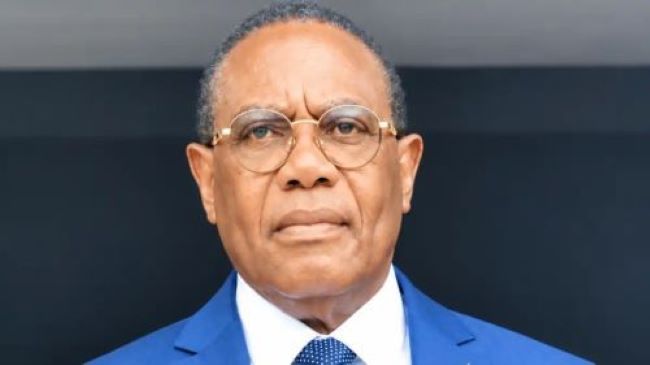
Biya appoints new Constitutional Council Chief ahead of 2027 elections
President Paul Biya appointed Rémy Nama as president of the Constitutional Council on October 16, 2026, filling a vacancy left by the death of Clément Atangana 12 days earlier. Under two decrees signed that day, Biya appointed Nama and Abdoullaye Daouda to the council before naming Nama its president. He becomes only the second person to lead the institution since it began operating in February 2018.
A senior magistrate trained at École nationale d’administration et de magistrature (ENAM), Cameroon’s national school for public administration and judicial training, Nama began his career as a deputy public prosecutor in Bertoua. He later served as a judge in Garoua before moving to the Ministry of Justice, where he headed the department responsible for enforcing criminal sentences.
Nama subsequently joined the presidency, where he spent more than three decades, first as an attaché and later as a special adviser in the General Secretariat. He represented the presidency on the boards of several public institutions, including Parc national de matériel de génie civil (Matgenie), a state-owned civil engineering equipment agency.
He succeeds Clément Atangana, who died in Paris on October 4, 2026. Atangana had chaired the Constitutional Council since it formally began operations in February 2018.
The second appointment fills the seat left vacant by the death of Bah Oumarou Sanda on August 7, 2026. Abdoullaye Daouda, a former deputy secretary-general of the National Assembly, had been selected by the speaker of the assembly after consultation with its Bureau.
The appointment procedure is governed by Article 51 of Cameroon’s Constitution. Of the Constitutional Council’s 11 members, three are selected by the speaker of the National Assembly after consultation with the Bureau. When a member dies, the same appointing authority selects a replacement to serve the remainder of the predecessor’s term.
Constitutional Council Returns to Full Strength Ahead of Parliamentary Elections
The two appointments restore the Constitutional Council to its full membership of 11, just months before Cameroon’s next parliamentary elections.
The council plays a direct role in those elections. It rules on disputes over candidate eligibility and challenges filed after voting. It is responsible for announcing the parliamentary election results within 20 days of polls closing.
Municipal elections follow a different procedure, with electoral disputes handled by administrative courts rather than the Constitutional Council.
The electoral calendar now leaves a relatively narrow window for holding parliamentary and municipal elections on the same day, as Cameroon did in February 2020.
The terms of members of the National Assembly have been extended until December 20, 2026. Under the Constitution, when parliamentary terms are extended, elections for a new assembly must take place no earlier than 40 days and no later than 120 days after the extended term expires. That places the parliamentary elections between January 29 and April 19, 2027.
The terms of municipal councilors elected in February 2020 were extended until February 28, 2027, under a decree issued on May 4, 2026. The Electoral Code requires municipal elections to be held no later than 20 days before the expiration of their terms, making February 8, 2027, the latest permissible date.
If parliamentary and municipal elections are again held together, and the existing legal provisions remain unchanged, only two Sundays fall within both electoral windows: January 31 and February 7, 2027.
The Electoral Code requires at least 90 days between the publication of the decree convening voters and election day. A January 31 vote would therefore require the decree to be issued by November 2, 2026. For a February 7 election, the deadline would be November 9.
No decree convening voters had been published by October 18. With the appointments of Rémy Nama and Abdoullaye Daouda, however, the Constitutional Council has regained its full 11-member composition ahead of any electoral disputes arising from the upcoming parliamentary elections.
Source: Sbbc


