
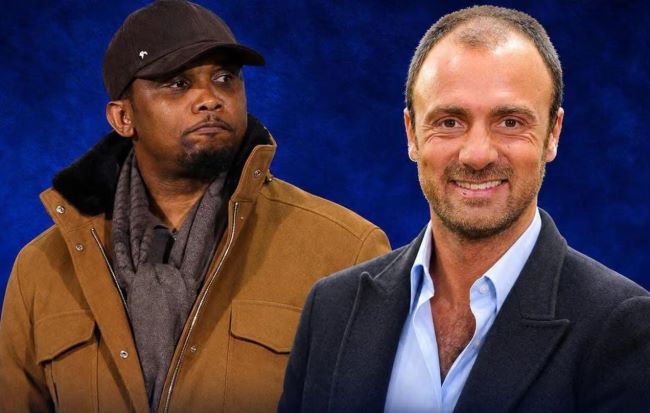
Football: Eto’o criticizes Christophe Dugarry and demands a public apology
Relations between Samuel Eto’o and French sports commentators appear far from amicable. After Daniel Riolo, it is now Christophe Dugarry who is facing criticism from the president of the Cameroon Football Federation (Fecafoot). The former Cameroonian international reacted strongly to the French commentator’s remarks about the Confederation of African Football (CAF) and the distribution of FIFA funding. In a message posted on his social media, he was particularly scathing.
Eto’o questioned the legitimacy of the former 1998 World Cup winner to speak on football governance issues. “Being a good player doesn’t automatically give you the legitimacy to talk about football better than others, let alone to understand football politics,” he stated.
The head of Fecafoot then clarified the distribution of FIFA funding, stating that the 211 member federations of the world governing body will receive the same amount. He accused Christophe Dugarry of relaying information he considers erroneous. “As stupidity sometimes has the peculiarity of persisting, I regret to inform you that the 211 FIFA member federations will receive the same sum, including the European federations,” he wrote.
The former FC Barcelona striker went even further, demanding a public apology from the French pundit. He believes the latter should acknowledge his mistakes and be honest about the information disseminated regarding CAF. “If you have any dignity left, just like those who deliberately spread false information about CAF, you should have the honesty to apologize,” he insisted.
Samuel Eto’o also took issue with Christophe Dugarry’s portrayal of his close relationship with CAF President Patrice Motsepe. “Please refrain from presenting President Motsepe as your friend. You operate in different worlds and your responsibilities are not comparable,” he concluded.
This latest attack by the president of Fecafoot reignites tensions between African football leaders and certain French pundits. It also brings back to the forefront issues of CAF governance, global football funding, and the role of media observers in discussions.
Source: seneweb


