Biya Orders Release of Maurice Kamto
Cameroon President Paul Biya has ordered the release of opposition leader Maurice Kamto, who was detained in January for organizing demonstrations in the central African nation.
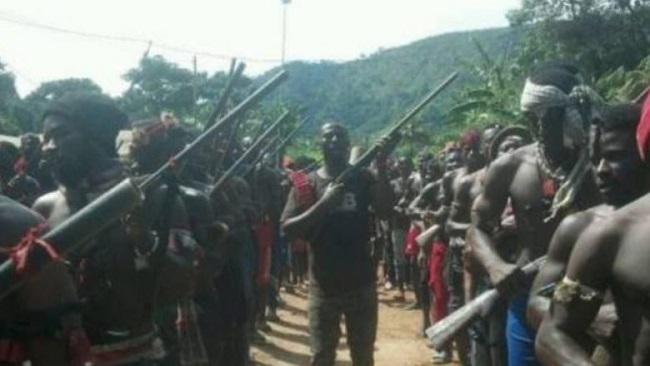
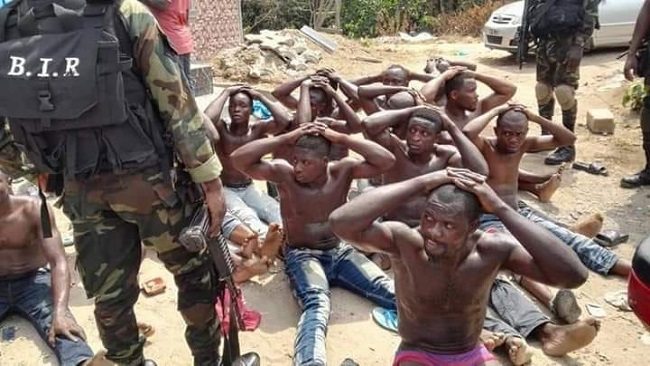
Representatives of the Southern Cameroons Interim Government in Ground Zero said the release of more than 300 fighters ordered by French Cameroun President Paul Biya is not enough to stop the war that has killed at least 2,000 people in the central African state.
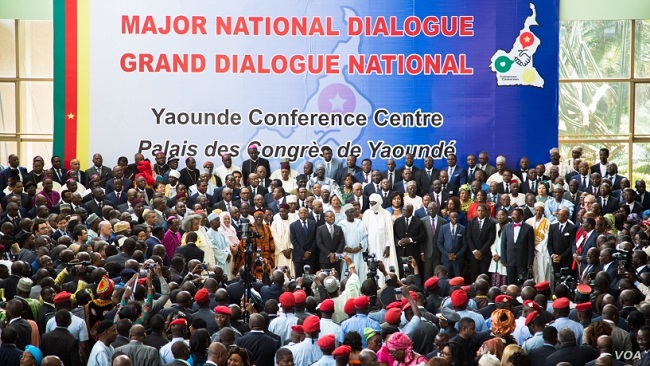
Separatists said calm can only return if leaders sentenced to life in prison are unconditionally freed. The president’s order came during a “national dialogue” sponsored by the government this week.
Biya’s order, issued Thursday, discontinues court proceedings against 333 separatist fighters from Cameroon’s English-speaking regions.
Biya said the order is part of efforts to calm a conflict that has killed at least 2,000 people in the past three years.
Order is a positive step
Sylvanus Ngufor, a Cameroonian sociologist who took part in the dialogue, said Biya’s order is a positive step, but said the government must do more to make English-speakers feel equal to the French-speaking majority.
“Our job is just starting,” Ngufor said. “All documents be printed in French and in English with the same sizes or logos. One language should not be a little smaller than the other. We are trying to rebrand the Cameroonian culture.”
Napoleon Ntamack, a 29-year-old taxi driver who traveled from the English-speaking town of Bamenda to take part in the dialogue, said peace can only return if top separatist leaders given life in prison by a military tribunal are unconditionally released.
These include the top separatist leader, Julius Ayuk Tabe, who was arrested in Nigeria with 47 of his supporters and extradited to Cameroon last year.
“If they do not release the separatist leaders that they arrested from Nigeria, if they do not release them, whatsoever they are saying, there will not be peace in this country,” Ntamack said. “For those that they think whatsoever the dialogue has decided can give us the solution [peace], I do not think so.”
Autonomy must be addressed
Kobo Emmanuel, 35, said the English-speaking Northwest and Southwest regions must also be given autonomy.
“It is time for us to be given that opportunity to vote our governors, our administrators and to manage our resources,” Kobo said.
Fontem Esua, Catholic archbishop of the English-speaking town of Bamenda, said even after the president’s announcement, fighting was reported in four English-speaking towns, including Bamenda and Mamfe. He said this is an indication Biya must do more to end the conflict.
“The problem that has caused the situation in which we live now, is the fact that the people are not satisfied with the form of government,” Esua said. “The best form of government in order to satisfy our needs is federalism.”
Peace talk demands
Restoration groups refused to take part in the dialogue but said they would agree to negotiations if they take place in a foreign country with United Nations mediators and in the presence of world powers such as the United States, Britain, France and Germany.
The crisis erupted in 2016 when English-speaking teachers and lawyers protested discrimination at the hands of the French-speaking majority.
Source: VOA with additional editing from Camcordnews
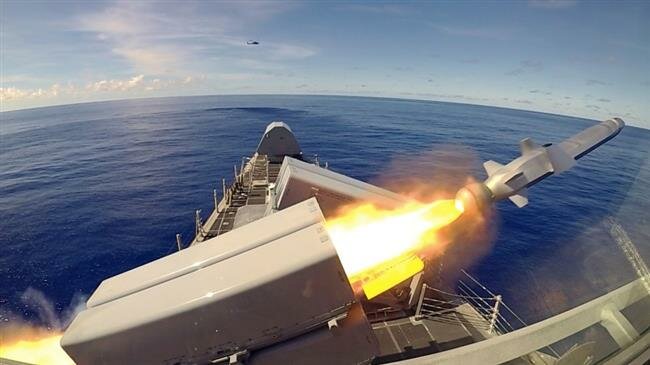
As China paraded some of its most powerful weaponry during celebrations marking the Communist state’s 70th anniversary on Tuesday, the United States Navy tested its newest piece of firepower in the Pacific.
In the waters off Guam, the USS Gabrielle Giffords fired off a Naval Strike Missile (NSM), a sea-skimming cruise missile that is difficult to spot on radar, and can maneuver to avoid enemy defenses.
The NSM, along with a variety of other weapons, were fired at a surplus US Navy frigate, the former USS Ford, which was towed to the Pacific to act as a target in an exercises called SINKEX.
The Giffords is the first US Navy ship to deploy with the Naval Strike Missile, and analysts say it helps even the equation in the Pacific, where China has been increasing its missile arsenal in terms of quality and quantity.
China now enjoys a 3-to-1 advantage in cruise missiles over the US, but the Naval Strike Missile can eventually “change the game,” said Carl Schuster, a former US Navy captain now an instructor at Hawaii Pacific University.
“The Pentagon is building a military force that can operate on a more sustainable basis and has a better chance of fighting and surviving within the PLA’s deadly anti-access, area denial envelope,” said Rand Corp. senior defense analyst Timothy Heath, referring to the mix of ships, aircraft and missiles amassed by China’s People’s Liberation Army to control parts of the Pacific.
The PLA was showing off much of that new arsenal on Tuesday in Beijing — everything from intercontinental ballistic missiles to new submarine drones.
“It is to show how much progress it has made, and how much more advanced it is compared to years before. Now, China has better capability to defend itself. It deserves equal and fair treatment from other powers,” Carnegie Tsinghua Center senior fellow and military analyst Tong Zhao told CNN.
Much of the US-China tension has been focused on the South China Sea, one of the most contested areas in the world. Multiple countries claim parts of the commerce-heavy region, but Beijing’s claim is by far the most expansive, covering the majority of the sea.
The sleek, stealthy Giffords, is a littoral combat ship (LCS) designed for operations in the shallower waters around coastlines and islands.
Most of the ships in the US Navy’s growing LCS fleet, which will eventually number more than 30, are planned to be armed with the Naval Strike Missile, Navy officials told a Senate Armed Services subcommittee earlier this year.
Key to the Naval Strike Missile is its range of more than 100 miles, more than 30% farther than the Harpoon missiles the US Navy has been using in this anti-ship capacity.
The ability to work with the helicopter drone enables the ship to target outside what its own surface radars can see.
Tuesday’s live-fire SINKEX exercise in the Pacific also saw missiles launched from other US Navy aircraft, bombs dropped from US Air Force B-52 bombers, and Harpoon missiles launched two stealth frigates from the Singapore Navy.
“This exercise provided important opportunities for realistic at-sea training with live ordnance, conditions that cannot be duplicated otherwise,” US Navy Capt. Matthew Jerbi, co-commander of the the exercise, said in a statement. “Training alongside our Singapore partners in a complex exercise like this is invaluable.”
Singaporean Col. Lim Yu Chuan said the exercise was “a valuable platform for the two navies to strengthen our mutual cooperation and interoperability.”
“With the vast training space available in the waters off Guam, the exercise also provides the RSN (Singapore Navy)with the opportunity to conduct high-end exercises of substantial scope and complexity,” Lim said.
(Source: CNN)
The Ambazonia Self Defence Council has denied any links with the so-called five ex-Ambazonia commanders who presented themselves in Yaoundé during the Grand National Dialogue forum stating that they are fake.
In a strongly worded statement issued today, the Ambazonia Self Defence Council informed Southern Cameroonians and the International Community that pictures and videos of alleged Ambazonia Restoration Generals attending the Yaounde peace talks were plain fiction.
“No Ambazonia General or Commander is attending the CPDM Convention dubiously called ‘National Dialogue”. What you are seeing is another effort and an attempt to manipulate and deceive our people and the International Community…” Part of the release reads.
The Ambazonia Self Defense Council further reiterated their position vis-à-vis the Biya Francophone teleguided talks observing that “Any call for Dialogue without the release of Ambazonians held in LRC jail are not accepted to us…The Ambazonia leader Sisiku Ayuk Tabe Julius and the Nera ten are the legitimate representatives of the Ambazonia people in any dialogue with LRC. They and all illegally held Ambazonians…must be released unconditionally prior to any talks.”
On the fourth day of the talks, five alleged Ambazonia Generals presented themselves to the Francophone dominated atelier and revealed that they have decided to drop their weapons in favour of peace.
Source: Journal du Cameroun
On Monday, 30 September, the government of Cameroon launched a national dialogue aimed at ending ongoing armed conflict in the Anglophone north-west and south-west regions. Prime Minister Joseph Dion Ngute is leading the talks in the capital, Yaoundé. During the days leading up to the dialogue, some armed separatist groups rejected the process and intensified their attacks in the disputed Anglophone regions, killing a number of people and damaging electrical infrastructure.
President Paul Biya announced the national dialogue on 10 September amidst growing pressure from the international community. Following her visit to Cameroon in May, the UN High Commissioner for Human Rights, Michelle Bachelet, urged “all sides, including the Government, to make a strenuous effort to end the fighting and begin peace talks.” In June the government of Switzerland also offered to mediate the conflict.
The government of Cameroon has consistently denied the gravity of the crisis and President Biya has dismissed the grievances of Anglophone protesters. Meanwhile, a number of separatist leaders have refused to attend the dialogue, emphasizing that they would only work with those willing to formally recognize the independence of the Anglophone regions.
The launch of the national dialogue coincides with the second anniversary of the separatists’ declaration of an independent state of “Ambazonia” on 1 October 2017. Since then there has been mounting evidence of the security forces perpetrating widespread extrajudicial killings, as well as of armed separatists committing numerous human rights abuses and violations. At least 650 civilians, 235 members of the security forces, and an estimated 1,000 alleged separatists have reportedly been killed as a result of ongoing conflict. More than 530,000 people have been displaced and more than 170 Anglophone villages have been burned or destroyed by government forces.
All parties in Cameroon should work towards a negotiated political solution to the armed conflict in the north-west and south-west regions. The government of Cameroon should release political prisoners, ensure all its military operations are undertaken in strict compliance with international law, and initiate credible and inclusive peace talks, without preconditions. Armed separatists should immediately call a ceasefire and negotiate with the government. The international community, including the African Union and Economic Community of Central African States, must help mediate an end to the conflict and ensure accountability for potential mass atrocity crimes.
Source: Reliefweb
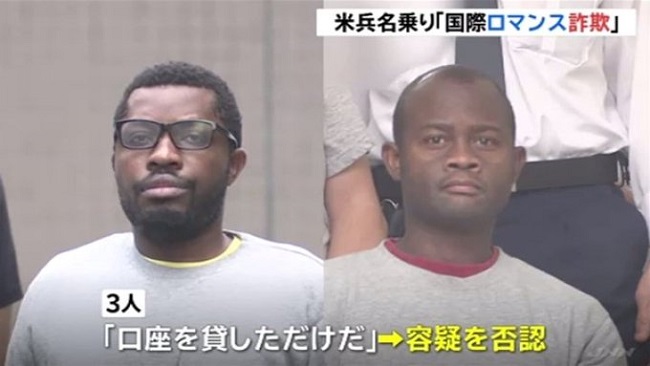
Tokyo Metropolitan Police have arrested three male Cameroonian nationals who posed as American servicemen online to swindle Japanese women seeking marriage, reports the Sankei Shimbun (Oct. 2).
According to police, the suspects, including a 32-year-old resident of Katsushika Ward, are believed to have swindled about 80 victims out of a total of 187 million yen since April, 2016.
Beginning at the end of March of last year, the trio posed as a American serviceman named “Alex” who was serving in Syria on a social-networking service.
In a text message with one of victims, a woman in her 50s and living in Tokyo, one of the suspects suggested marriage. “As a reward for compensation for being dispatched to Syria, I received 8 diamonds from the military,” one of the messages said.
Another message indicated that a payment would be necessary to cover customs fees in sending the jewels to Japan. The suspects began collecting money from the victims in May.

Thus far, police have only accused the suspects of using ATM machines in the capital to withdraw of 23.2 million yen in cash from an account of that one women between May and September of last year.
The matter emerged when the woman became suspicious and contacted police. All of the suspects deny the allegations, telling police that they “did not know” that the proceeds were the result of a crime. “An acquaintance lent me [access] to the account to withdraw money,” one of the suspects was quoted.
In a text message posted by Fuji News Network, one of the suspects wrote to a victim, “Don’t be shy my dear. I will always love you and respect you all my live [sic]. You are so special and you deserve to be treated with much love and respect. You are a wonderful woman.”
She responded, “I want to know about where you live.”
Police believe the suspects are part of ring that carries out what is known as “International Romance Fraud.”
Terue Shinkawa, the director of Stop! International Romance Fraud, advises women to inspect identification cards carefully since many are forged. “With peace of mind, friendships can form and feelings of love sprout,” she said.
Cameroon’s president is freeing more than 300 separatist fighters from the country’s Anglophone regions in a bid to calm a conflict that has killed nearly 3,000 people in the past two years.
An order signed Thursday by the presidency’s secretary-general says President Paul Biya made the decision to help ensure that peace returns to the country’s Southwest and Northwest regions.
The order discontinues court proceedings against the separatist fighters but does not apply to their leaders. It says the fighters had been accused of misdemeanors.
Cameroon is holding a national dialogue this week to try to resolve the conflict but key separatist leaders refused to attend.
The fighting between the Anglophone separatists and the majority Francophone security forces has forced more than 500,000 people from their homes since 2017.
Source: AP
Prime Minister Dion Ngute could soon get a sack as prime minister to make way for a Southern Cameroons new generation leader Minister Paul Elung, Cameroon Intelligence Report has gathered from a well-placed source in Yaoundé.
Ngute virtually represents nothing, following the numerous challenges on his management of the so-called Grand National Dialogue that came from prominent Southern Cameroonians who are still flirting with the Biya Francophone Beti Ewondo regime in Yaoundé.
Ngute’s advisers originally believed a dubious pattern in dishing out invitations to the dialogue would go a long way to enhance the prime minister’s political image and that Ambazonian leaders who hail from the Southern Zone would swiftly commit to the head of government’s agenda.
However, the people of Southern Cameroons and their Interim Government had other ideas which prompted the complete and total failure of the Yaoundé peace talks. “Prime Minister Joseph Dion Ngute (to use his three names is running out of road” our source added.
The ease with which delegates are picking up quarrels and threatening to fight is also presenting a problem for the prime minister, who does not even have a convincing message for the people attending the Yaoundé forum. This means Prime Minister Dion Ngute ultimately have little choice but to resign.
However, pro Ngute comedians are saying he would take a different course this coming Friday and find some way to redirect the talks to meet national and international standards. But this is not what President Paul Biya anticipated when he announced the Grand National dialogue.
As a result of Prime Minister Ngute’s failure, French Cameroun CPDM barons including Biya are growing nervous and believe they may have to act first to prevent Ngute from speeding the collapse of the Biya regime. “A new Anglophone prime minister has to be Elung Paul” our informant further pointed out.
Some CPDM hardliners in Yaoundé now believe that the only surefire way to prevent Southern Cameroonians from breaking away from La Republique du Cameroun is to remove Ngute from office and replace him with a younger and more flexible Southern Cameroonian.
Under the new French Cameroun plan, Elung Paul as prime minister and head of government will appoint Barrister Agbor Balla, the former Chairman of the Ambazonia Restoration Council Mr. Kumeta, former Ambazonia Acting President Sako Ikome into government with the sole purpose of diverting attention from the Southern Cameroons war and quest for independence.
By Soter Tarh Agbaw-Ebai
Five separatist fighters, among them a key commander known as “General Capture and Destroy”, laid down their weapons on Wednesday at a national dialogue to end separatist conflict in Cameroon’s two English-speaking regions.
The ex-fighters told a press conference in the capital, Yaounde, their decision was guided by a quest to restore peace and stability in the troubled regions.
“It is time for us to give peace a chance. People suffering are in Nigeria as refugees. Let’s bring peace back to our homeland. Let us see how we can reconstruct the villages that have been burned and lives that have been frustrated,” the ex-commander said.
He said, as a measure to resolve the conflict amicably, the government should give more autonomy to the ten regions of the country especially the English-speaking regions.
The five ex-separatist fighters bring the number of ex-fighters that are taking part in the national dialogue that began on Monday to 35.
The decision of the ex-fighters to drop their weapons during the talks was a major step towards the success of the national dialogue and return to peace in the regions, spokesperson of the national dialogue, George Ewane told reporters.
Some leaders of separatists, mainly based out of the country, have declined an invitation to participate in the talks, stressing that they are not “inclusive and sincere.”
The dialogue will end on Friday with “pragmatic and long-lasting solutions” according to Cameroon’s Prime Minister, Joseph Dion Ngute.
Since 2017, armed separatists have been clashing with government forces in the two Anglophone regions of Northwest and Southwest in a bid to create an independent nation they called “Ambazonia”.
Hundreds have died and more than 530,000 have been displaced internally by the conflict, according to the United Nations.
Source: Xinhuanet
A 37-year-old man from Cameroon died Tuesday in U.S. Immigration and Customs Enforcement custody, after undergoing treatment for a brain hemorrhage since Sept. 26 at Sharp Chula Vista Medical Center.
Nebane Abienwi was being detained at the Otay Mesa Detention Center in San Diego, according to an ICE news release. He was rushed to the emergency room Thursday after experiencing a hypertensive event in the middle of the night, according to the news release.
BuzzFeed News first reported on the man’s in-custody death Wednesday.
The man applied for admission into the United States in early September at the San Ysidro Port of Entry.
Physicians at Sharp Chula Vista provided treatment to Abienwi, who was non-responsive to questions. He appeared paralyzed on his left side and remained in the hospital until he passed away Tuesday, according to ICE.
Medical staff at the hospital pronounced Abienwi dead on Oct. 1. His next of kin and the Consulate General of Cameroon were notified of his death.
Physicians identified the cause of Abienwi’s death as brain death secondary to basal ganglia hemorrhage, ICE said.
“ICE is firmly committed to the health and welfare of all those in its custody and is undertaking a comprehensive agency-wide review of this incident, as it does in all such cases,” a statement from ICE said. “Fatalities in ICE custody, statistically, are exceedingly rare and occur at a small fraction of the rate of the U.S. detained population as a whole.”
Abienwi’s death is the first in ICE custody in the new fiscal year, which began Tuesday, as BuzzFeed News reported Wednesday morning.
Source: The San Diego Union Tribune