
Nigeria to repatriate nearly 600 from South Africa after xenophobic violence
Nigeria to repatriate nearly 600 from South Africa after xenophobic violence
Nigeria to repatriate nearly 600 from South Africa after xenophobic violence
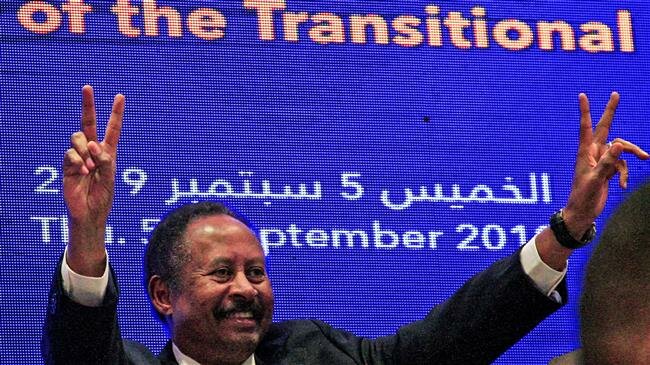
Sudan’s first cabinet since the ouster of president Omar al-Bashir was sworn Sunday as the African country transitions to civilian rule.
The 18-member cabinet led by Prime Minister Abdalla Hamdok took oath at the presidential palace in Khartoum, AFP reported.
It is expected to steer the daily affairs of the country during a transition period of 39 months.
The cabinet includes four women, among them Asmaa Abdallah, who becomes the country’s first female foreign minister.
It also includes Ibrahim Elbadawi, a former World Bank economist who will serve as finance minister, and Madani Abbas Madani — a leader of the civilian coalition that negotiated the transition deal with the military — as minister of industry and trade.
The line-up was formed after Sudan last month swore in a “sovereign council” — a joint civilian-military ruling body that aims to oversee the transition.
The 18 ministers were seen greeting members of the sovereign council, including its chief, General Abdel Fattah al-Burhan, in images broadcast by state television from the palace.
The council itself is the result of a power-sharing deal between the protesters and the generals who had seized power after the army ousted Bashir in April.
Hamdok’s cabinet is expected to lead Sudan through formidable challenges that include ending internal conflicts in three regions. Rebel groups from the marginalized regions of Darfur, Blue Nile, and South Kordofan states had waged long wars against Bashir’s forces.
Sudan’s power-sharing deal aims to forge peace with armed groups.
Hamdok’s cabinet will also be expected to fight corruption. It was a worsening economic crisis that triggered the fall of Bashir, who is now on trial on charges of the illegal acquisition and use of foreign funds.
(Source: Agencies)
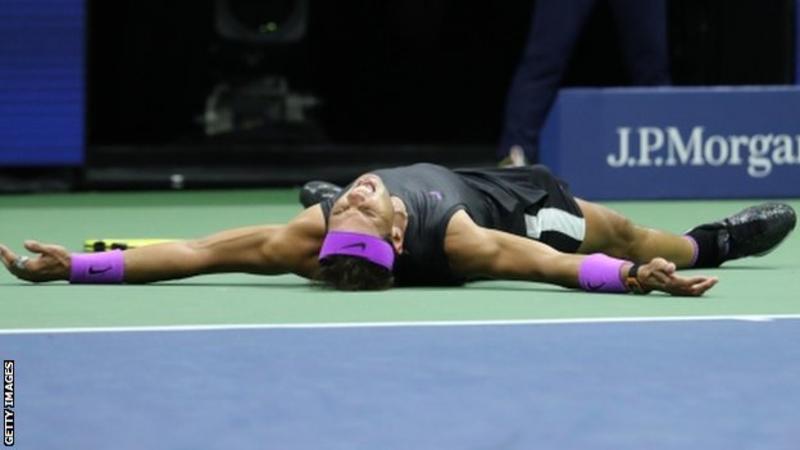
Rafael Nadal won his 19th Grand Slam title after holding off Russian Daniil Medvedev’s exhilarating fightback in one of the greatest US Open finals.
Spain’s Nadal, 33, won 7-5 6-3 5-7 4-6 6-4 against the fifth seed in New York.
Nadal, seeded second, was cruising at two sets and a break up, only for Medvedev to force a decider.
But Nadal stopped his momentum to clinch a thrilling win in four hours and 50 minutes – just four minutes shorter than the longest US Open final.
Nadal’s victory moves him within one of Swiss rival Roger Federer’s all-time leading tally of Grand Slam victories.
“It has been one of the most emotional nights in my tennis career,” Nadal said. “It has been an amazing final. It has been a crazy match.”
After taking his third match point, Nadal collapsed to the court in celebration, covering his face as contemplated another famous victory which epitomised all of his fighting spirit.
Medvedev, 23, trudged around the net to warmly congratulate his opponent, who looked on the verge of tears as he hid behind his sweat-soaked vest while taking rapturous acclaim.
“I just want to congratulate Rafa, a 19th Grand Slam title is something unbelievable, outrageous,” said Medvedev, who looked mesmerised as he watched a video montage of Nadal’s achievements.
Those lucky enough to be watching among a near 24,000 capacity crowd were regularly left open-mouthed at what they witnessed, with the majority jumping to their feet and celebrating wildly after every point, helping create an electric atmosphere on a noisy Arthur Ashe Stadium.
Medvedev had been booed by the crowd earlier in the tournament, yet heard his name loudly chanted by many as he threatened to complete an extraordinary comeback.
Ultimately it was too late as he was unable to become the first man outside Nadal, Federer and Serbia’s world number one Novak Djokovic to claim one of the sport’s biggest prizes since Stan Wawrinka’s victory here in 2016.
Nadal, Federer and Djokovic have won the past 12 Grand Slams after the Spaniard lifted the trophy in New York for a fourth time.
Now Nadal has the chance to draw level with 38-year-old Federer, who was nine titles better off than his long-time rival in 2007, at the Australian Open in January.

Despite Nadal, Federer and Djokovic being in their 30s, nobody has been able to break their stranglehold on the men’s game and Medvedev was the latest to fall short after a heroic effort.
That has allowed the illustrious trio to pile on the Grand Slam victories over the past three years, livening up the race to be crowned the greatest of all time, which Federer once seemed certain to win.
Nadal, who also won his 12th French Open title earlier this year, is now within one of Federer’s tally for the first time.
The magnitude of his achievements – which were shown on the big screen inside Ashe – hit the emotional Spaniard, who broke into tears while he sat in his chair and watched them.
That was a release of all the expendable emotional energy built up over the final two sets of a match which, against a less inspired opponent, he may have wrapped up much earlier.
A couple of hours before, Nadal appeared to be heading to a dominant three-set win against Medvedev, who was the first Russian man to compete in a Grand Slam final since Marat Safin at the 2005 Australian Open.
A physical contest, where both men jousted for supremacy as they tried to outlast each other in brutal rallies, seemed to be going to end in familiar fashion when Nadal broke for a 3-2 lead in the third set.
From somewhere, Medvedev summoned the strength to not only survive but threaten to produce one of the most memorable comebacks ever seen.
But Nadal’s intensity allowed him to eventually outlast the wiry Russian who, despite struggling with a quad injury during the tournament, continued to hang in even as the clock approached five hours.
Nadal’s mental resilience saw him through in the end, despite Medvedev producing another fightback from a double break down at 5-2 in the decider.
A fourth victory at Flushing Meadows seals another stellar year for Nadal, who reached three Grand Slam finals in the same year for the fourth time of his incredible career.
Source: BBC
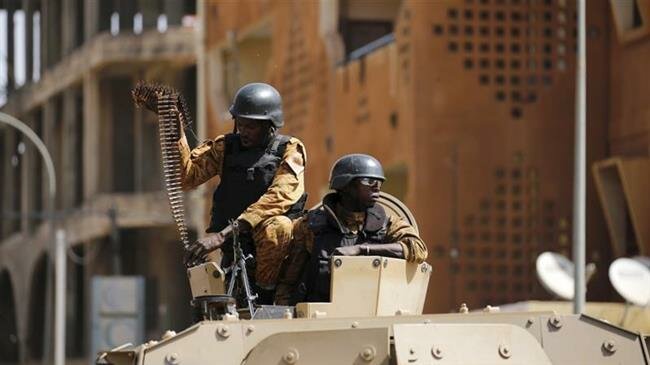
At least 29 people were killed in two attacks in northern Burkina Faso on Sunday, in a region prone to extremist violence, the government said.
One vehicle transporting people and goods “rode over an improvised explosive device (IED) in the Barsalogho area” leaving at least 15 passengers dead, government spokesman Remis Fulgance Dandjinou said in a statement.
A security source said most were traders.
Meanwhile, around 50 kilometers (30 miles) away, 14 people were killed when food vans travelling in convoy were attacked, the spokesman added.
Local sources said many of the dead were the drivers of the three-wheeler vans, which were carrying provisions for people displaced by fighting.
“Military reinforcements have been deployed and a thorough search is under way,” Dandjinou said.
A former French colony that ranks among the world’s poorest countries, Burkina Faso has been struggling with an extremist revolt since 2015.
The country’s army has been increasingly targeted by the radical militants. Earlier this month, an attack on a military base in northern Burkina Faso killed 24 in an unprecedented blow to the army in its campaign against extremists.
The insurgency, which came from neighboring Mali, began in the north but has since spread to the east.
Since 2015, more than 500 people have died in attacks that have become increasingly violent especially in the north and the east, according to a toll compiled by AFP.
The capital Ouagadougou has been attacked three times, including a March 2018 extremist assault on the military headquarters that left eight dead.
A summit of regional heads of state is due to be held in Ouagadougou on Saturday to discuss the security situation.
(Source: AFP)
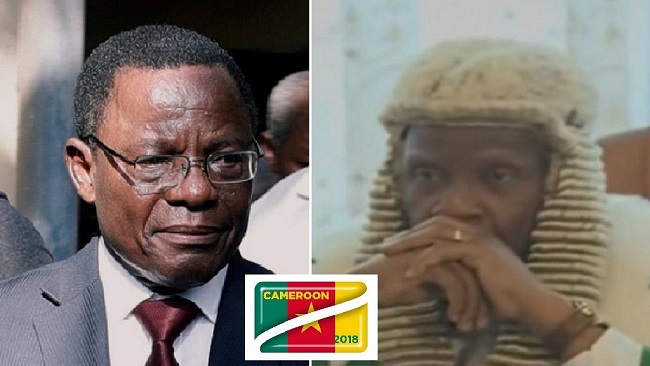
Cameroon’s main opposition leader, Maurice Kamto, has gone on trial in a military court in Yaoundé, along with 90 of his supporters. Kamto, who was the runner-up in last year’s presidential election, is accused of insurrection and rebellion, and could face the death penalty.
Kamto arrived in court on Friday under tight security. The trial venue was protected by 200 police officers in anti-riot gear, while others patrolled the area in pick-up trucks.
There had been calls from the opposition leader’s followers for a protest rally outside the court.
Kamto, together with several dozen of his political allies and supporters, faces charges of insurrection, hostility to the motherland and rebellion, crimes which, in theory at least, could carry the death penalty.
The head of the opposition Movement for the Rebirth of Cameroon (MRC) was arrested in January after months of peaceful opposition protests denouncing the results of the October 2018 presidential election.
The MRC alleges that the election was rigged in favour of President Paul Biya, who has been in power for 36 years. Kamto claims that he himself won the election.
Cameroon’s former colonial ruler France, the United States and the European Union have repeatedly called for his release.
“There is no justification for Mr Kamto and his supporters to have been incarcerated for eight months in these conditions,” their French lawyer Antoine Vey told the French news agency, AFP.
“None of them took part in acts of violence, none called for acts of violence or rebellion, there is no reason for their arrest other than a political motive.”
Ready for justice
The crackdown against the opposition has caused outrage among rights groups and many western governments.
In March, the US assistant secretary of state for African Affairs Tibor Nagy, told RFI that Cameroon would be “very wise” to release Kamto because his detention is widely perceived as politically motivated.
A top European Union official criticised the arrests and the military court’s “disproportionate” proceedings against them.
France in May also demanded the release of Kamto and his supporters.
On Monday, just days ahead of their trial, Kamto and his fellow defendants said they were “ready to face justice so the truth would come out,” demanding free public and press access to the courtroom.
“Mr Kamto is full of confidence,” his spokesman Olivier Bibou Nissack told journalists.
Conflict on all fronts
The authorities in Cameroon dismiss claims from the defendants and others that this a political trial designed to “decapitate” the opposition.
Along with the political protests, President Biya is facing a struggle on other fronts.
Since 2017, fighting between the army and English-speaking separatists demanding independence in two western regions has killed hundreds, forced nearly 500,000 people from their homes and filled jails with anglophone activists accused of militancy.
In the north of the country, Boko Haram’s nearly 10-year Islamist insurgency which is based in northeastern Nigeria, has more recently spilled over into Cameroon.
Source: AFP
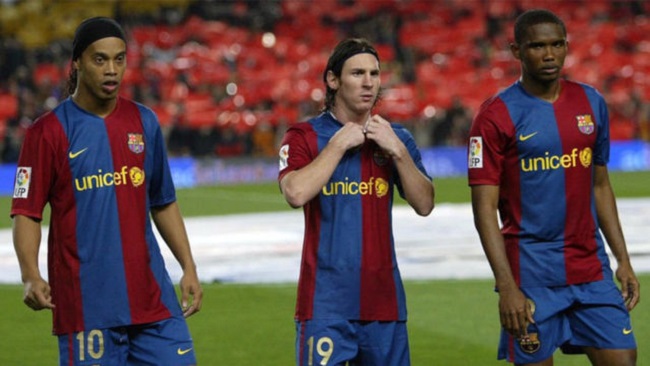
Former Barcelona captain Carles Puyol, present club captain Lionel Messi, former Chelsea forward Didier Drogba and a host of football stars have sent their best wishes to Samuel Eto’o after his retirement.
Eto’o took to social media on Friday to make a low-key announcement of his retirement from the playing scene following an illustrious 22-year career which started in 1997 at Real Madrid.
The 38-year-old played in Spain with Real Madrid, Leganes, Mallorca, Espanyol and Barcelona before travelling to Italy where he featured for Inter Milan and Sampdoria, he also had stints in England with Chelsea and Everton, and in Turkey with Antalyaspor and Konyaspor and Anzhi Makhachkala in Russia
During his playing career, Eto’o won several team and individual laurels including three Champions League titles, four African Footballer of the Year awards, three La Liga titles, amongst others.
While many players congratulated Eto’o for his success on the field, Messi, particularly, hoped that the Cameroon legend would reach the 40-year mark before hanging his boots.
 Sunday Oliseh
✔@SundayOOliseh
Definitely one of the Best players ,if not the best to Come out Of Africa. Congratulations Samuel on a legendary Career.
“Have you decided to stop, Samu? I thought you would reach 40 at least… All the luck in the world in what you want to do from now on, genius,” Messi wrote on Instagram.
“Congratulations for this great career Samuel Eto’o and very good continuation for the new challenges that await you… Africa is very proud of one of its greatest ambassadors,” Drogba wrote.
“Thank you for all brother. It has been a pleasure to share team with you. Good luck in this new stage,” Puyol wrote on Instagram.
“Soccer will miss you on the grass, brother. But I know you have a lot to contribute… Soccer needs you always friend… You’ve been very big as a player and I’m sure you will do it in everything that comes. Good luck in the new stage of your life, brother,” Deco wrote.

An appeal, funded by residents of Canada, has been lodged against the sentences of life imprisonment handed down last month by a Cameroonian military tribunal to six academics arrested in Abuja, Nigeria, and deported back to Cameroon in January 2018.
The academics – who were teaching in Nigerian universities and had lived in the country in some cases for many years, marrying Nigerians and raising children there – were accused of terrorism and of belonging to an outlawed organisation, the aim of which was to facilitate the secession of Anglophone Cameroon from the rest of the country.
The academics are: Professor Augustine Awasum of Ahmadu Bello University, Zaria; Dr Tata Henry Kimeng, associate professor at Ahmadu Bello University, Zaria; Dr Egbe Nguitui Ogork, associate professor at Bayero University, Kano; Dr Fidelis Nde-Che, associate professor at the American University of Nigeria in Yola; Dr Cornelius Kwanga, a senior lecturer at Umaru Musa Yar’adua University; and Dr Sisiku Julius Ayuk Tabe of the American University of Nigeria in Yola.
Ayuk Tabe is reportedly the first self-proclaimed president of “Ambazonia”, a breakaway state declared in October 2017 in two English-speaking regions of Cameroon.
Barrister was ‘merely an observer’
The academics’ barrister Paddy Yong told University World News his role in the hearing was merely that of an “observer” but he had filed an appeal a few days after the ruling.
He said some “patriotic” Anglophone Cameroonians resident in Canada had contributed jointly towards the non-refundable sum of US$10,000 required to appeal the tribunal’s decision. “I have sent this amount of money to a dedicated bank account of the government treasury in Yaoundé,” he confirmed.
He said as a sign of solidarity with the convicted academics, Anglophone lawyers in the country had unanimously agreed to go on strike for four days.
The six academics were arrested after a meeting in January 2018 at a hotel in Abuja, Nigeria, where they apparently gathered to discuss the humanitarian situation facing Anglophone Cameroonian refugees in Nigeria. They were among 47 other separatists also arrested at the same time.
Two major objections
Yong said the trial had not been open to the public and had gone ahead despite him raising two major objections.
“When the trial was to commence, I raised two fundamental objections. First, I objected to the fact the military tribunal was headed by Lieutenant Colonel Misse Njone Jacques Beaudoin and that five other high-ranking military officers were members of the presiding panel. I objected to the fact that those accused were civilians who did not participate in any military uprising.
“My second objection was to the fact of the trial being conducted in French. My clients are Anglophone Cameroonians. Therefore, the trial should be held in English.”
Yong said his two objections were rejected. “But the trial continued. My role was reduced to that of an observer,” he said.
According to Yong, the linguistic crisis had its roots in what he called the “naïve” marriage between elites of Anglophone Cameroon and Francophone Cameroon on 1 October 1961 to form the Federal Republic of Cameroon. He said the bilingualism upon which the federal republic was founded had not prevailed for many years.
In March this year, two separate judgments handed down by the Federal High Court in Abuja found that the arrest and detention of the academics was unconstitutional and that their deportation from Nigeria to Cameroon was illegal.
Problematic judgment
Nigerian barrister Abdul Oroh, who represented the academics when they were still in Nigeria, told University World News the ruling was problematic on three grounds.
“First, a Nigerian High Court sitting in Abuja declared illegal the forceful abduction of these university teachers and said they should be returned from Cameroon to their respective universities in Nigeria where they were working.
“Second, the trial of civilians by a military court was challenged as an aberration in the Court of Law in Yaoundé. The military tribunal ignored this case and continued with its assignment.
“And third, the judgment of life imprisonment smacks of a travesty of justice,” he said.
Culled from University World News
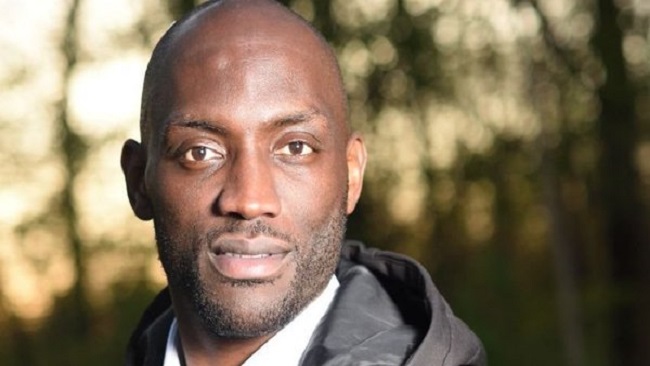
A Cameroonian-born German citizen Wilfried S. was detained in Yaounde in February over anti-government protest videos on his camera. His trial for allegedly trying to destablilize Cameroon is pending.
“It’s just a nightmare. I think the situation is drastic and we need to do something very quick for him to come back home,” his wife Layoko Siewe told DW.
On 29 August 2019, a military court in the capital Yaounde sentenced Wilfried S. to three years in prison on charges related to the unrest at the Kondengui Central Prison in Yaounde.
The 41-year-old engineer and father of two from Erlangen in southern Germany is still due to face trial for allegedly trying to destabilize the government.
Since the charges carry a life sentence, Lakoyo Siewe. is desperately campaigning for her husband’s release. She is adamant that he did not take part in the prison rioting on 22 July 2019 as alleged in court.
The couple and their two small children were due to depart Yaounde after a vacation when police apprehended Wilfried while taking photographs of a justice building.
The officers who searched and deleted the images found videos of protests against the government of Cameroon that were recorded. Layoko Siewe says her husband was not at the protests at which the videos were shot.
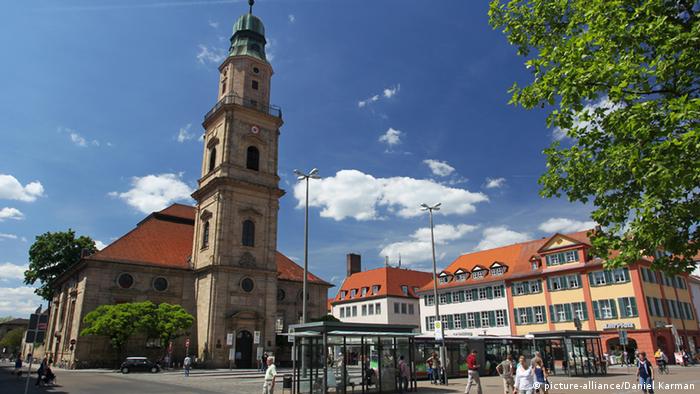 Erlangen in southern Germany, where Wilfried S. lives and works as an engineer
German political support
The jailing of Wilfried S. is clearly politically motivated, says Christoph Hoffmann, who heads the German parliamentary group for Central Africa.”In our point of view, freedom of expression includes taking pictures of demonstrations. However, autocrats have a different point of view,” Hoffmann told DW.
It is understandable that many people within the Cameroonian diaspora are speaking out against the government of President Paul Biya, he says. However, returning to Cameroon, where there is no rule of law, is very dangerous, according to Hoffmann.
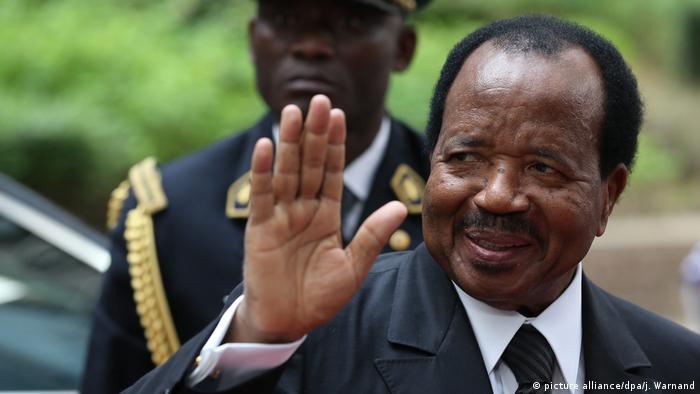
President Paul Biya’s government has been criticized for not tolerating dissent
The Biya government is facing mounting international criticism over its conflict with armed separatists in Cameroon’s Anglophone regions.
Cameroonians living abroad are particularly vocal and often speak out against the Biya government, on social media and in street demonstrations. Many are supporters of the Anglophone separatist movement.
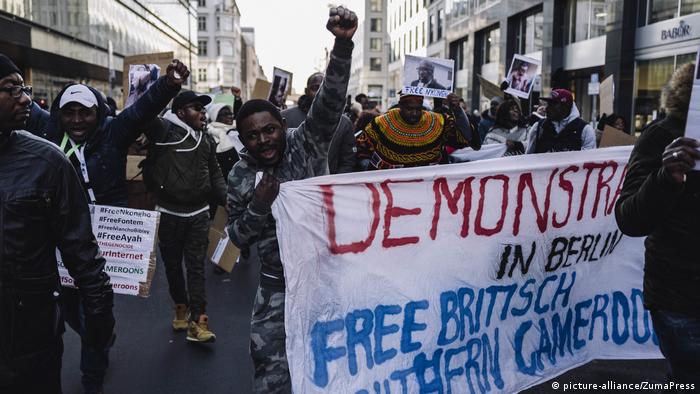 Protesters occupied the Cameroon embassy in Berlin as the Anglophone crisis intensified on 27 January 2017
Petition in circulation
German lawmaker Kathrin Vogler of the opposition Left party says the recent jailing of separatist leaders and Biya’s main opposition rival, Maurice Kamto, amounts to a violation of human rights.
“Biya’s government and the security forces crack down on anything that they feel is against the current government. And they do not stop at German citizen Wilfried S,” Vogler told DW.
The Foreign Office in Germany says it is aware of the case and confirmed that the embassy in Yaounde is providing consular support to Wilfried S.
Meanwhile, an online petition for the release of Wilfried S. has drawn more than 66,000 signatures. At a demonstration in Erlangen on 30 August 2019, participants called for his release and return to Germany.
“I’m just pleading with the German government – I know they are doing a lot already and I’m grateful for that – but I’m pleading with them to do more and put more pressure so that my husband comes home,” says Layoko Siewe.
Source: Deutschewelle
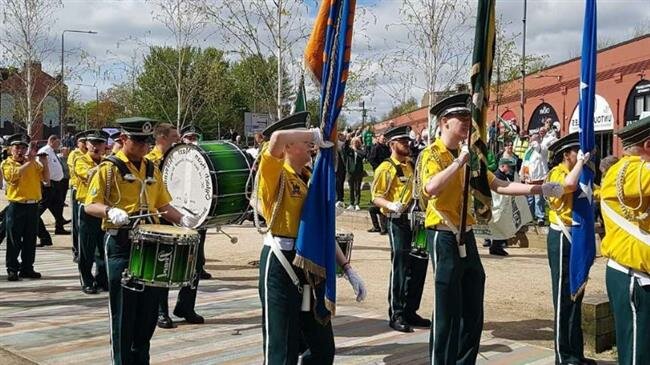
The Scottish city of Glasgow is awash with anticipation today as two Irish Unity marches are set to take place later in the afternoon.
The events are expected to attract violent loyalist counter-demonstrators who may try to disrupt the peaceful Irish Unity rallies.
Police Scotland has said it will have a “significant” presence at both marches and that security for the events had been “extensively planned”.
A week ago, an Irish Unity march, organized by the James Connolly Republican Flute Band (named after a leader of the Easter Rising of 1916 who was executed by the British), was attacked by loyalist gangs.
Today’s marches are organized by two distinct Scotland-based Irish Republican groups.
The first march, led by the Cairde na hEireann (Friends of Ireland) group is set to march from Millroad Street (in the east end of Glasgow) beginning at 14:00 BST.
The second march, organized by the Friends of the Irish Republican Prisoners Welfare Association (IRPWA), is set to commence at 15:00 BST from Blythswood Square (near the city centre) and finish at Barrowlands Park.
The rally by Cairde na hEireann is particularly sensitive as it will include the controversial Irish nationalist group, the Sean Mcllvenna Republican Flute Band.
Named after a volunteer of the Irish Republican Army (IRA) who was killed by the Royal Ulster Constabulary in 1984, the Sean Mcllvenna Republican Flute band is being probed under the Terrorism Act over a recent IRA-supporting Facebook post.
The Irish Unity marches in Scotland are unfolding against a backdrop of intense activity by Irish nationalist groups in Northern Ireland, the Republic of Ireland and Scotland.
The spectre of a no-deal Brexit, coupled with the ascension of an extremist and unpredictable hard-right Tory government in London, has galvanised Irish Republicans to call for a conclusive resolution to the Northern Ireland crisis.
In late July, Mary Lou McDonald, the leader of the mainstream Irish Republican group, Sinn Fein, called for a border poll (or an Irish Unity referendum) in the event of a no-deal Brexit.
Furthermore, the Irish Unity marches in Glasgow have intersected with Scottish politics by pitting Scotland’s First Minister, Nicola Sturgeon, against Glasgow City Council.
Sturgeon, who is also the leader of the Scottish National Party (SNP), has defended the Irish Unity marches, whereas Glasgow City Council (which has a residual Scottish Labour influence) initially tried to ban them.
Loyalist groups, in addition to elements of the Tory party, regularly accuse the SNP of sympathising with the Irish Republican movement.
Source: Presstv
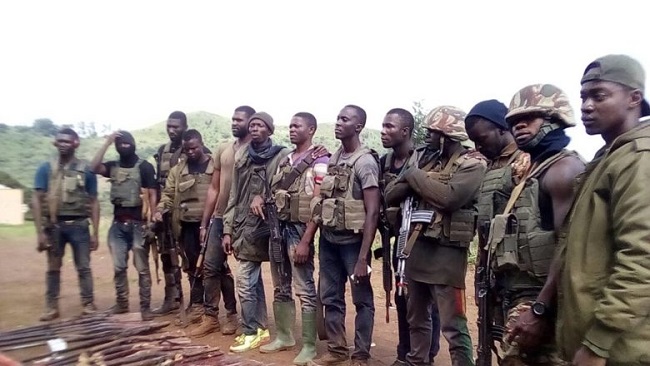
Six Southern Cameroons Self-Defense Groups have announced the formation of a unique restoration force to curb crimes and abductions in Ambazonia. The groups in the Southern Zone also say the new force is needed to coordinate self-defense action against the invading French Cameroun army soldiers.
Vice President Dabney Yerima who brokered the deal is expected to issue a statement on the outcome of very intensive and productive discussions that were held late yesterday. Cameroon Intelligence Report sources in Ground Zero revealed that the merger would operate as a coalition working within the framework of the Ambazonia Interim Government.
A spokesperson for Comrade Dabney Yerima told this reporter that the merger policy will also be implemented in the Northern Zone in the weeks ahead and the Vice President will call for a new strategy of popular resistance to French Cameroun occupation and colonization and opposition to policies that fuel the weakness of the Interim Government by perpetuating division.
In a recent outing in the Federal Republic of Germany, Vice President Yerima warned that Ambazonians faced liquidation if they could not achieve unity in the face of the intensified French Cameroun attacks. He also emphasized the need to uphold the Interim Government under the leadership of President Sisiku Ayuk Tabe as the legitimate and sole representative of the Ambazonian people.
The participating self-defense groups will remain independent but strive to be a model of Southern Cameroons unity that would get rid of the French Cameroun occupation, win the right to self-determination in a sovereign state with Buea as its capital.
By Asu Isong in London with files from Sama Ernest and Rita Akana

