
Breaking News

Cameroonian men whiten skin to look Like their Congolese musician idols
Skin whitening is no longer a strictly female affair. With so many cosmetic products, men are getting into it too, reducing their melanin levels in order, they say, to “look better”. However, some fear that skin whitening might not only lead to medical problems, but also a loss of identity.
“I always wanted to have lighter skin. I find it cleaner and more presentable. I buy cosmetic products once in two months. It’s not to imitate women, it’s my personal choice”, Séverin, a travel agency manager from Douala, who started lightening his skin several years ago, said.
It is no longer surprising to see a man with black arms or legs and with a lightened face on the streets of the country’s large cities. Some are following fashion, while others want to look like their favourite celebrities. This is the case of Kévine. At 28, this aspiring singer admits to having started whitening his skin to look like his idols.
“I’m a fan of some Congolese celebrities who have lightened skin. The skin of many of those who I admire has become lighter over time. And since I identify with some, of them, I try to be like them by using skin depigmenting products”, he said.
The phenomenon is gaining ground. Beauty stores have noted their new clientele. Karest, a perfume shop manager from Douala, admits having been surprised by men contacting her via social networks to place orders.
“The first time a man contacted me [to buy these products], he told me that he was buying them for his wife. But I ended up realising that those products were for him. He said that next time he bought them, admitting the change and effectiveness. Every week, I get at least five orders from men”, she said.
Online stores have dozens of male customers. Non-lightening cosmetics seller Lucy Ngah confirms this. According to her, most men use products that she sells to smooth out the effects of skin whitening products.
“Some of my male clients who lighten their skin often buy natural soap to reduce the negative effects on their skin, such as greenish veins that appear, acne and redness”, she said.
In Cameroon, women who engage in skin lightening are often criticised, but men are criticised even more. Celebrities suspected of skin lightening are mocked and criticised on social networks. So far, very few male celebrities have dared to take the plunge. Sputnik talked to psychosociologist Maurice Somo to discuss the causes of this social phenomenon.
“From the psychological point of view, skin lightening is a rejection of one’s self-image and a desire to change oneself in accordance with the ideal created in one’s mind. The main motivation of both men and women stems from being admired or lack of admiration”, the specialist explained.
According to the psychosociologist, this behaviour results from the “prestige” of white-skinned people, as well as other people with a light skin tones, in Africa. In addition, some start lightening their skin to imitate others, or to demonstrate their socioeconomic success.
“In sub-Saharan Africa, fair skin is considered very close to the white ideal. By the way, mestizos are very popular. Fair skin is also proof of the economic status, which makes it possible to make the skin tone you want. Ultimately, the main motivation is the inferiority complex regarding to the natural skin colour”.
The negative impact of skin lightening is not only limited to psychological disorders, of which it is indicative. This social phenomenon also indicates serious health problems. In a country where they are struggling with fake medicines, which can still be found on the market, many cosmetic products enter the market without having previously obtained the necessary authorisations.
Cameroon regularly holds awareness campaigns to draw attention to the long-term effects of skin lightening, but apparently they are ineffective. Until minds change, people will continue lightening their skin…
Source: Sputniknews

Biya regime turns stadium into isolation centre as coronavirus cases hit 650
Cameroon has turned a football stadium in the country into an accommodation centre for coronavirus patients as authorities grapple with lack of space to lodge and treat the growing number of people testing positive for the virus.
Minister of Public Health, Dr Manaouda Malachie, said on Saturday that the Yaounde military stadium will now serve as one of the large capacity centres in the capital expected to increase the country’s management capacity to more than 3,000 beds.
He had earlier accompanied the Secretary General of the Cameroon Presidency, Mr Ferdinand Ngoh Ngoh, for an inspection of the stadium.
Authorities are also using some newly constructed social housing apartments in the country as accommodation centres.
Confirmed cases of Covid-19 in the Central African country have hit 650 as it recorded nine deaths and 17 recoveries.
The country was the fifth on the continent with the highest number of confirmed cases after South Africa, Algeria, Egypt and Morocco as at Saturday.
Source: Daily Nation

OPEC Fund supports Cameroon’s cotton sector
The OPEC Fund is contributing €30 million to support the Republic of Cameroon’s production and trade of cotton fiber.
The financing facility, which is led by the International Islamic Trade Financing Corporation (ITFC), will enable Cameroon to finance the purchase of agricultural inputs which will be processed into cotton fiber and sold into the export markets.
Cotton is an important product in Cameroon. The sector employs around 200,000 farmers, while over 2 million people benefit along the value chain.
Source: opecfund.org

Coronavirus Pandemic: Why the resistance against hydroxychloroquine?
The world is used to thinking that American systems are the best in the world, but a small virus has simply exposed the so-called superpower.
While other countries have gone about the spread of the Coronavirus in a quiet and philosophical manner, in America, it has become a soap opera, with politics standing in the way of business.
Just agreeing on the way forward has been an Herculean task. America is not the only democracy in the world and it is not the only developed country in this planet of ours.
I have always held that size is not necessarily a sign of strength. For decades, Japan with a small population was a lot stronger, both militarily and economically than China that has always counted over a billion inhabitants.
Today, the American tenet that bigger is better is simply falling apart. Its ability to deal with health emergencies has been tested and this country has failed the test woefully.
The American health system leaves much to be desired and due to nasty politics, it will be tough to get the system fixed.
The American healthcare system like the country’s electoral system needs a facelift, but this will not be possible in a context in which winning an election trumps over other components of life.
The political bickering is making it hard for even the smallest things to be achieved. Even in the face of a pandemic that is robbing many families of their happiness, Americans are still fighting, instead of working together to keep this invisible enemy at bay.
There is no cure for this pandemic and it seems to be determined to spread across the country at lightning speed. For now, the only hope is the use of hydroxychloroquine to save some lives, but the pushback is incredible.
For weeks, the American drama has been playing out, but it is not palatable to millions across the world.
The world is really sick and tired of hearing Americans resisting the use of hydroxychloroquine which is already being used in other countries.
This medication is being tried in Canada and a French expert has proven that lives have been saved, thanks to this medication.
I know some American media networks such as CNN hate Trump with his policies and they are doing a great job at giving him a very bad name for floating the idea that hydroxychloroquine could be used, especially in an election year. But what options do Americans really have in the face of this pandemic that is mowing down many of their fellow citizens?
This medication has been used for decades against malaria in Africa and it did really save so many lives. Its side effects are known and its potential to slow down the virus is no longer a secret.
Is the world going to wait for American laboratories to accept that this drug be used before it becomes useable across the world?
Anyways, for many people across the world who are simply spectators, they will continue to watch this drama from a distance as Americans die like flies which have been sprayed with a strong insecticide.
There is an urgent need to save lives and many people around the world think that a lot of flexibility needs to be demonstrated when the world is faced with medical emergencies.
Of what value will it be to manufacture a ‘silver bullet’ that will take two years when everybody would have been dead and gone?
If this medication had all the side effects Americans are raising today, why did they ship this drug to Africa? Is it that Africans are not human enough? The number of deaths in America will continue to rise if strong and robust measures are not taken. And for now, only hydroxychloroquine holds that promise.
In less than a month, America has lost more than 8,000 people. How many more Americans need to die before the CNN and other media outfits that hate the Trump administration can understand that the world has been thrust into a race against time?
What if Trump’s gamble pays off, will the CNN and its likes acknowledge their own mistakes? Many non-Americans usually side with the Democrats, but in this case, they don’t think lives must be wasted just because the idea is Trump’s.
A little bit of modesty and caution could help postpone death for thousands of Americans who are waiting for any medication that can bring them some relief.
How did China cure its own cases? Can Americans be humble enough to learn from those who have already gone through this ordeal?
For how long are they going to continue fighting each other while the real enemy continues to blight their lives?
This is no time for talking. All efforts must be geared towards finding a solution. It does not really matter who comes up with one. The world just needs to roll back the insidious virus. That should be the focus.
By Dr Joachim Arrey
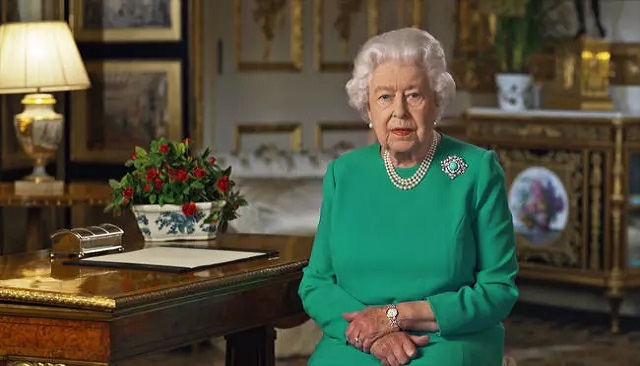
Queen Elizabeth calls for ‘self-discipline’ in coronavirus fight
Queen Elizabeth told the British people on Sunday that they would overcome the coronavirus outbreak if they stayed resolute in the face of lockdown and self-isolation, invoking the spirit of World War Two in an extremely rare broadcast to the nation.
In what was only the fifth televised address of her 68-year reign, Elizabeth called upon Britons to show the resolve of their forbears and demonstrate they were as strong as generations of the past.
“Together we are tackling this disease, and I want to reassure you that if we remain united and resolute, then we will overcome it,” the 93-year-old monarch said in the address from her Windsor Castle home where she is staying with her husband Prince Philip, 98.
“While we have faced challenges before, this one is different. This time we join with all nations across the globe in a common endeavour, using the great advances of science and our instinctive compassion to heal. We will succeed – and that success will belong to every one of us.”
The broadcast came hours after officials said the death toll in Britain from the virus had risen by 621 in the last 24 hours to 4,934 with high fatalities still expected in the next week.
Prime Minister Boris Johnson is among those in self-isolation after testing positive for COVID-19, and the queen’s own son and heir Prince Charles, 71, has recovered after suffering mild symptoms of the virus.
Like many countries in Europe, Britain is in a state of virtual lockdown, with people told to stay at home unless it was essential to go out. Health minister Matt Hancock said even stricter rules might be imposed if the current rules to curb the spread of the virus were flouted.
World War Two Spirit
Elizabeth thanked those who were staying at home, thereby helping to spare others from suffering the grief already felt by some families.
She also paid tribute to health care staff for their selfless work and commended the “heart-warming” stories of people across the Commonwealth, of which she is head, and beyond for delivering food and medicines to those who needed them.
Sunday’s address was extremely rare as the queen usually only speaks to the nation in her annual televised Christmas Day message.
In order to ensure any risk to the elderly monarch herself was mitigated, it was filmed in a big room to ensure a safe distance between her and the cameraman, who wore gloves and a mask and was the only other person present.
Elizabeth said the situation reminded her of her first ever broadcast in 1940, when she and her late sister Margaret spoke from Windsor to children who had been evacuated from their homes to escape bombing raids by Nazi German aircraft.
She said that in the future people could take pride in how they too had dealt with such a challenge and disruption to their lives.
“Those who come after us will say the Britons of this generation were as strong as any,” she said. “That the attributes of self-discipline, of quiet good-humoured resolve and of fellow-feeling still characterise this country. The pride in who we are is not a part of our past, it defines our present and our future.”
She even invoked the words of the famous song “We’ll Meet Again” by Vera Lynn from World War Two which became a symbol of hope for Britons during the conflict.
“We should take comfort that while we may have more still to endure, better days will return,” she said. “We will be with our friends again; we will be with our families again; we will meet again.”
(REUTERS)
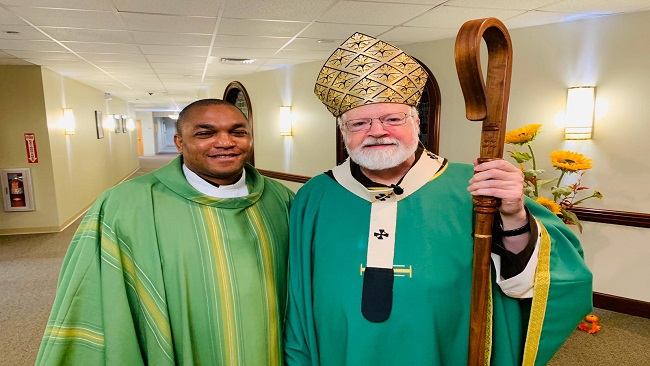
The Present Continuous Tense of Palm Sunday
Ste Anne’s Parish, Salem MA, Roman Catholic Archdiocese of Boston
Palm Sunday Catechesis: (April 5, 2020)
The Present Continuous Tense of Palm Sunday:
“Blessed is He who comes in the Name of the Lord” (Mark 11:9)
Dear Holy People of God,
Today, we celebrate the liturgy of Palm Sunday, in which we enter in a sacramental sense, Jesus’s entry into Jerusalem.
- In the Gospels of Mathew, Mark and Luke, more pointedly in Luke, Jesus’ entire ministry is one, long preparation for this journey to Jerusalem, so much so that Jerusalem, the City of David, appears as the interpretive principle of the ministry of Jesus: Jesus lives for the vision of Jerusalem, a vision that embodies the universalization of the Yahweh’s promise through Israel to the nations of the world: “And many peoples and great nations will come to seek the LORD Sabaoth in Jerusalem and to entreat the favour of the Lord” (Zechariah 8:22). Hence, the journey to Jerusalem, in the light of the inner development of Israel’s faith, marks an eschaton moment in which the particularity of Israel’s calling as a nation by God (Genesis 12), is accorded a definitive and an irrevocable openness to the nations.
- With this journey, Israel’s Passover becomes the Passover of the nations, and only in this sense can the Christian enter into the spiritual heritage of Israel’s faith: the Passover, celebrated in Jerusalem, in the particularity of Israel, becomes the Eucharist, in the universality of the nations, so much so that the words of the Psalmist find their concrete fulfillment: “From the rising of the sun to its setting praised be the name of the Lord!” (Psalm 113:3).
- On the other hand, the Gospel of John presents not one (like the Gospels of Mathew, Mark and Luke), but three Passover Feasts, namely, the cleansing of the temple (John 2:13-25), the multiplication of the loaves (John 6:4), and finally, the Passover of the death and resurrection of Jesus (John 12:1, 13:1). For the write of the gospel of John, Jesus is the Passover Lamb who, as the Lamb of God, takes away the sins of the world (John 1:29).
- There are therefore, two versions of the journey to Jerusalem in the four gospels: the gospels of Mathew, Mark and Luke embody one layer of meaning in which the public ministry of Jesus is a single ascent to the mountain city of Jerusalem, and, on the other hand, the version of the Gospel of John, in which there is a back and forth from Jerusalem, and in the final analysis, Jesus becomes the Sacrificial Lamb for the world.
Given this biblical context, let us examine more closely, the text that, in my opinion, stands out from today’s liturgy of the word:
- The text is from the cry of the crowds that followed Jesus: “Hosanna! Blessed is He who comes in the Name of the Lord” (Mark 11:9). As Joseph Ratzinger/Benedict XVI points out in a very significant text, “People had heard of the prophet from Nazareth, but he did not appear to have any importance for Jerusalem, and the people there did not know him. The crowd that paid homage to Jesus at the gateway to the city was not the same crown that later demanded his crucifixion” (Joseph Ratzinger/Benedict XVI, Jesus of Nazareth, Vol. II, p. 8).
- Dear Holy People of God, very early on, Christian liturgy saw in the proclamation of the Palm Sunday crowds, the entry into the abiding presence of the Lord who comes. Palm Sunday led the early Church to quite organically, place this proclamation just before the Rite of Consecration, in the text of the Holy, Holy, Holy Lord: the triple Sanctus, Sanctus, Sanctus, holy, holy, holy, is a reminder of the Trinitarian God: the first “Holy” is to the Father, the second “Holy” is to the Son, and the third “Holy” is to the Spirit (Augustine of Hippo, De Trinitate).
- I do not think that the decision of the early Church to chant the “Holy, Holy, Holy Lord, (…) Blessed is He who comes in the Name of the Lord, Hosanna to the Son of David (…),” just before the Rite of Consecration, – as we still do today at every Holy Mass, was an exercise in serendipity. I think the Hosanna chant showed a conscious profession that in what they were about to encounter in the form of Bread and Wine, in the Eucharist species, the Son of David, just as he rode into Jerusalem, truly comes into the Jerusalem of the Church of the here and now.
- In this sense, therefore, Palm Sunday takes on a new meaning, thanks to the sacramental sense of the Christian liturgy. Palm Sunday is not something of the past. In the liturgy, Palm Sunday comes alive. The Lord comes into the assembly gathered around his Name. The Eucharistic liturgy is therefore, the locus, the place wherein Palm Sunday happens. “Blessed is he who comes in the name of the Lord,” the Church’s faith proclaims before the Rite of Consecration.
- The Liturgy of the Church is therefore, the sure guarantee of the timelessness and present-continuousness of Palm Sunday. Only in that chant of the Church’s faith, do we find the enduring meaning and efficacy of Palm Sunday. And if such is the state of things, it therefore is the case that Palm Sunday can only come alive and be sensible when the individual is united or allows the self to enter into the believing community. In other words, it is possible to have a nirvana-experience of Palm Sunday.
- And isn’t this a source of hope and encouragement for us today, when, frightened so much by the pandemic of COVID 19, we might feel alone, perhaps abandoned, frightened and anxious about the present and the future? Palm Sunday, as a gateway into the communio of the reality of the Church, offers us the comfort that the Lord is coming, a coming that is not just something of the future, talk less of the past, but a coming that is, in its most profound level, a thing of the present, a present that brings the past with it and opens up to the future, thereby ensuring a present-continuous sense of purpose and meaning, for with the Lord, present in our midst, the believer knows that he or she has a future, for where the Lord is, life overcomes death, light overcomes darkness, love overcomes loneliness and the fear of the unknown. And because the Lord is coming to us, the believer can face tomorrow and today! Amen!
- May the Lord bless you and keep you! May the Lord let his light shine upon you! May the Lord be close to you and fill you with his peace!
Fr Maurice Agbaw-Ebai
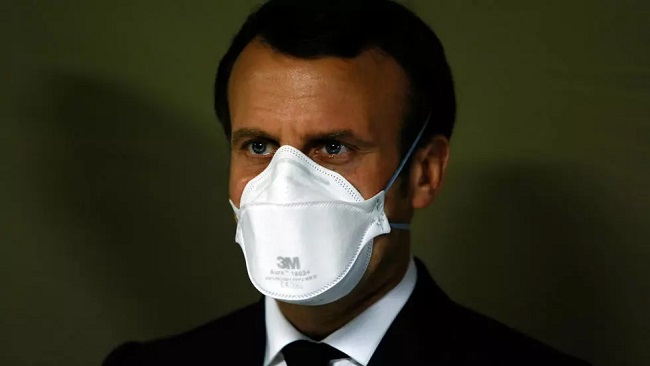
Coronavirus crisis throws a lifeline to Macron’s troubled presidency
While the coronavirus epidemic rages in France and around the world, President Emmanuel Macron’s poll ratings have jumped to a two-year high. Analysts say that, while his leadership style played badly during the Yellow Vest protests and pensions strikes, it has been an asset during the current crisis.
A series of polls over recent weeks has shown that Macron is enjoying a popularity bump amid the coronavirus crisis. In late March, a Harris Interactive survey found that 51 percent of French people “have confidence” in Macron – a 13-point increase on the previous month. It is the first time he has enjoyed a majority approval rating since January 2018.
Other pollsters have noted similar upticks in his popularity, with Ipsos showing him up by 14 points and Ifop up by 11.
France’s coronavirus death toll stands at more than 7,500 and the number of confirmed cases at more than 68,600, making it Europe’s third-worst-affected nation behind Italy and Spain. The country has been under lockdown since March 17 – a situation that will last until April 15 at the very least, with people allowed to leave their homes only to buy necessities, go to work, exercise or seek medical care.
‘Astonishing popularity surge’
Like many other world leaders, Macron has not shied away from massive state intervention in the economy to manage the crisis. He announced plans to quickly ramp up production of face masks and ventilators to address shortfalls, while his government will disburse around €300 million to businesses affected by the virus – warning that it “won’t tolerate” such companies rewarding shareholders with dividends this year – and has responded to the threat of food shortages by exhorting supermarkets to “stock French products”.
The president has also taken a firm stance in his televised addresses. In his speech announcing the lockdown on March 16, he took pains to stress the gravity of the situation, repeating the refrain, “We are at war” and admonishing people who disregarded a previous request for social distancing: “We saw people gather in parks, crowded markets, restaurants and bars who did not follow the instructions … Not only are you not protecting yourself, but you are not protecting others.”
The speech got a record 35 million audience as more than half of the French population tuned in.
For many, this approach has bolstered Macron’s credentials as an efficient manager who knows what he is doing, said Paul Smith, a professor of French politics at Nottingham University. The president is seeing an “astonishing popularity surge” because “this sort of crisis allows the technocrat to step in and take tough decisions – the French state is, after all, built for just such a situation and most people understand the need for massive intervention”.
‘Symbol of an out-of-touch elite’
Macron argued that the French head of state should adopt an imposing style long before he announced sweeping restrictions on daily life in response to the coronavirus crisis.
Ever since its foundation in 1958 by the famously imperious Charles de Gaulle amid the chaos of the Algerian War, France’s Fifth Republic has been characterised by a powerful presidency, sometimes described as a republican monarchy. Macron put his own distinctive stamp on this concept. After winning the Élysée Palace in the 2017 elections, he declared that France needed a “Jupiterian” presidency – referring to Jupiter, the Roman king of gods.
To many critics, this leadership style has seemed haughty, fuelling the anger of the Yellow Vest protesters who first took France by storm in late 2018 and that of the unions opposed to Macron’s pension reforms, who shut down large parts of France last winter in the country’s longest strike since 1968.
Tellingly, a survey conducted by the Elabe pollsters on March 5 – before the widespread realisation that the coronavirus would soon upend people’s way of life – showed Macron’s approval rating had fallen by two points to a paltry 29 percent after he forced his pension bill through the National Assembly in late February by using Article 49.3. Arguably the Fifth Republic’s most controversial legal instrument, this constitutional clause allows the government to pass legislation without a parliamentary vote.
“A lot of people felt that using Article 49.3 was anti-democratic; a symbol of an out-of-touch elite,” said Andrew Smith, professor of French politics at the University of Chichester.
The far right is the ‘real opposition’
But by this point, many people will have “forgotten what Article 49.3 even meant”, Andrew Smith said. And in the current context, “the Jupiterian style is a real asset” because it “shows clear lines of command” and allows Macron to portray himself as an “effective leader”.
It may be difficult for the opposition parties to make traction amid the epidemic. The traditional parties of the right and left have been flagging and divided since Macron’s centrist upstart party, La République En Marche (The Republic on the move), captured the National Assembly with a landslide in the 2017 parliamentary elections.
“Most opinion polls for the 2022 presidential elections put far-right Marine Le Pen first in the first round, before losing to Macron in the second,” observed Paul Smith. “But do the French want that? Eighty percent say not.”
Le Pen’s Rassemblement National (the National Rally party, formerly the National Front) are the “real opposition”, Andrew Smith added. But the coronavirus crisis is pushing Macron towards a much more interventionist economic agenda that may deprive them of one of their key selling points. “Where [far-right] appeal has broadened is around re-centring the focus inwards in terms of development and investment, focusing on French towns and provinces,” he said. But since the coronavirus crisis, “there is a shift towards a more Keynesian focus, and that may rob them of the ability to make traction on these issues”.
Nevertheless, Macron’s predecessors Nicolas Sarkozy and François Hollande enjoyed similar boosts in the polls after the 2008 financial crisis and the 2015 terror attacks, respectively. It was a temporary phenomenon for both. And while Hollande’s popularity surged as many French rallied around the flag after the Paris attacks, few would have predicted that his young economy minister, Emmanuel Macron, would later break with his mentor and take the presidency two years later.
Source France 24
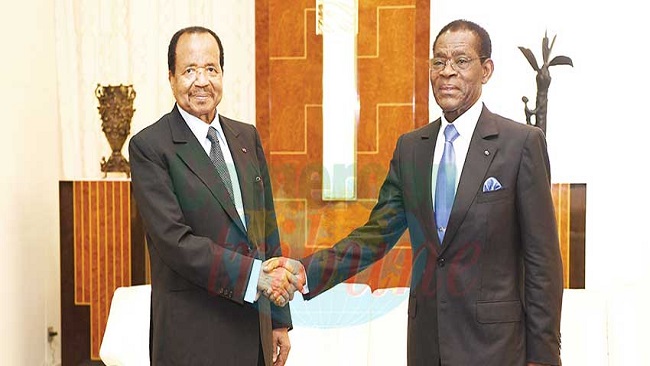
War looms as Biya and Obiang of Malabo feud over border wall
The Francophone dominated government in Yaoundé has launched an unprecedented attack against the regime in Equatorial Guinea for starting the construction of a six kilometers road inside Cameroonian territory.
Two senior Cameroon government ministers in charge of security issues recently travelled to the borders with Equatorial Guinea to assess the situation and hundreds of Cameroonian soldiers have been deployed to the area.
Joseph Beti Assomo, the Minister Delegate in charge of Defense and Paul Atanga Nji, Minister of Territorial Administration met with officials from Malabo on the disputed territory and are expected to report to President Biya who has not been seen ever since the outbreak of COVID-19.
Cameroon Intelligence Report gathered that the Equatorial Guinea government does not intend to stop the construction work currently going on which includes a huge wall that will separate the two countries.
Sources in Yaoundé say the Biya regime wants to play the diplomatic card and are considering referring the matter to the African Union.
By Rita Akana