
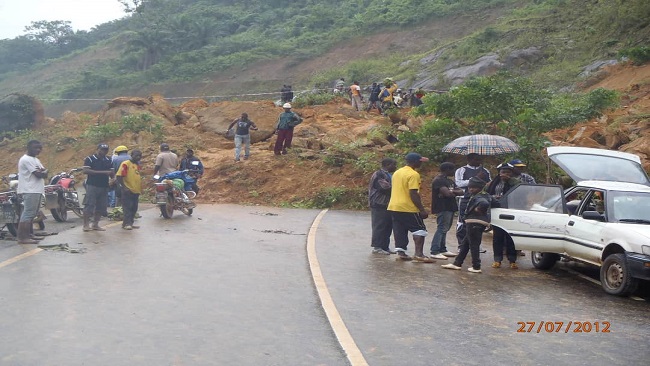
Biya regime links ring road construction to youth job creation in the North West
In Cameroon’s violence-hit Northwest region, authorities have positioned the Ring Road project as more than a transport upgrade. The government has embedded the construction program in a broader social stabilization strategy that seeks to create economic prospects for young people and reduce their vulnerability to recruitment by armed separatist groups.
In this context, 17 municipalities located along the Ring Road have received road maintenance equipment to strengthen upkeep of local routes. State broadcaster CRTV reported that authorities supplied 85 municipal road committees with water tanks, pumps, wheelbarrows and other basic tools to facilitate routine maintenance. The Ministry of Public Works has led the initiative in partnership with the International Labour Organization. The partners have aimed to reinforce the durability of infrastructure investments while generating local employment through regular maintenance activities.
Employment as a Bulwark Against Armed Recruitment
On December 27, 2021, the Ministry of Public Works and the International Labour Organization signed a technical assistance agreement under Phase III of the Transport Sector Support Program, which covers construction of National Road No. 11, known as the Ring Road. The agreement has provided for implementation of a youth employability support project through a labor-intensive approach.
The program has sought to create economic opportunities and decent jobs by opening up the districts of Bamenda, Ndop, Kumbo, Nkambe and Wum. At the same time, the authorities have assigned the project a security dimension because they intend to offer young people concrete alternatives to limit their exposure to recruitment by armed groups.
The International Labour Organization has estimated that the project will mobilize around 2,500 young people, including 30% women, to carry out related infrastructure works along the 365-kilometer road. The Ministry of Public Works has set the overall budget at CFA1,023,590,000, or more than CFA1 billion. The authorities have relied on professional integration as a lever for peace consolidation.
Infrastructure With Strong Symbolic Weight
The initiative has also enabled the operational rollout of strategies from the Ministry of Youth through the National Volunteer Program and services of the National Civic Service Agency for Participation in Development. Beyond road works, the program has supported beneficiaries in developing promising agricultural value chains in order to strengthen job sustainability and avoid purely temporary opportunities.
Authorities first promised the Ring Road in 1983, and local populations still attach strong symbolic importance to the project. In a context shaped by the Anglophone crisis and persistent insecurity, officials have presented progress on the road as a signal of state presence and as a potential instrument for restoring the economic and social fabric.
By combining territorial connectivity, community maintenance equipment, training and decent job creation, the project has aimed to transform a road into a stabilization tool. Policymakers have anchored the approach in a development-driven peace strategy based on the premise that employment and economic inclusion can provide durable safeguards against the lure of armed groups.
Source: Business in Cameroon


