
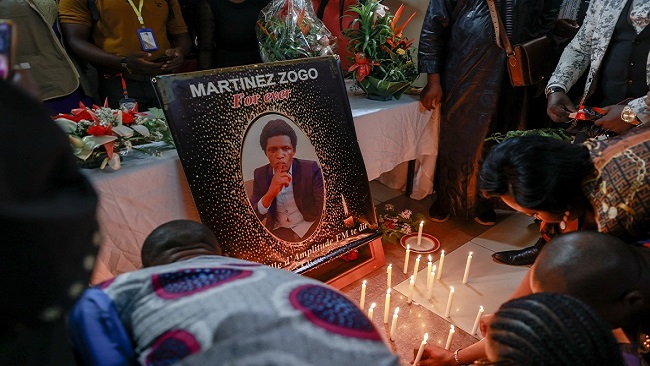
Martinez Zogo Affair: Trial delayed after witness’s Algeria trip draws defense challenge
The trial over the killing of journalist Martinez Zogo was delayed again on October 5, 2026, after the absence of prosecution witness Lt. Col. Dieudonné Bialo and the timing of an official travel order sending him to Algeria prompted a lengthy dispute before the Yaoundé Military Court.
To explain Bialo’s absence, the government prosecutor presented a mission order covering an assignment in Algeria from October 2 through October 8. According to information discussed in court, the document was issued on May 11, 2026, even though the prosecution said it learned that the witness would be unavailable only on the morning of October 5.
That timeline drew objections from some defense attorneys. Bialo had first appeared on September 15 as the prosecution’s 35th witness and was due to continue his testimony. At the start of Monday’s hearing, government prosecutor Lt. Col. André Éric Atemengue Omgba requested an adjournment because Bialo was abroad.
When the presiding judge asked for documentation explaining the witness’s absence, the prosecutor produced the mission order, which the parties were allowed to review. Issued by the defense minister, the document authorizes Bialo’s travel to Algeria as part of security cooperation between the two countries.
Mission order date challenged
Attorney Tchoungang, who represents Jean-Pierre Amougou Belinga and Bruno Bidjang, challenged the circumstances under which the court was informed of Bialo’s absence. He argued that the lieutenant colonel should have notified the court through the prosecution that he would be unavailable and requested that his testimony be rescheduled.
Tchoungang focused in particular on the date of the mission order presented in court. According to the attorney, it was issued on May 11, 2026, several months before Bialo first appeared before the court in September. He questioned why the assignment had not been disclosed during that earlier hearing.
The attorney also questioned the document’s appearance, saying it “looks like a montage” and alleging that one of the dates appeared to have been altered. Nothing presented during the proceedings reported on October 5, however, established that the document had been falsified.
Tchoungang linked Bialo’s absence to what he described as the repeated absence of military assessors over several hearings. Addressing the presiding judge, he described the situation as a “hostage-taking of your court” and accused the Defense Ministry of attempting to keep the witness away from the trial. The allegation was made by the defense and was disputed during the hearing.
The government prosecutor rejected the challenges to the mission order. Atemengue Omgba argued that the defense attorneys’ observations were not sufficient to call the document’s legality into question. He said the defense could request an expert examination if it wanted to challenge its authenticity.
On the decision to send Bialo on an official assignment while his testimony was still underway, the prosecutor said that decision fell within the authority of the defense minister.
Lawyers divided over consequences of absence
Attorney Mbuny, who represents Justin Danwe, raised the possibility of what he called a “tactical absence” by the prosecution, while acknowledging that the request for an adjournment could be accepted because the witness’s unavailability had been documented.
Mbuny nevertheless criticized the failure to disclose Bialo’s absence at the previous hearing. He also noted that the government prosecutor himself appeared to have received the information only shortly before the October 5 proceedings. Attorney Assira took a different position. He said there was no evidence that called into question either the authenticity of the mission order or Bialo’s unavailability.
Assira argued, however, that the court was not required to hear witnesses in a particular order. The prosecution could therefore call another witness to testify rather than wait for the lieutenant colonel to return.
Attorney Kenmoe, representing the civil party, also considered Bialo’s unavailability to have been established. He argued that the government prosecutor had no reason to keep away from court a witness whom the prosecution itself had called and whose testimony was intended to help support its case.
After hearing the arguments, the Yaoundé Military Court adjourned the case until October 12 and 13, 2026. Additional hearings remain scheduled for October 26 and 27. The mission order presented to explain Bialo’s absence covers October 2 through October 8.
Source: Sbbc


