French Cameroun: Rebellion Boils as Biya Seeks to Extend Rule
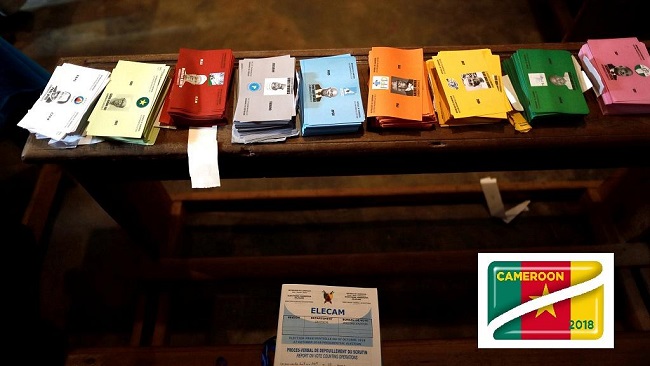
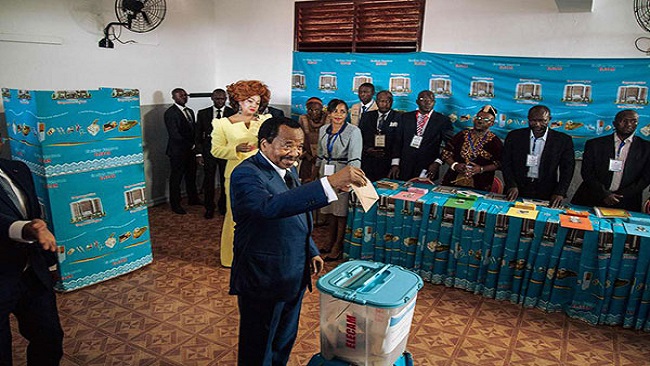
While President Paul Biya appears to be a shoo-in to extend his 36-year rule in elections next month, he’s had no success in stifling a rebellion in Anglophone regions that’s threatening to split the mainly French-speaking central African nation.
“I’m not surprised this happened,” said Agnes, a 66-year-old former civil servant who fled her farm in the Southwest Region where she’d hoped to retire and now lives with her son in the capital, Yaounde. “When there’s a lot of repression, there’s going to be an explosion,” she said, asking not to be identified by her family name.
Like Agnes, many Cameroonians are afraid to speak publicly about the country’s worst crisis in decades, fearing both the secret service and reprisals from the secessionists.
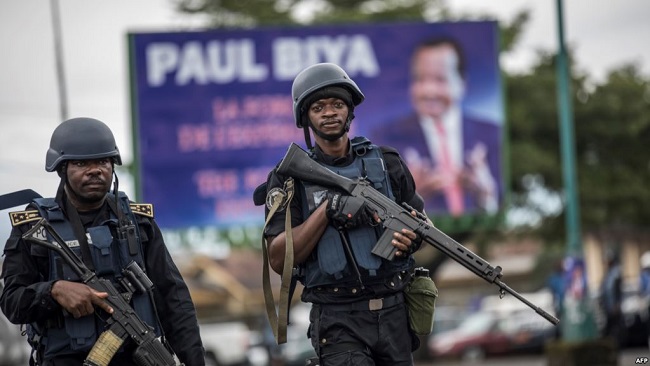
In a bid to sabotage the start of the school year this month, separatists murdered the headmaster of a primary school and abducted six girls from a secondary school. On Saturday, gunmen seized an excavator and dug a trench in a highway to the Northwest’s regional capital, Bamenda. They forced buses to stop and killed two passengers. The government responded by imposing an indefinite nighttime curfew in the Northwest Region.
Escalation of Violence
“Nothing can justify the atrocities committed by criminals who lay claim to the secessionist movement with their only goal being the disruption of the 2018-19 school year,” government spokesman Issa Tchiroma Bakary said on Twitter. “We must all condemn in the strongest possible terms this escalation of violence.”
Oil-dependent Cameroon is increasingly a key regional hub, with roads and ports that are vital for landlocked neighbors including Chad and Central African Republic.
The only country in Africa with both English and French as official languages, Cameroon was split after World War I into a French-run zone and a smaller British-controlled area. They were unified in 1961, but the English-speaking minority, about a fifth of the population, has complained of marginalization for decades. Only in recent years did the struggle become violent.
“It’s taken this magnitude because there was no anticipation and no early efforts to quickly resolve the crisis,” Manasse Aboya Endong, a political science lecturer at the University of Douala, said in an interview. “Now, the movement has been hijacked by radicals who want to split up the state and refuse all mediation.”
At the same time, advocacy groups such as New York-based Human Rights Watch have documented evidence of troops killing protesters, jailing hundreds of people and burning down villages — allegations the government denies.
Widespread Discontent
The rebellion has highlighted widespread discontent with Biya and his handling of the crisis. Biya rules mainly by decree and often spends weeks at a time at the Intercontinental Hotel in Geneva for “private visits.” Government spokesman Bakary has defended the trips, saying Biya works very hard while he’s in Europe.
Biya has convened only one cabinet meeting this year, the first since 2015, and hasn’t addressed the revolt apart from a brief statement in November. His decision to run again was announced on Twitter.
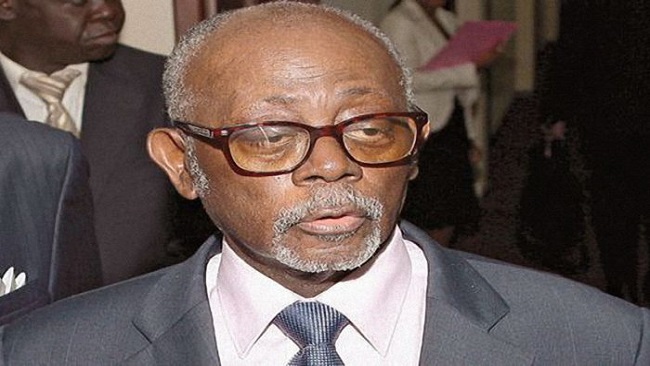
“Nobody knows what the guy is thinking,” Akere Muna, a 66-year-old opposition candidate whose late father Salomon was Cameroon’s first Anglophone prime minister, said in an interview. “We have tens of thousands of people who are internally displaced, thousands of kids who can’t go to school, and yet the president doesn’t speak. We are in a rudderless ship.”

Akere Muna
Despite Biya’s absenteeism, Cameroon’s opposition has never been able to effectively unite and unseat him in elections.
Calls for talks between the authorities and the insurgents have so far fallen on deaf ears. The government refuses to release secessionist leaders who’ve been in prison since January following their expulsion from neighboring Nigeria. That’s left the movement without a visible leadership, while Anglophones who don’t support secession are accused of being sell-outs by those who call for armed struggle.
Moderate Anglophone leaders are now pushing for a general conference to choose representatives and persuade the government to hold talks.
Initially scheduled for Aug. 28-29, the conference has been postponed to avoid tensions surrounding the presidential vote and to allow more time for Anglophones in the diaspora to attend, said Simon Munzu, a former senior United Nations official who is organizing the conference.
“We believe that this will nudge them towards a national dialogue,” Munzu said in an interview. “We can have federalism at a low cost now or separatism at an exorbitant cost on the population, and we have to weigh those costs.”
Source: Bloomberg
Russia to kick off largest drill in decades; China, Mongolia to participate
Hundreds of thousands of Russian troops will take part in the country’s largest ever military drills Tuesday, in a massive show of force featuring Chinese soldiers that has rattled the West.
The week-long deployment dubbed “Vostok-2018” (East-2018), which will kick off in eastern Siberia and includes the Chinese and Mongolian armies, has been condemned by NATO as a rehearsal for “large-scale conflict”.
President Vladimir Putin is expected to attend Vostok-2018 after hosting an economic forum in Russia’s far eastern city Vladivostok where his Chinese counterpart Xi Jinping is one of the prominent guests.
The military exercises come at a time of escalating tensions between Moscow and the West over accusations of Russian interference in western affairs and ongoing conflicts in Ukraine and Syria.
The Russian army has compared the show of force to the USSR’s 1981 war games that saw between 100,000 and 150,000 Warsaw Pact soldiers take part in “Zapad-81” (West-81) — the largest military exercises of the Soviet era.
But Defence Minister Sergei Shoigu said this time would be even larger, with 300,000 soldiers, 36,000 military vehicles, 1,000 planes and 80 warships taking part in the drills.
“Imagine 36,000 military vehicles moving at the same time: tanks, armoured personnel carriers, infantry fighting vehicles — and all of this, of course, in conditions as close to a combat situation as possible,” Shoigu said.
Latest hardware
The Russian army will roll out all of its latest additions for the event: Iskander missiles that can carry nuclear warheads, T-80 and T-90 tanks and its recent Su-34 and Su-35 fighter planes.
At sea, the Russian fleet will deploy several frigates equipped with Kalibr missiles that have been used in Syria. NATO said that Vostok-2018 “demonstrates Russia’s focus on exercising large-scale conflict”.
“It fits into a pattern we have seen over some time — a more assertive Russia, significantly increasing its defence budget and its military presence,” the alliance’s spokesman Dylan White said late August.
Last month, Kremlin spokesman Dmitry Peskov said Russia’s “ability to defend itself in the current international situation which is often aggressive and unfriendly to our country is justified, essential and without alternative”.
Relations between Russia and the West declined sharply in 2014 with Moscow’s annexation of Crimea and the subsequent conflict in eastern Ukraine. The Kremlin has also accused NATO of expanding westwards and threatening Russian national security.
Moscow has increased the number of its large-scale military exercises in the Caucasus, the Baltic and the Arctic in recent years. Russia’s previous military exercise in the region, Vostok-2014, was almost half the size, with 155,000 soldiers participating.
The country’s war games in Eastern Europe last year, Zapad-2017, saw 12,700 troops take part according to Moscow. Ukraine and the Baltic states said the true number was far bigger.
(AFP)
Bilateral deals, corporate investment to the fore as China trims state funding to Africa
China has for the first time reduced the amount of money pledged to support the promises of the Forum on China-Africa Cooperation, as elements of the event suggest a maturing of Sino-African relations.
Chinese trade with Africa has dropped significantly in recent years, down to $170 billion in 2017 from a peak of $220 billion peak in 2014. As scrutiny of China’s influence in Africa – the debts owed, political involvement via training programmes, military presence – intensifies and Beijing’s own attention is diverted by the emerging trade war with the US, the $10 billion reduction in funding announced at the 2018 FOCAC forum in Beijing this month should perhaps not be seen as a surprise.
At $60 billion, the headline figure for the mix of aid, loans and credit lines promised seems at first glance to match the amount pledged at the previous summit in Johannesburg in 2015. Up until then, the figure had grown dramatically since the triennial summits of the FOCAC programme began in 2006.
This year’s $60 billion pledge comes as more of a mixed bag for African nations, as it actually includes a $5 billion reduction in the overall amount of pledges, loans and export credits at $35 billion, down from $40 billion three years ago. However, the level of concessional assistance to Africa is now $5 billion, the highest rate ever, according to analysis by Johns Hopkins University.
Most noticeably, the figures for the various amounts of government funding add up to $50 billion, and Chinese President Xi Jinping arrived at $60 billion again by including $10 billion in extra investment that Chinese companies would be encouraged to make on the continent. No further details of this were available and Chinese companies here in Ivory Coast are not yet prepared to comment on what the announcement means for them.
Around the prearranged announcements of the forum itself were side events and bilateral meetings as the Chinese hosts sought to integrate their Belt and Road trade initiative more concretely with individual nations. Details are yet to emerge, but some African leaders entered the meetings with clear requests. For example, Kenya’s President Uhuru Kenyatta sought help for an extension for the country’s troubled railway project that has previously been financed by China.
At the continental level, President Xi outlined eight areas of initiative and cooperation including industrialisation and agriculture hailed by the FAO; healthcare, hailed by the WHO; aligning with the African Union’s Agenda 2063 development plan; security and green development, an area in which China is the global leader.
China’s ‘five-no’ pledge
While some African nationals took to social media to criticise their leaders for what they believed was the blind acceptance of Beijing’s will, the mood at the events in the Chinese capital was of genuine cooperation. According to sources at the event, the announcements most welcomed by African delegates were the “five-no” promises, the clarification of five things that China will not do in Africa.
In the Chinese president’s own words there will be “no interference in African countries’ pursuit of development paths that fit their national conditions; no interference in African countries’ internal affairs; no imposition of our will on African countries; no attachment of political strings to assistance to Africa; and no seeking of selfish political gains in investment and financing cooperation with Africa”.
These declarations are a direct response to the growing criticism, predominantly by the West, of what is being called Chinese neo-colonialism across the continent – the notion of saddling countries with debt for useless projects as a way to secure resources. For example, over 90% of Djibouti’s external debt is held by China.
South African President Cyril Ramaphosa, who co-chaired the event with China’s Xi, said at the forum, “In the values that it promotes, in the manner that it operates, and the impact it has on African countries, FOCAC refutes the view that a new colonialism is taking hold in Africa, as our detractors would have us believe”.
Ramaphosa went on to state that: “We are working [together] to build an Africa that is defined by good governance, democracy, respect for human rights, justice and the rule of law,” listing all the areas in which China is most criticised by the West.
The forum’s announcements were immediately accompanied by supportive editorials from China’s state media. The People’s Daily, the publication seen as the most direct link to the Communist Party, pushed out fact sheets on social media defending China’s involvement in Africa.
Back in China, the announcements of funding led to criticism online by Chinese citizens complaining about the amount of money being sent overseas when parts of their own country are extremely poor. Such comments were promptly removed by censors.
It will take some time for the details of the 2018 event to emerge, but the China International Import Expo later this month in Shanghai is now the next China-Africa date on the calendar after Xi announced reduced or free participation for African nations and pledged to create a specific China-Africa trade expo.
The FOCAC events started at the request of African leaders 18 years ago to make bilateral relations more transparent. The triennial summits alternate between China and an African nation playing host. The 2021 FOCAC gathering will take place in Senegal.
Source: France 24
EU negotiator says Brexit deal possible in 6-8 weeks
The European Union’s chief negotiator for Brexit has indicated that a deal with the United Kingdom on the country’s departure from the bloc would be possible by November.
Michel Barnier said Monday that if the EU and the UK could stick to the realities on the ground, a deal on Brexit would be in their reach.
“I think that if we are realistic, we are able to reach an agreement on the first stage of the negotiation, which is the Brexit treaty, within six or eight weeks,” said Barnier while in Slovenia for a forum.
The French diplomat made the remarks after British authorities set November as the deadline for a deal on Brexit, saying any agreement after that would make it difficult to gain the parliamentary approval needed before Britain officially leaves the EU at the end of March.
Barnier endorsed that notion and said that a deal before that deadline would be possible.
“Taking into account the time necessary for the ratification process, the House of Commons on one side, the European Parliament and the Council on the other side … we must reach an agreement before the beginning of November,” he said, adding, “I think it is possible.”
The announcement was a huge boost for the British pound as it was traded on a five-week high of $1.3052, while it also rose around 0.3 percent against the euro. It came against the backdrop of warnings that Britain could crash out of the EU without a deal to regulate trade and other issues in future.
Fears about a no-deal Brexit had intensified in early July when Britain submitted its final proposals for reaching a deal. Barnier and other EU officials rejected many of the UK’s demands, especially those concerning the situation of the Irish border.
Reports have suggested that the two sides still vastly differ on how to treat the border between the UK province of Northern Ireland and EU member Republic of Ireland once Britain has left the EU.
Source: Presstv
Nigeria: Senate president submits presidential nomination forms
Nigeria’s Senate President, Abubakar Bukola Saraki, has submitted nomination forms he picked up for the presidential candidacy race of the main opposition Peoples Democratic Party, PDP.
Saraki wrote on Twitter that he had submitted the presidential nomination and expression of interest forms to the PDP at the Abuja headquarters of the party, adding “It is time to #GrowNigeria!”
Saraki defected from the ruling All Progressives Congress, APC, in late July and quickly joined the PDP. His quit message read: “I wish to inform Nigerians that, after extensive consultations, I have decided to take my leave of the All Progressives Congress (APC).”
After giving reasons among others that the APC had failed to deliver on the promises that brought them to power in 2015, he declared his presidential ambition almost a month later on August 30.
He is reported to have quit the APC seeing that incumbent Muhammadu Buhari had expressed interest in seeking a second and final term in office. Saraki, a former Kwara State governor on the ticket of the PDP, will come up against a number of heavyweights.
Former vice president Atiku Abubakar and former Kano State governor Muhammed Rabiu Kwankwaso are two main challengers Saraki will face in the PDP primaries.
He has fended off calls to resign his post ad leader of the Senate because it was a post he got by being an APC member. He insists that it is a role he got from colleague senators and not the party.
APC leadership are on record to have threatened to impeach him if he fails to step down. The Senate is currently on recess and is not known when it will be reconvened.
Source: Africa News
Cameroon No Longer Under President Biya’s Control, CPDM baron Says
A senior member of the Yaoundé Francophone regime has told Cameroon Intelligence Report that the country is no longer under the control of President Biya and his forces. The French Cameroun political elite who hail from the South region also said the Ambazonian Restoration Forces stand a better chance of taking control of more territory deep inside French Cameroun.
The CPDM MP and Central Committee member who sued for anonymity further pointed out that the mismanagement of the crisis in Southern Cameroons and Biya regime’s excessive use of force against innocent Ambazonian civilian population has made the situation more intractable.
An indefinite dusk to dawn curfew has been imposed on Southern Cameroon’s Northern Zone after the Minister of Territorial administration, Paul Atanga Nji and his gang reportedly staged armed attacks on buses in Bamenda late on Saturday and blamed it on the Ambazonian Restoration Forces.
Cameroon Intelligence Report understands the Francophone Northwest governor Adolphe Lele Lafrique said the curfew between 6pm and 6am from Sunday will remain effective till further notice. The attack on buses is also apparently the reason that the Francophone army retreated from the Southern Cameroons suburbs to the main motorways linking French Cameroun to Southern Cameroons.
Cameroon government sources have also reported that the 85 year-old President Biya has for the 9th time decided to split the responsibilities of his top military officers, taking away from non Beti Ewondo army generals the sole mandate for dealing with the crisis that has gripped La Republique du Cameroun in the Far North, the East and presently in Southern Cameroons.
The mandate in Buea, the chief city in the Southern Zone was recently passed partly to a Francophone colonel after General Melingui was sacked and ever since he took over control, the colonel has been responsible for military operations and repression including arrest of Southern Cameroons resistance forces. Cameroon Intelligence Report also gathered that President Biya’s relatives in the army and in the gendarmerie are now imposing a blockade on families of the Cameroon political establishment, in order to prevent them from leaving the country.
If these intelligence that were handed over to our senior political correspondent in Yaoundé are correct, they point to a very heavy pressure on Biya and his French backers, and indicate fear bordering on hysteria as to what is happening in the nation’s capital.
Despite troubling signs of a major crack within the army and the police, the highest ranks of the military billionaires are still loyal to the CPDM regime. Many junior officers who were recently deployed to Southern Cameroons simply defected and escaped to the Ivory Coast via Nigeria. It is not clear whether the Ivorian government is aware of the presence of many French speaking Cameroonian soldiers on its territory.
Violence continued over the week end as the Ambazonian Interim Government reported that several Southern Cameroons civilians were killed by Cameroon government forces in restive areas on the outskirts of Buea, Bamenda, Manyu and Wum Counties.
The deaths in the Wum and Mamfe areas included 27 teenagers and two women. The African Union and the UN Security Council are not seeking military action to end the bloodshed in Southern Cameroons.
By Soter Tarh Agbaw-Ebai
Tanzanian president seeks end to birth control
President John Magufuli has urged Tanzanian women to “give up contraceptive methods,” insisting his country needs more people, local media reports.
“You have cattle. You are big farmers. You can feed your children. Why then resort to birth control? This is my opinion, I see no reason to control births in Tanzania,” Magufuli said in a speech on Sunday, according to The Citizen daily newspaper.
“I have traveled to Europe and elsewhere and have seen the harmful effects of birth control. Some countries are now facing declining population growth. They are short of manpower.”
Magufuli urged Tanzanians to ignore bad advice disseminated by outsiders saying, “It is important to reproduce.”
“Women can now give up contraceptive methods,” he added.
Tanzania has a population of around 60 million people, up from 10 million at independence in 1961.
The UN predicts Africa’s population will double to around 2.5 billion by 2050, leading to warnings of a demographic time bomb if economic growth and job creation cannot keep up.
(Source: AFP)
US threatens to arrest ICC judges if they pursue Americans for Afghan war crimes
The United States threatened Monday to arrest and sanction judges and other officials of the International Criminal Court if it moves to charge any American who served in Afghanistan with war crimes.
White House National Security Advisor John Bolton called the Hague-based rights body “unaccountable” and “outright dangerous” to the United States, Israel and other allies, and said any probe of US service members would be “an utterly unfounded, unjustifiable investigation.”
“If the court comes after us, Israel or other US allies, we will not sit quietly,” Bolton said.
He said the US was prepared to slap financial sanctions and criminal charges on officials of the court if they proceed against any Americans.
“We will ban its judges and prosecutors from entering the United States. We will sanction their funds in the US financial system, and we will prosecute them in the US criminal system,” he said.
“We will do the same for any company or state that assists an ICC investigation of Americans,” he said.
Bolton made the comments in a speech in Washington to the Federalist Society, a powerful association of legal conservatives.
Investigation into detainee abuse
Bolton pointed to an ICC prosecutor’s request in November 2017 to open an investigation into alleged war crimes committed by the US military and intelligence officials in Afghanistan, especially over the abuse of detainees.
Neither Afghanistan nor any other government party to the ICC’s Rome Statute has requested an investigation, Bolton said.
He said the ICC could formally open the investigation “any day now.”
He also cited a recent move by Palestinian leaders to have Israeli officials prosecuted at the ICC for human rights violations.
“The United States will use any means necessary to protect our citizens and those of our allies from unjust prosecution by this illegitimate court,” Bolton said.
“We will not cooperate with the ICC. We will provide no assistance to the ICC. We certainly will not join the ICC. We will let the ICC die on its own.”
‘Threat’ to US sovereignty
The condemnation of the ICC added to the White House’s rejection of many supranational institutions and treaties the president does not believe benefit the United States.
Bolton also condemned the record of the court since it formally started up in 2002, and argued that most major nations had not joined.
He said it had attained just eight convictions despite spending more than $1.5 billion, and said that had not stemmed atrocities around the world.
“In fact, despite ongoing ICC investigations, atrocities continue to occur in the Democratic Republic of the Congo, Sudan, Libya, Syria, and many other nations.” he added.
But Bolton said the main objection of the administration of President Donald Trump is to the idea that the ICC could have higher authority than the US Constitution and US sovereignty.
“In secular terms we don’t recognize any higher authority than the US constitution,” he said.
“This president will not allow American citizens to be prosecuted by foreign bureaucrats, and he will not allow other nations to dictate our means of self defense.”
(AFP)
Southern Cameroons Crisis: Northern Zone hit by French Cameroun dawn-to-dusk curfew
An indefinite dusk to dawn curfew has been imposed on the English-speaking Northwest Cameroon after armed separatists attacked buses and blocked access into the regional capital, Bamenda late on Saturday.
Northwest governor Adolphe Lele Lafrique said the curfew between 6pm and 6am from Sunday will remain effective till further notice.
“During the said period, movements of vehicles, persons and goods shall be strictly forbidden. All off licences, snack bars and night clubs shall remain closed….and night travel suspended,” the governor’s order reads.
The restriction that exempts administrative authorities, law and order agencies, persons and vehicles in possession of special authorisations and ambulances, came a day after armed separatists attacked buses and passengers and obstructed movement into and out of Bamenda.
Partially damaged
Over 20 70-seat passenger buses were blocked at Akum on the outskirts of Bamenda Sunday morning, with some partially damaged.
A trader, Mr Gideon Fai, who was traveling to Douala, recounted on phone that gunmen stopped and ordered them out of their bus, then forced them to tear off the Cameroon flag from their national identity cards.
The men had dug a trench across the road with the help of an excavator from a road construction company. They later set the excavator ablaze.
Separatist groups claimed responsibility for the attack on social media, saying it was part of a plan to stop military reinforcement from other regions and also to disrupt the presidential election scheduled for October 7.
The anglophone separatist activists who have been clamouring for secession and the creation of the Republic of Ambazonia, have warned that they would not allow any election organised by the Yaoundé regime to take place in “their country”.
They have also warned that no buses would be allowed into or out of the English-speaking northwest and southwest regions after September 15.
Strikes and protests
The almost two-year long violence that has gripped the English-speaking regions started as an industrial strike by lawyers and teachers, but escalated into an internal armed conflict with fears the Central African country could slide into a civil war if the violence persists.
Violence and unrest escalated in late 2016 after a series of strikes and protests against what teachers, lawyers and students viewed as further discrimination against Anglophones. Between September 22 and October 1, 2017, large-scale protests were organised across the Anglophone regions to symbolically proclaim the independence of a new state of Ambazonia, but the government responded with violent repression.
Recurrent confrontations between armed separatists and government troops have led to the killing of dozens of people, hundreds others imprisoned while thousands have been forced out of their homes.
The UN Office for the Coordination of Humanitarian Affairs (Ocha) estimates that some 160,000 people have fled their homes in the strife-hit regions into the bushes, while more than 21,000 have crossed to next door Nigeria as refugees.
Source: The East African
Ecobank announce Winners of 2018 Fintech Challenge
Winners of the 2018 Ecobank Fintech Challenge were announced at a ceremony held at Ecobank’s (Ecobank.com) headquarters in Lome, Togo on 30th August 2018. Nala, from Tanzania, beat the ten other finalists to emerge as the overall winner of the competition. Virtual Identity from South Africa and Wallet.ng from Nigeria were the first and second runners up. They won cash prizes worth US$10,0000, $7,000 and US$5,000 respectively.
Nala, based in Tanzania, is a mobile money application that works offline, without an internet connection. Nala provides a unified user experience in which multiple financial services can be connected on one application. It can host multiple SIMs, enabing users to manage their spending and take control of their finances.
Second placed Virtual Identity is an innovative platform designed to disrupt traditional customer onboarding for banks. The process is fully digital, creating a virtual video conferencing link between the agent and the customer. Its easy to use web-based solution allows the client to complete tedious KYC processes from anywhere, making it both convenient and time saving.
The third placed prize winner, Wallet.ng, is a start-up providing an alternative bank for a growing generation of digital natives. Its core strength is building a banking platform that is as native to customers’ devices as Facebook and WhatsApp.
Ade Ayeyemi, Ecobank Group CEO praised the finalists for their innovative solutions and welcomed them to the Fellowship: “We are proud of the impressive start-ups that made it to our 2018 final. They are shining examples of the entrepreneurial spirit and creativity that will propel our continent’s global competitiveness in the commercial services markets, and I sincerely expect some, if not all, of them to be the business titans of tomorrow. They have my congratulations and we look forward to working closely with all eleven Fellows over the next year to deliver innovative banking services at better price-points that will improve the lives of Africans.”
This year’s Fintech Challenge was keenly contested with applications from over 412 innovative fintech entrepreneurs from across Africa, Europe, North America and Asia. All eleven (11) finalists were inducted into the Ecobank Fintech Fellowship, a one-year business program where they can explore opportunities for commercial partnerships with the Ecobank Group, to launch and scale products across Ecobank’s 33 country markets in the continent.
Launched in 2017, the second year of the Ecobank Fintech Challenge brought together fintech start-ups and innovators, policy makers, investors and development organisations from across the world to network, witness the 2018 finalists’ exhibitions, and celebrate the induction of the finalists into the 2018 Ecobank Fintech Fellowship.
Also present at the finals was the Honourable Alhaji Dr. Ibrahim Awal Mohammed, Minister of Business Development of Ghana, who commended Ecobank for this initiative and urged more support for young African entrepreneurs to improve job creation on the continent.
The Ecobank Fintech Challenge and Fellowship is designed and managed by the advisory firm Konfidants and supported by FMO, Microsoft4Afrika, Accion Venture Labs, Cellulant and FinConecta.