
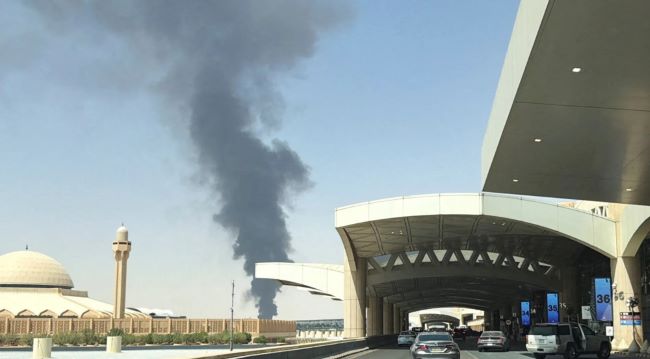
At least 12 killed, multiple people wounded in attack on Riyadh airport
Saudi Arabia’s General Authority of Civil Aviation (GACA) has admitted that an attack on King Khalid International Airport in Riyadh on Saturday left at least 12 people dead and 309 others wounded, some critically, forcing the suspension of all flights and the evacuation of the facility.
In a follow-up statement carried by the Saudi Press Agency on Saturday, GACA said the fatalities included four Saudi nationals, two Bangladeshis, one American, one Egyptian, one Jordanian, one Syrian, one Palestinian and one Sudanese.
The wounded are receiving treatment at multiple hospitals. Property damage is still being assessed.
All operations at the capital’s main airport were halted, with hundreds of flights cancelled or diverted over the preceding day.
The blast, reported in the afternoon, prompted the immediate evacuation of passengers as ambulances rushed to the scene. Witnesses described chaos inside the terminal, including reports of a strike hitting near a domestic departure gate.
The incident marks the latest in a series of operations by Yemen’s armed forces targeting Saudi aviation and military sites in direct retaliation for Riyadh’s intensive military aggression and the operations of its mercenary forces inside Yemen.
Yemeni forces, led by Ansarallah, had already carried out missile and drone strikes on King Khalid Airport earlier in the week, which Saudi authorities themselves linked to the deaths of Saudi nationals, including a pilot, and damage to a Saudi aircraft, alongside earlier strikes on Abha and other airports.
Brigadier General Yahya Saree, spokesman for the Yemeni armed forces, has repeatedly announced precise hits on the Riyadh airport and other Saudi targets in recent days, while warning international airlines that Saudi airspace (outside the holy cities of Mecca and Medina) has become a theater of military operations.
Yemen has called these actions a necessary response to Saudi Arabia’s ongoing airstrikes, ground offensives under operations such as “Dawn of Yemen,” and efforts to reverse Ansarallah advances near the Bab al-Mandeb Strait.
Riyadh has sought to minimize the strikes’ impact even as major international carriers cancel flights to the kingdom’s primary aviation hub for days or weeks ahead.
The latest high-casualty attack underscores the reach of Yemen’s missile and drone capabilities deep into Saudi territory and the continued vulnerability of civilian infrastructure despite years of Saudi air-defense investments.
The escalation is the latest in a renewed confrontation between Yemen and Saudi Arabia, which began in July after Saudi Arabia bombarded areas around the main airport in the Yemeni capital, Sana’a.
The attacks caused Yemen to announce a new phase of counter-operations to break a decade-long crippling economic siege imposed by Saudi Arabia on the country.
The Yemenis have carried out extensive drone and missile attacks on energy infrastructure in Saudi Arabia while advancing to areas near the Strait of Bab el-Mandeb in the Red Sea in an attempt to restrict the kingdom’s access to the waterway for oil exports.


