
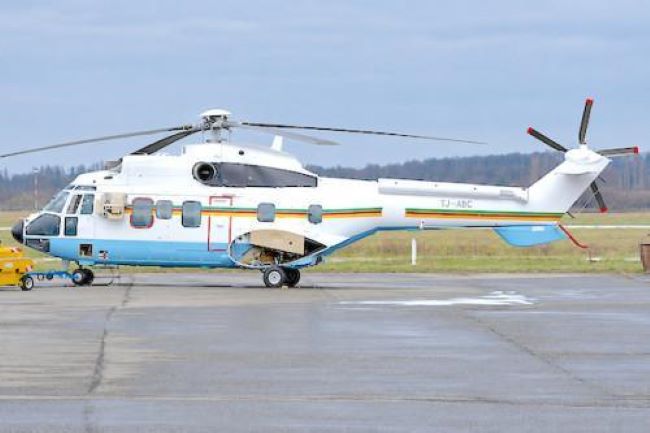
Biya’s $660,000 presidential helicopter payment caught in Qatar liquidation
Cameroon is trying to recover $660,000 about CFA355 million allegedly paid in 2018 to complete repairs on a helicopter intended for the president, but its attempt to reclaim the money from the liquidation of a Qatari company has yet to clear a key procedural hurdle.
The claim, filed on Cameroon’s behalf with the Civil and Commercial Court of the Qatar Financial Centre on January 21, 2025, concerns funds in the liquidation of Horizon Crescent Wealth LLC, or HCW.
According to the filing, Cameroon had contracted with an HCW subsidiary to repair the helicopter. In January 2018, it allegedly paid $660,000 to settle the remaining amount and allow the work to be completed. The money, however, was allegedly transferred to HCW itself rather than the subsidiary that was party to the contract, before the company’s accounts were frozen.
A February 24, 2025 court decision recounts those claims but does not determine whether they are valid. It establishes neither the terms of the contract nor whether the repairs were completed, and it does not confirm that the $660,000 was among the assets recovered in the liquidation.
The payment trail also remains unclear. The ruling does not identify the subsidiary involved or explain why money allegedly owed to it was transferred to its parent company. It provides no beneficiary account, helicopter model or registration number, or total contract price. It also does not identify the Cameroonian authority that authorized the expenditure or state whether the repairs were ultimately completed.
A Property Claim, Not an Ordinary Debt
Cameroon is not presenting itself as an ordinary creditor seeking repayment of a debt. Instead, the filing asserts that the country owns the funds, an approach the Court likened to a trust-based claim.
That distinction could affect how the $660,000 is treated in the liquidation. If assets are recognized as being held for a third party, they do not belong to the liquidated company and, in principle, cannot be used to pay its debts.
The claimant must still establish its ownership rights and link the disputed funds to assets that remain available. That becomes more difficult when money has been mixed with other assets, as a February 12, 2026 appeals ruling on claims by trust beneficiaries explains. The Court did not reach those questions in Cameroon’s case. It stopped at an earlier issue: whether the lawyer who submitted the claim had authority to act on behalf of the state.
Power of Attorney Stalls Cameroon’s Claim
Swiss lawyer Jean Orso of Geneva-based Orso Avocats is identified as counsel for Cameroon. The power of attorney submitted to the Court was dated January 17, 2025, four days before the restitution claim was filed.
It had been signed by another Geneva lawyer who held a September 2018 mandate to represent Cameroon in a dispute with an HCW subsidiary. The available documents, however, do not identify the Cameroonian authority that issued the original mandate or establish whether it permitted such a delegation.
The judges found that this chain of powers of attorney was insufficient to establish Orso’s authority. In its February 24, 2025 decision, the Court required “proper authorisation.”
The ruling was strictly procedural. It neither awarded the funds to HCW nor rejected Cameroon’s underlying claim.
Jean Orso Previously Represented HCW
The situation is more unusual because Orso previously represented HCW and its executives in the same liquidation proceedings.
In December 2023, Orso Avocats informed the Court that it had taken over HCW’s defense. Orso later represented the company before the appellate division, which refused on April 15, 2024 to allow HCW to challenge its liquidation.
In July 2024, another ruling still identified him as counsel for HCW’s executives in an attempt to replace the liquidator. Then, on January 17, 2025, a power of attorney was issued for him to represent Cameroon in its claim to part of the funds held in the liquidation.
That switch raises the question of a potential conflict of interest. Swiss law requires lawyers to avoid conflicts between clients’ interests. Case law, however, requires a concrete risk, assessed in part through the relationship between the mandates and the potential use of confidential information obtained during previous representation.
The Qatari decisions do not provide enough information to determine whether those conditions apply to Orso’s case.
HCW, a Sanctioned Trust Administrator
HCW was established in the Qatar Financial Centre in February 2015 and was authorized to administer trusts, but not to conduct regulated financial activities such as asset management. Between May and August 2017, about €12.5 million, or CFA8.2 billion, was deposited into Qatar National Bank accounts held in HCW’s name. The accounts were frozen in February 2018 after regulators opened an investigation amid money-laundering suspicions.
Orso maintains that Cameroon’s $660,000 payment, allegedly made shortly before the freeze, was among the immobilized funds. Public court decisions, however, provide no bank statement or tracing evidence that isolates the amount within the frozen assets.
The Qatar Financial Centre Regulatory Authority later identified serious deficiencies in HCW’s anti-money-laundering controls. In 2019, the regulator imposed penalties totaling 30 million Qatari riyals for violations that included failures to comply with anti-money-laundering rules, the apparent conduct of unauthorized asset-management activities and the provision of false or misleading information.
The Qatar Financial Centre Authority separately imposed a $280,000 penalty. Those sanctions provide context for the account freeze and liquidation but do not establish that Cameroon’s disputed $660,000 was connected to illegal activity.
HCW ultimately entered liquidation in December 2023. The Court cited its insolvency and the need to identify the true owners of the remaining funds. By February 2024, four filed claims totaled 51.88 million riyals, including more than 48 million claimed by Qatari authorities.
Cameroon Still Must Establish Ownership
Other claimants have since secured recognition of rights over some funds held in trust. In February 2026, the appellate division authorized the liquidator to pay three beneficiaries, although that authorization does not establish that the payments were actually made.
At that point, the liquidator held about 38.06 million riyals and estimated net available assets at 34.67 million. After accounting for the three recognized claims, about 30.28 million remained against nearly 49 million in preferential claims. The Court therefore expected no funds to remain for other creditors unless additional assets were recovered.
For Cameroon, the financial stakes hinge on establishing ownership of the disputed $660,000 rather than merely securing recognition as a creditor. If its ownership claim succeeds, the funds could fall outside the ordinary creditor priority order.
The public decisions reviewed to date do not show whether Cameroon subsequently provided the required authorization, whether its ownership claim was ultimately considered on the merits or whether any of the money was returned.
Source: Business in Cameroon


