
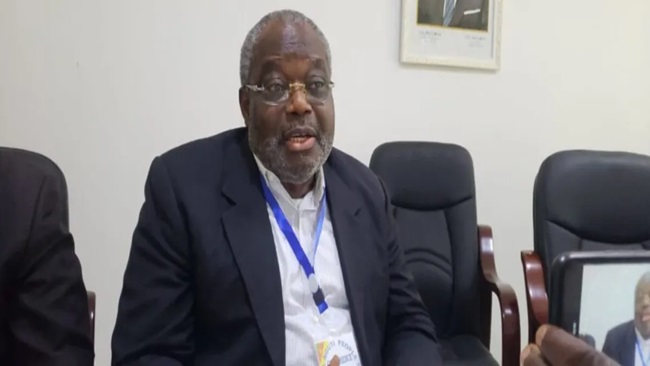
Hope Sona Ebai: iconic South West figure goes home to rest
The passing to eternity of the renowned board chairman of the Cameroon Development Corporation (CDC), His Royal Highness Chief Hope Sona Ebai is not merely the departure of a great South West business and political figure; it is the quiet dimming of a particular kind of leadership in Anglophone Cameroon forged not in the spotlight of daily operations, but in the steady glow of stewardship.
Chief Hope Sona Ebai as board chairman of the CDC will always live in the margins of Cameroon history. He was never the loudest voice in the room but this fertile mind from Manyemen town was often the final one to speak each time President Biya tasked South West elites with holding both ambition and restraint in delicate balance.
When such a very powerful and refined intellectual figure passes, what lingers is not simply his résumé or the shareholder value accrued under his watch both in Cameroon and Nigeria. It is the tone they set. The culture they guarded and the productive moments deep within the International Cocoa Organization (ICCO) the world’s leading cocoa authority and Cameroon’s National Cocoa and Coffee Board (ONCC).
His Royal Highness Chief Hope Sona Ebai understood that power, at its best, is custodial. To him, power is borrowed and it is temporary and must be exercised with humility. His true work as a prominent South West elite was often preventative and he always reminded English speaking Cameroonians to look at the bigger picture. In everything he did during his time in the National Cocoa and Coffee Board, Chief Hope Sona Ebai reminded everyone around him that legacy matters and that trust, once fractured, rarely fully returns.
The passing of such a great figure from the Nguti sub constituency in the South West region invites uncomfortable introspection and begs some seventy million dollar questions: what does governance mean in an age of relentless acceleration? Who guards the guardians? Are Cameroonian boards still sanctuaries of independent judgment, or have they become ceremonial extensions of executive ambition?
As a distinguished chairman of the CDC, Chief Hope Sona Ebai’s life offered both inspiration and warning. Inspiration, because Chief Hope Sona Ebai was a very principled gentleman who shaped the CDC establishment and warning, because his absence now leaves a vacuum — not just of authority, but of moral gravity.
In mourning Chief Hope Sona Ebai, we are reminded that leadership at the highest levels is less about control and more about conscience. His role at the CDC though symbolic, represented something profound. Chief Hope Sona Ebai had the discipline to listen, the courage to take action and the wisdom to step back when necessary.
All in all, perhaps the measure of a successful board chairman during this difficult period in Anglophone Cameroon is this: Did the CDC become stronger than Chief Hope Sona Ebai? Did CDC learn to govern itself with integrity as taught by Chief Hope Soan Ebai? Is CDC now serving not only its investors, but its employees, its communities, and its future?
When such a man with a good heart and a good head on his shoulders passes, the biggest agro-industrial plant in West Africa may open the next morning as usual. But inside the halls Chief Hope Sona Ebai once presided over, there will be silence — and within that silence, a question.
Who will now hold the long view?
Chief Hope Sona Ebai was appointed chairman of the board of directors of the CDC on 27 May 2021. An internationally renowned expert in the cocoa sector, he was an unsuccessful candidate in 2016 for the position of Executive Director of the International Cocoa Organisation (ICCO).
He was the first General Manager of Cameroon’s National Cocoa and Coffee Board (ONCC) and had nearly 30 years of experience in the cocoa economy in Cameroon, Africa and around the world. After heading the ONCC for seven years, Chief Hope Sona Ebai spent 11 years as Secretary General of the Cocoa Producing Countries Alliance (COPAL), which accounts for 75% of global cocoa bean production. From this position at COPAL, he was instrumental in organizing the summits of heads of state of African cocoa-producing countries in Abuja in 2006 and Accra in 2007. He was also credited with organizing four international conferences on cocoa research.
His arrival on the board of directors of the CDC, Cameroon’s second largest employer after the public administration greatly contributed to the product diversification that the CDC has been seeking for several years.
By Soter Tarh Agbaw-Ebai


