
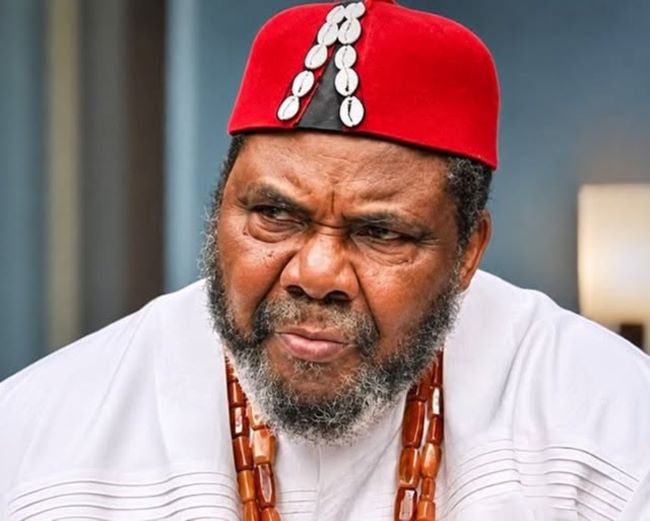
Pete Edochie: An Iroko Falls
Most actors spend careers trying to disappear into roles. Pete Edochie achieved the opposite. His roles disappeared into him
Africa occasionally produces figures so commanding that they transcend their profession and become institutions unto themselves. Peter Uwadiegwu Ogugua Edochie, better known as Pete Edochie was one such man. His death at 79 years of age, closes a chapter in the story of Nigerian cinema, but not in the story of African culture, where his voice, bearing and wisdom will continue to echo for generations. He died in Enugu on November 25, 2026, ending a career that spanned broadcasting, television and film, and made him one of the most recognizable faces on the continent. In the crowded pantheon of African popular culture, few figures became quite so synonymous with authority as Pete Edochie. Generations of filmgoers knew immediately what to expect when he appeared on screen: a deep baritone voice, a measured stare, a proverb sharpened into a weapon, and the distinct possibility that somebody was about to learn an unforgettable lesson. He leaves behind not merely a filmography but a continental cultural archetype. Most actors spend careers trying to disappear into roles. Pete Edochie achieved the opposite. His roles disappeared into him.
Long before Nollywood became a global brand, Pete Edochie had already mastered the art of commanding an audience. Born March 7, 1947, he started not as an actor but as a broadcaster, joining the Eastern Nigerian Broadcasting Corporation in 1967 and rising through the ranks before cinema claimed him. Yet it was a fictional Igbo warrior who would immortalize him. His defining moment came in 1987, when he played Okonkwo in the Nigerian Television Authority [NTA] adaptation of Chinua Achebe’s Things Fall Apart. It was one of those rare performances that seemed less an interpretation than an incarnation. It was not merely a performance. For millions who had read Achebe’s masterpiece, Edochie became Okonkwo. The stern gaze, the thunderous diction, the tragic pride. Through him, one of Africa’s greatest literary characters acquired flesh and blood. For many Africans, Achebe wrote Okonkwo; Edochie became him. The role could easily have trapped a lesser actor. Instead, it liberated him. As Nollywood exploded into one of the world’s largest film industries, Edochie became its resident monarch, patriarch and custodian of tradition.
Audiences rarely remembered the titles of all his films. They remembered him. Kings, chiefs, elders, titled men and guardians of tradition all seemed to find their natural home in his imposing frame. His deep baritone voice carried the weight of ancestral authority. His gift was not subtlety. It was gravitas.
At a time when cinema increasingly rewarded noise, Edochie mastered stillness. He did not need special effects to dominate a scene. A raised eyebrow, a pause, a proverb delivered with surgical precision often proved sufficient. His dialogue often sounded less scripted than inherited. The proverbs for which he became famous were delivered with such conviction that they became part of popular culture. “A man who pays respect to the great paves the way for his own greatness,” became one of his most quoted lines. So, too, did variations of the old maxim: “When a child washes his hands, he dines with kings.”
Whether scriptwriters borrowed from tradition or tradition borrowed from him eventually became difficult to determine. Africans quoted him not simply because he sounded wise, but because he made wisdom sound eternal.
Like Sean Connery was to James Bond, Pete Edochie became larger than the roles he played. His name evolved into shorthand for dignity, gravitas and authentic African masculinity. In homes across Africa and beyond, his presence on screen signaled that a lesson, a rebuke or a profound truth was about to be delivered. Edochie eventually stopped portraying authority and started embodying it. He became a reference point. Younger actors measured themselves against him. Memes introduced him to audiences who had never watched his classic films. Yet even in the age of social media, he remained unmistakably old-fashioned: dignified, deliberate and unapologetically African. Honours followed, including the national award of Member of the Order of the Niger and multiple lifetime achievement recognitions. Such distinctions seemed almost beside the point. His real achievement was helping give Nollywood its moral center of gravity. His true award was affection. Audiences did not merely admire him; they trusted him.
The family announcement of his passing carried a simple headline: “An Iroko Has Fallen.” It is difficult to improve upon that verdict. Economists admire institutions. Africans admire iroko trees. Pete Edochie, improbably and magnificently, managed to become both. For nearly six decades, Pete Edochie stood like that great tree: rooted, towering and unmistakably African. In death, as in life, he reminds a continent that true greatness is not measured by fame alone, but by the ability to embody a people’s values. The actor has departed. The legend has not. May Pete Edochie reincarnate as an African.
By Ekinneh Agbaw-Ebai


