
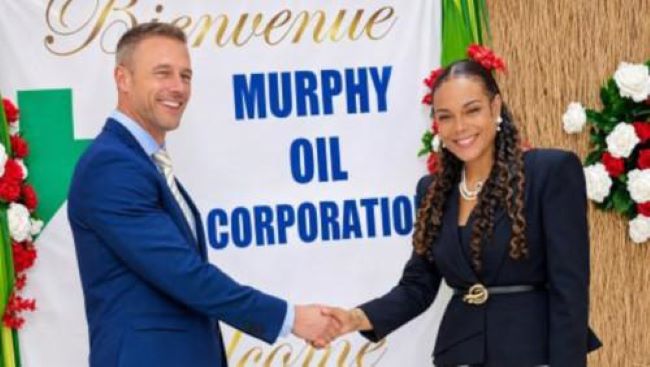
Murphy Oil signs 4 Cameroon offshore deals
U.S. oil company Murphy Oil Corporation signed four production-sharing contracts (PSCs) with Cameroon on November 11, 2026, in Yaoundé, covering the Etinde Exploration, Tilapia, Elombo and Ntem offshore blocks in the Douala/Kribi-Campo Basin. Together, the blocks span 10,578.13 square kilometers. The associated exploration program is valued at an estimated $202.4 million (CFA113.3 billion), but nearly 99% of that amount is tied to drilling commitments that depend on optional extensions of the exploration permits.
A joint statement from the National Hydrocarbons Corporation (SNH) and Murphy announced an investment of approximately $200 million (CFA112 billion) over a period of up to seven years. However, details presented at the signing ceremony by Claudine Manga, chair of the Permanent Commission for the Negotiation of Oil and Gas Contracts, provide a clearer picture of how the funds would be spent.
During the initial three-year exploration period, Murphy Cameroon Exploration & Production SASU must spend at least $600,000 (approximately CFA336 million) per block on “reprocessing seismic data and conducting detailed geoscience studies,” according to Manga. That brings the minimum expenditure for the four blocks during the initial period to $2.4 million (approximately CFA1.34 billion). The work is intended to improve geological knowledge of the exploration areas before any potential drilling.
Up to Eight Exploration Wells, Subject to Contract Extensions
The contracts allow for two successive two-year extensions. Most of the anticipated investment would take place during these additional periods. “At each renewal, MURPHY undertakes to drill one (01) exploration well at an estimated cost of US$25 million,” Manga explained.
If the first extension is granted for all four blocks, Murphy would drill four wells at an estimated cost of $100 million (CFA56 billion). A second extension, if granted and exercised across all four blocks, would bring the program to eight wells and total drilling expenditure of $200 million (CFA112 billion).
Including the $2.4 million allocated to the initial exploration period, the total commitment outlined by the negotiation commission reaches $202.4 million. Of that amount, $200 million, or 98.8%, is tied to the optional extensions.
The signing of the four PSCs therefore does not guarantee that all the announced investment will materialize. Actual spending will depend in part on the results of the initial studies and whether exploration continues beyond the first three years. There is also a discrepancy between the program announced on November 11 and the requirements originally set by SNH. In its August 1, 2025, call for expressions of interest, the state-owned company required at least one exploration well to be drilled during the initial exploration period for the same blocks, along with the acquisition of 3D seismic data.
The program presented on November 11, 2026, no longer lists those activities among the initial work commitments. Instead, it provides for the reprocessing of existing data and places drilling obligations in the optional extension periods. The available documents do not establish whether the 2025 requirements were changed during negotiations or whether some obligations were simply omitted from the account presented at the ceremony. The full signed contracts have not been released.
Manga nevertheless stated that each PSC includes a guarantee letter covering the minimum work program. The documents provided do not specify the amount of the guarantee or the conditions under which it can be called.
SNH Has the Option to Take Up to 20% of Future Projects
The four contracts also establish the financial terms that would apply if commercially viable oil or gas deposits are discovered.
In a statement issued in Houston on November 11, Murphy Oil said its subsidiary would initially hold a 100% interest in all four blocks and serve as operator. SNH would retain the option to acquire a stake of up to 20% in future development projects. That option would become relevant only if a commercially viable discovery is made. Whether SNH exercises it would depend on the terms of the contracts.
The negotiation report also outlines the mechanisms through which Murphy can recover eligible exploration and development expenses. The share of production available for cost recovery is capped at 70% for crude oil and 85% for natural gas. In practice, once a field enters production, part of the oil or gas extracted can be allocated to recover investments and expenses recognized under the contract. The remaining production is then divided between the government and the operator according to an agreed formula. The 70% and 85% ceilings therefore do not represent Murphy’s final share of production.
The negotiation commission also reported a 35% tax rate on profits and production bonuses of between $1 million and $3 million, depending on the production thresholds reached. The division of net production will be determined by a mechanism based on the ratio of the operator’s cumulative revenue to its cumulative investment, known as the R-factor.
The percentages applicable to the different tiers of this mechanism were not disclosed in the available statements.
The contracts also include local-content obligations requiring the training of Cameroonian nationals who are not company employees. The announced annual training budget is $110,000 during exploration and $250,000 during development and production. It remains unclear whether these amounts apply to each block individually or to the entire program.
Five Contracts Signed Following the 2025 Tender
Murphy’s entry comes at a time when Cameroon’s crude oil production is declining. According to SNH figures, national output fell from 21.377 million barrels in 2024 to 19.374 million barrels in 2025, a decrease of 9.4%. Minister of Mines, Industry and Technological Development Fuh Calistus Gentry acknowledged the decline at the signing ceremony. “Several of our mature fields are in natural decline, and our production fell in 2025,” he said.
The four contracts formalize the awards announced by SNH on April 24, 2026, following an international call for expressions of interest issued on August 1, 2025, for nine oil and gas blocks. Four blocks were awarded to Murphy West Africa Ltd, while the Bolongo Exploration block in the Rio del Rey Basin went to Octavia Energy Corporation Limited. According to the minister’s remarks, a contract with Octavia was signed on August 14, 2026.
All five blocks awarded through the 2025 process are therefore now covered by signed contracts. For Murphy’s four blocks, the next step announced by the U.S. company is to continue assessing their oil and gas potential with SNH. Its November 11 statement gave no date for the first exploration well.
Source: Business in Cameroon


