
Golar reports CFA853 billion in benefits to Cameroonian state interests from Hilli Episeyo project
The Hilli Episeyo floating liquefied natural gas (LNG) facility generated more than $1.5 billion in financial benefits for interests linked to the Cameroonian state between 2018 and 2026, according to Golar LNG. That amount is equivalent to more than CFA853 billion at the August 13, 2026, exchange rate. Golar included the figure in a review presented to investors at the end of its eight-year contract in Cameroon and reiterated it in its 2025 environmental, social, and governance (ESG) report, published on October 23, 2026.
The company first disclosed the figure on August 13 during its second-quarter 2026 earnings presentation. Golar described it as cash revenue generated for Cameroonian state interests but did not provide a breakdown. The amount may include several types of financial flows, although the published documents do not identify the exact beneficiaries or how much each received.
Without that breakdown, it is impossible to determine how much went to the National Hydrocarbons Corporation (SNH), how much, if any, was transferred to the government budget, or what other revenue was associated with Cameroonian public interests. The CFA853 billion figure therefore cannot be treated as revenue actually collected by the Cameroonian Treasury. The conversion uses the exchange rate published by the Bank of France on August 13, 2026, when one euro was worth $1.1534. Based on the fixed exchange rate of CFA655.957 per euro, one dollar was worth approximately CFA568.7. The resulting CFA figure is an indicative conversion at that date, not a calculation of the amounts received over the eight years of operation.
Golar’s financial statements provide another perspective on the project’s economics. In its 2025 annual report filed with the U.S. Securities and Exchange Commission (SEC), the company reported $226.8 million in revenue from liquefaction services provided under its contract with Perenco Cameroon and SNH, compared with $225 million in 2024. These figures represent revenue Golar recorded from its Cameroonian customers and are separate from the cumulative financial benefits to state interests reported by the company.
Over CFA45 Billion in Purchases From Local Suppliers
Golar also reports spending more than $80 million on goods and services from Cameroonian suppliers over the life of the project. That represents approximately CFA45.5 billion at the August 13, 2026, exchange rate. According to the company, more than 70 local businesses and service providers participated in the project’s operations. However, Golar’s summary does not break down these purchases by company, type of service, or year.
Its ESG report provides an additional point of comparison. Local procurement reportedly reached $12 million in 2025, excluding salaries, equivalent to approximately CFA6.8 billion at the same exchange rate. The figure therefore does not include wages paid to Cameroonian employees. On employment, Golar says it employed more than 100 Cameroonians during the project. Local workers accounted for more than 40% of the personnel aboard Hilli Episeyo. The company also reports 400 training sessions, more than 30 promotions awarded to Cameroonian employees, and 70 beneficiaries of educational support programs, including university scholarships and vocational training assistance.
These figures form part of the company’s own assessment of the project. The available publications do not establish the total wages paid locally, the value of contracts awarded to individual suppliers, or the indirect economic effects of the company’s spending.
10.79 Million Tons of LNG Produced Before the Vessel’s Departure
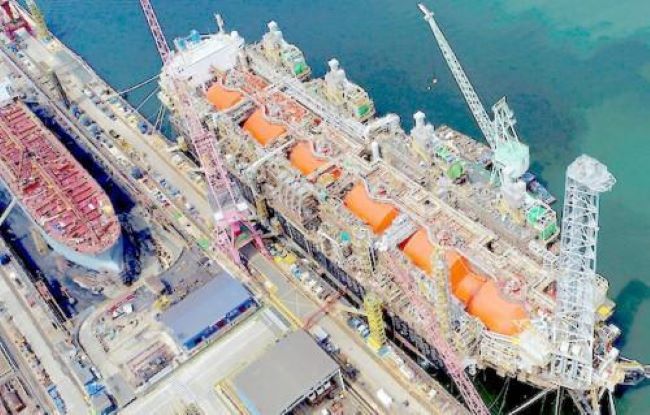
According to Golar, Hilli Episeyo produced 10.79 million tons of LNG between June 2018 and July 2026. A total of 156 cargoes were loaded from the floating facility, which converted natural gas from fields including Sanaga South into LNG. The final cargo was loaded on July 27, 2026. On August 4, the vessel left Cameroonian waters with the assistance of two tugboats and headed to Seatrium’s shipyards in Singapore. These dates appear in Golar’s August 13 earnings release filed with the SEC.
Golar intends to upgrade the vessel and extend its operating life before redeploying it to Argentina. A new 20-year contract with Southern Energy SA is scheduled to begin in the second half of 2027. The company forecasts annual adjusted earnings before interest, taxes, depreciation, and amortization (EBITDA) of $285 million under that contract, excluding potential additional revenue linked to gas prices. This forecast relates to future operations in Argentina and is separate from the financial benefits reported for the Cameroon project.
Hilli Episeyo’s departure marks the end of eight years of offshore LNG production for export from Kribi. In a statement published on July 5, 2026, SNH attributed the end of operations to the natural decline of the gas field and the reduced profitability of operating the facility at that location. The state-owned company said natural gas from fields still in production would continue to supply the Kribi thermal power plant, operated by Kribi Power Development Company (KPDC), for electricity generation. It also reported that negotiations were underway for additional gas supply agreements with major companies, without announcing any finalized contracts.
Golar has not ruled out returning to Cameroon. In its August 13 statement, CEO Karl Fredrik Staubo thanked SNH and Perenco for their cooperation and expressed interest in working with them again on gas development projects. The company’s October ESG report reaffirmed that interest, although no new contract in Cameroon has been announced.
Source: Business in Cameroon


