
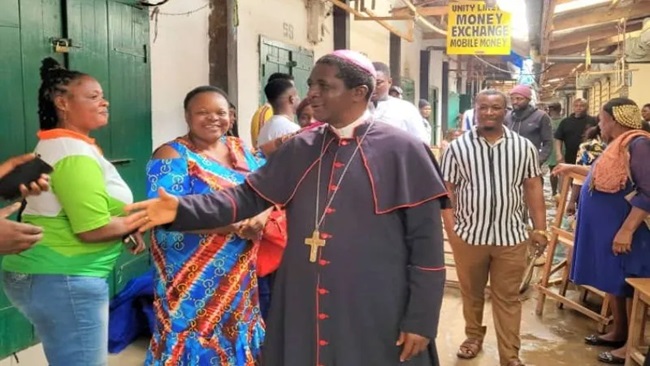
Archbishop Nkea urges joint climate action to protect water sources
Archbishop Andrew Fuanya Nkea of Cameroon’s Catholic Archdiocese of Bamenda has called for coordinated action to protect water sources and vulnerable households from climate change, warning that pressure on shared natural resources can divide communities.
Speaking during a Tuesday, October 27 presentation of research findings at St. Joseph Cathedral of Bamenda Archdiocese, Archbishop Nkea urged communities to respond through cooperation and shared responsibility.
“A challenge that affects everyone can become a real reason for division if we respond with indifference, competition, and blame. But that same challenge can become a reason for solidarity if we respond with wisdom, compassion, and a willingness to work together,” he said.
The research, titled “Climate Change and Community Vulnerability in the North West Region of Cameroon: A Sharpener of Collective Harmony Shift”, examined the relationship between climate change, environmental degradation and community vulnerability.
Presenting the findings, Professor Niba Mary identified deforestation, slash-and-burn agriculture, bushfires, overgrazing, wetland degradation and unplanned urban expansion as activities placing pressure on the environment.
Together with changing rainfall patterns and rising temperatures, these pressures contribute to flooding, erosion, landslides and declining water availability. They also threaten agricultural production and household livelihoods, potentially intensifying competition over land and water.
Archbishop Nkea, who also serves as President of the National Episcopal Conference of Cameroon (NECC), said climate change was already affecting farmers, families dependent on safe drinking water, young people whose livelihoods depend on the land, and women responsible for providing food for their households.
He warned that changing climatic conditions were compounding existing social, economic and environmental difficulties, placing additional pressure on vulnerable households.
“In our North West Region, where agriculture, community relationships, and natural resources play such important roles in people’s lives, the question of environmental vulnerability deserves our serious and common attention,” he said.
The Cameroonian Archbishop said the response must safeguard both natural resources and the relationships that sustain communities. He challenged participants to protect vulnerable people, encourage responsible use of shared resources and bring together people of different religious, cultural and social backgrounds.
“The protection of our common good is not the responsibility of the government alone, nor of the Church, nor of researchers, traditional authorities, or civil society organisations acting separately. It is a shared responsibility,” he said.
For the Church, he added, care for creation is inseparable from care for human dignity, including the needs of poor and vulnerable people with limited resources to withstand environmental shocks.
“Our faith calls us to stewardship rather than exploitation, solidarity rather than selfishness, and responsibility rather than indifference,” said Archbishop Nkea, who began his episcopal ministry in August 2013 as Coadjutor Bishop of Mamfe Diocese and was installed as Archbishop of Bamenda in February 2020.
Traditional authorities and other participants proposed practical responses to the environmental pressures outlined in the research.
Fon T.T. Tabi Teghencha of Zang Tabi outlined eight areas for action: tree planting, forest and water-catchment protection, climate-smart agriculture, sustainable livestock management, environmental education, renewable energy, waste management, and community-led environmental initiatives.
Panel discussions also emphasized cooperation between farmers and cattle rearers and the additional burdens that water shortages place on women and girls. Participants called for women to participate meaningfully in climate-adaptation and water-management decisions.
Raphaela Kianda, coordinator of Bamenda Archdiocese’s Justice and Peace Commission, presented four broad recommendations arising from the discussions: strengthening community-based adaptation, protecting vulnerable groups, establishing an interfaith and community climate-action platform, and expanding public education on climate change.
Proposed measures included climate-smart farming, agroforestry, soil conservation, water-source protection and community disaster-preparedness plans, alongside livelihood diversification and skills development.
Participants called for women, young people, smallholder farmers, older persons and persons with disabilities to be included in decision-making.
The proposed climate-action platform would bring together religious leaders, traditional authorities, youth groups, women’s associations and civil society organisations to raise awareness, mediate natural-resource disputes and coordinate environmental initiatives.
Archbishop Nkea commended the researchers and called for their findings to inform public policy, community planning and climate-adaptation strategies.
“The real value of research is also seen in what happens afterwards. Our purpose is not simply to discuss climate change. Our purpose is to understand it better and to identify what we can do together about it,” he said.
He urged participants to translate the findings into practical commitments through continued dialogue, clear responsibilities, partnerships and sustained follow-up. He also asked the Justice and Peace Commission to develop the eight strategies presented by Fon Tabi Teghencha and circulate them among traditional rulers across the Cameroonian Archdiocese.
Source: aciAfrica


