
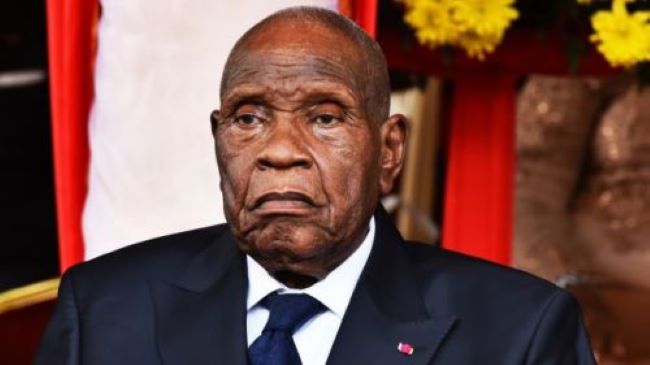
CPDM Crime Syndicate: Constitutional Council Chief dies in France
Clément Atangana, president of Cameroon’s Constitutional Council, died in France on Sunday, October 4, 2026, at the age of 85, leaving the institution without its head just months before legislative elections expected in 2027. Several Cameroonian media outlets reported that he died at the American Hospital of Paris, where he had been evacuated for medical care.
Born on September 20, 1941, Atangana had led the Constitutional Council since 2018. The institution is responsible, among other duties, for ensuring the regularity of presidential and parliamentary elections.
His death immediately raises the question of who will succeed him at the head of the Council as the next legislative elections approach. It also reduces the institution to nine serving members out of its normal 11, following the August 7 death in Yaoundé of its senior member, Bah Oumarou Sanda, at the age of 86.
Nearly Half a Century in the Judiciary
Atangana entered the judiciary on December 20, 1968, after studying law, training at the National School of Administration and Magistracy and attending the International Institute of Public Administration in Paris.
Over the course of his career, he served as an investigating judge in Nkongsamba and as president of the courts of Eséka, Bafia, Mora and Sangmélima. He was also deputy director of Judicial Affairs and the Seal at the Ministry of Justice, prosecutor general at the North Court of Appeal, president of the Center Court of Appeal, a justice of the Supreme Court and later president of its Administrative Bench.
He retired from the judiciary in December 2014. On February 7, 2018, President Paul Biya appointed him as a member of the Constitutional Council and, in a second decree issued the same day, named him president of the institution.
The Council had been provided for under the constitutional revision of January 18, 1996, but had not been effectively established until then. Atangana’s six-year term was renewed on January 18, 2024, for another six years.
Two Presidential Elections Under His Leadership
Atangana presided over the Constitutional Council during Cameroon’s 2018 and 2025 presidential elections. Televised election hearings played a major role in shaping his public image.
In 2018, the Council notably examined challenges filed by Maurice Kamto and other candidates following the election. The frequency with which the term “inadmissible” came up during the hearings earned Atangana the nickname “Mr. Inadmissible” among some members of the public and on social media.
The situation was different in 2025. Issa Tchiroma Bakary contested the presidential election result proclaimed by the Constitutional Council, which declared Paul Biya the winner with 53.66% of the vote, against 35.19% for his main challenger. Tchiroma’s camp, however, announced that it would not take its post-election dispute before the Constitutional Council. Other candidates did file challenges.
Another episode sparked controversy after the results were announced. In a video circulated on social media, Atangana appeared to raise a glass in front of relatives and say: “I am happy that you are celebrating both the work done by your father and the victory of your candidate.” The footage revived debate over the Constitutional Council president’s impartiality.
Two Seats Now Vacant
Atangana’s death comes less than two months after that of Bah Oumarou Sanda. The magistrate and former diplomat died in Yaoundé on August 7, 2026, at the age of 86. Like Atangana, he had served on the Constitutional Council since it became operational in 2018 and held the position of senior member, or Conseiller-Doyen.
Two of the Council’s 11 seats are therefore now vacant. Under the Constitution, when a member dies, the authority or body that originally appointed that person names a replacement, who serves out the remainder of the existing term.
The Council president is one of three members appointed by the president of the Republic, meaning the decision on Atangana’s successor rests with the president.
The rules governing the institution’s immediate leadership, however, are less explicit. The law governing the organization and operation of the Constitutional Council states that when its president faces a “provisional impediment or temporary unavailability,” the oldest member takes over and holds the title of Conseiller-Doyen. The provision does not expressly mention the death of the Council president, and the institution has no vice president.
Next Legislative Election Disputes Loom
The vacancy comes just as Cameroon’s electoral calendar is set to bring the Constitutional Council back to the center of the political process. The term of members of the National Assembly, originally due to expire on March 31, 2026, was extended until December 20, 2026.
Under Article 15 of the Constitution, the election of a new National Assembly must take place between 40 and 120 days after that extension expires. That places the legislative elections between January 29 and April 19, 2027.
The terms of municipal councilors have also been extended until February 28, 2027, unless an election is held before then. As of October 5, 2026, no decree convening voters for the next combined elections had been identified and no election date had been set.
For legislative elections, the Constitutional Council has jurisdiction over disputes concerning candidate lists and challenges to the regularity of the vote. Ahead of the February 2020 elections, it received 39 appeals against decisions concerning candidacies and had a maximum of 10 days to rule on each case.
Disputes related to municipal elections, by contrast, fall under the jurisdiction of the administrative courts.
Source: Sbbc


