
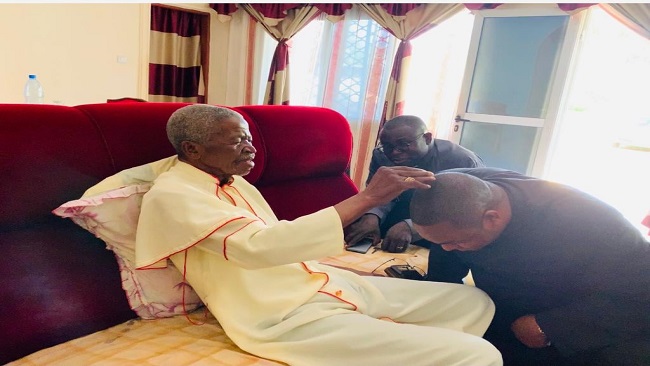
Benedictus Lysinge: Homily, Mass of the Bamenda Provincial Association of Diocesan Priests
Homily: Midnight Holy Mass:August 12, 2026
In Memoriam: Most Rev. Francis Teke Lysinge
St. Joseph’s Cathedral, Mamfe
(Association of Diocesan Priests, Religious Men and Women, and Seminarians)
Dear Rev. Fr. Augustine Nkwain, Chairman of the Provincial ADP,
Dear Esteemed Fathers, Religious Men and Women, Seminarians,
Dear Holy People of God,
- “We believe that Jesus died and rose again, and that it will be the same for those who have died in Jesus: God will bring them with him.” (1 Thess: 4:14). To the Thessalonians, it was not just enough to declare that Jesus is Risen. It was equally of utmost importance that they understood just why and how this singular resurrection of Jesus was consequential to their lives in the particular context of the First Century of Greek Macedonia. And this was the central nexus of the Pauline teaching: both the living and the dead share a future with Christ, as a consequence of Jesus’ resurrection.
- The resurrection of Jesus is the Father’s eschatological event in history. It is the definitive epiphany of God. It is God’s verb in the grammar of human existence. God has done something in Jesus of Nazareth that has implications for the world. By raising Jesus from the dead, God has shown that He is interested in doing something about evil, pain, injustice, and sin in the world. Like the Thessalonians, we too have power to shape history. The resurrection of Jesus shows that love has quick steps, that love wants to do the good for the beloved and to do so quickly.Jesus’ resurrection is thus, an evolutionary leap that completely changes the dynamisms of history in both its linear and cyclic senses. As the Risen One, Jesus is now both the center and fulfilment of history. Heaven, the fullness of God, begins here. In the Risen One within history, the God that Greek philosophy articulated as the Unmoved Mover, as the One Beyond Being, is now Infinite Closeness, Infinite Nearness. We pass from bio to zoe, from life to life, because of the Risen One, Life itself. We need not fear, even if we go through the valley of darkness, as the Psalm of this liturgy reminds us.
- Jesus died and rose again. God will bring us all with Jesus. These creedal statements by Paul, can offer us some keys that might enable us to grasp the message that comes to us from the life of our beloved Bishop Francis Teke Lysinge. Later today, we will bury the remains of our beloved Mola in the earth of this Cathedral Church that he labored with his whole heart to construct to the glory of God, as a seed of immortality – an immortality borne from memory, love, dialogical relationality with Christ, the Living One (Ratzinger, Eschatology).Hence, our relationship with the living Christ is the metaphysical condition for our immortality, which, for the Christian, is not just of the soul – as one finds in Plato, but even more, is bodily, glorified bodies, as Paul again explains in his letter to the Church in Corinth (1 Cor 15:43).Though our hearts are rightly saddened, in the light of our faith as explained to us by Paul, we are hopeful and grateful to God, for blessing this local Church with such a Christ-centered shepherd, a man of God, of profound faith, humble hope, and great love.
- Jesus died and rose again! Because of the resurrection of Jesus, word and action are now efficacious. And this is the foundation of this Sacrament of the Holy Mass. A Sacramentis that which we do, that left to ourselves, we cannot do.We are only able to be and to do in the name of Christ, because He, Christ, has loved and called us first: vos autem dixit amicos – I call you friends. And this, our saintly Bishop Lysinge, so consistently lived out in his priestly life. Only one who has understood and experienced a certain level of intimacy with Jesus, could be so attached to Eucharistic Adoration, to the Office of Readings, to prayer, as our beloved Mola was.
- The ancient Romans defined friendship as, same likes, same dislikes – idem velle, idem nolle. Friendship with Jesus is to love what Jesus loves. Because Jesus has made us his friends, we have been invited into his power, into his relationship with the Father. Standing by Jacob’s well (Jn 4:6-15), we suddenly realize that it is not the well that is deep and us having no cistern to draw from the well. The real well is Jesus, and the water Jesus gives us to quench our thirst is our friendship with him. From this intimacy of Jesus and the Father, we too, like our beloved Bishop Lysinge did so fruitfully, become agents of bringing about God’s liberating love to our world that is so much in need of God’s love, and yet often unconscious of this need.
- Idem velle, idem nolle: What was the young Godwill Teke Lysinge of Sasse College after, when he converted to Catholicism in 1955, chiefly influenced by a reading of the lives of the saints, especially that of St. Francis Xavier? Here again, we see the saints, as the main apologists of Catholicism. Like Francis Xavier, Francis Lysinge was after Jesus Christ. He sought Jesus with all his heart and might and was always eager to bring Jesus to others. His conversion in Sasse that led to the choice for the seminary shows us what our beloved pioneer bishop of Mamfe truly lived for, which is tied to what he truly worshipped: God in Christ Jesus. Like Ignatius of Loyola, Lysinge of Mamfe was drawn by an interior consolation in reading the accounts of the saints. And from this knowledge of the saints, our beloved Mola grew in intimacy of knowledge and communion with Jesus, his friend, for friendship always demands intimacy and knowledge. And starting from this friendship with Jesus, we can discern three hermeneutical keys thanks to which our beloved late bishop sought to help us know, love and understand Jesus better:
- I am what I am, by the grace of God: (1 Cor 15:10) Every priest makes a decision at the time of his priestly ordination to adopt a text that captures his inner consciousness of the ministry he is about to undertake, thus providing an indication of how he intends to live out the gift of the priesthood. At his priestly ordination on April 17th, 1966, the young Fr. Lysinge adopted St. Paul’s retrospective analysis of his life: I am what I am, by the grace of God! Herein lies the first hermeneutical keyto understanding the great legacy of our beloved and saintly pioneer bishop. Bishop Lysinge’s life teaches us thatgrace is a dialogical relationship. A thingnification approach to grace misses out on what is most essential. Because of this dialogical relationality, there emerges, as a consequence, an anthropological eclipsing of the self,that was so unmistakably evident in the life of our beloved late bishop: Jesus, must increase;Lysinge must decrease.
- We could characterize the life of our saintly late bishop using the category of “disposable anthropology.” Anyone who encountered Mola was immediately struck with the man’s Christ-centeredness. His life was an example of a Christian existentialism noticeable in the likes of Augustine, Pascal, Kierkegaard and Blondel. It was easily noticeable that for Bishop Lysinge, life was simply a standing for Another. He was a representative of Another, a being-in-reference to Another. From this, it became so evident that the life of this humble servant of God, had become so conformed to Jesus that it had a single purpose: to keep the window of the world open to the refreshing and life-giving breeze of God. Our beloved late bishop had responded to the call of the Lord as a priest with so much generosity that his life in the horizontalization of priestly ministry was a reflection of the verticalization that took precedence and shaped the resultant person-outcome of Francis Teke Lysinge.
- But as Augustine came to discover as recorded in his Confessions, the eclipsing of the self in Christ, this decreasing of the self, is precisely the pathway to the finding the self – Sero teamavi – Late, have I loved you, O Beauty, so ancient and so new: late have I loved you! You were within me, and I was outside myself. I have tasted you: and now I hunger and thirst for more. You have touched me: and I have burned for your peace (Confessions, X, 27 (28). As Karl Rahner explains, in receiving God, the human being does not cease to be human. Rather, God’s ontological, total, self-communication actualizes humanity’s deepest potential. Humans are spirit-in-the-world, the supernatural existential. I am what I am, by the grace of God. Because of Christ, I am someone. I am being, to use a phrase of Heidegger. From April 17, 1966, Fr. Lysinge never lost this consciousness that all was grace, meaning the purpose of life was to be in Christ. We saw this in the life of our holy bishop Lysinge, that a life of grace shows that God is real, faith is real, and to live from God and for God, is something beautiful. The good, the true, and the beautiful, constitutive a comprehensive unity, a Hegelian synthesis if one may call it that, in what the spiritual masters, our beloved Lysinge clearly amongst such, characterize as the will of God.
- Fiat Voluntas Tua– Thy Will Be Done: This is the second hermeneutical key that unlocks the great life of Lysinge of Mamfe. To do the will of God at the present moment has always been the primary preoccupation of the saints. Following the drama of Gethsemane – Not as I want, but as you want – saints never seek to do their own will. Certainly, Gethsemane remains even today, the battle royale for many a Christian and priest. There is always the human appeal of our subjective freedom: “Take this cup from me.” This is the desire for self-realization, of the autonomous will of Kant, Voltaire, Nietzsche and Feuerbach. It is in human nature to construct a tower of Babel, based on the will to power!For us religious persons, this desire easily takes the form of a religiosity whose inner core has absolutely nothing to do with the God of Jesus Christ, as one finds in Dostoyevsky The Grand Inquisitor, Soloviev’s The Anti-Christ, andBenson’sLord of the World. But the saints, like our beloved Bishop Lysinge, show us another path: To discern, and do God’s will, as challenging as it is, is what eventually brings about human fruitfulness and joy. It is what ultimately endures. Only God truly matters.
- Fiat Voluntas Tua – Your Will be done! Even for our beloved late bishop, discerning the will of God did not come easy. He was unsure what to make of the dream of the Dominican Nun who, months earlier, had forcefully declared to him in the sacristy one day after Mass, that she saw him being ordained a bishop. Sitting before Nuncio Felix Del Blanco, he was convinced that the priest that had accompanied him to the Nunciature in Yaoundé had more administrative skills than he and had made up his mind to ask the Nuncio to instead recommend that priest to the Holy Father for the See of Mamfe. On the eve of his episcopal ordination, while in Adoration and almost inimical to Gethsemane, he worried if he was doing the right thing accepting ordination as bishop of Mamfe. He disliked the fact that in a sense, he was at the center of the event. It is always the mark of saints: Jesus must increase, they must decrease: “Not to be encompassed by the greatest, but to let oneself be encompassed by the smallest – that is divine. – Non coercerimaximo, contineritamen a minimo, divinum est” (Ratzinger, Christianity, 146). Saints are always uneasy about themselves, because their God-centeredness amplifies their own littleness and unworthiness. To saints, Chalcedon, by upholding both the divinity and humanity of Jesus in a healthy tension, provided the foundational framework of Christian living.
- Like all saints, Francis Lysinge was very conscious of his own inadequacies and limitations. He was not a Nietzschean Übermensch. Bishop Lysinge,like Augustine of Hippo, saw the episcopacy as communion and love. Like all saints, he believed that the Church was ultimately the work of God. Like all saints, he was knowingly ignorant of human sinfulness, of the abuse of human freedom. Like all saints, he too had his hours of desolation, his Good Fridays. But again, like all saints, our Christ-centered bishop believed very firmly that Mamfe was the work of God. And as Jesus’ resurrection shows us, It is in the nature of God to live, not to die.
- Now is not the time to do an assessment of theenormous human and material enhancements and constructions carried out by our beloved pioneer bishop, thanks to his tireless appeals and trips, both within the diocese and in the diaspora: from his legendary relationship with the Church in Nigeria that brought so much good to Mamfe, material and personnel wise, especially regarding the formation of our seminarians; to his frequent trips to Germany that formed bonds of partnerships with Mamfe; from Austria to Italy; from France and the UK to the USA, and the list goes on.Bishop Lysinge went everywhere that it was possible to go to, to secure help for this diocese. Christian Cardinal Tumi once said to Bishop Lysinge in my presence: “Francis, from where are you getting all these monies that you are building all these things in Mamfe? Whenever I ask you, you say it is God! Are you the only one who know God? I know you won’t tell me. Italian Mafia!” Our beloved late Bishop established firm essential diocesan structures that continue to serve the pastoral and administrative needs of our diocese.
- But even more, to those seeking to play the administrative judgment card in terms of suitability, it might be helpful to listen again to these words of Ratzinger at the Holy Mass Pro Eligendo Romano Pontifice preceding his election as Bishop of Rome: (April 18, 2005): “All people desire to leave a lasting mark. But what endures? Money does not. Even buildings do not, nor books. After a certain time, longer or shorter, all these things disappear. The only thing that lasts forever is the human soul, the human person created by God for eternity. The fruit that endures is therefore all that we have sown in human souls: love, knowledge, a gesture capable of touching hearts, words that open the soul to joy in the Lord.” And again: “To him who as spirit upholds and encompasses the universe, a spirit, a human heart with its ability to love, is greater than all the milky ways in the universe. Quantitative criteria become irrelevant; other orders of magnitude become visible, according to which the infinitely small is the truly embracing and truly great.” (Ratzinger, Christianity, 146 – 147). And more: “The highest power is demonstrated as the calm willingness completely to renounce all power; and we are shown that it is powerful, not through force, but only through the freedom of love, which, even when rejected, is stronger than the exultant powers of earthly violence.” (Ratzinger, Christianity, 150). Mola’s enduring fruitfulness and greatest legacy are not the constructions especially in setting up the basic diocesan structures upon which his successors have continued to build, as great and broad as these are, but more importantly, the fruits of love, tenderness, humility and compassion that so marked his pastoral ministry in Mamfe
- Mola’s was a pastor’s heart that we find in the Gospel of this liturgy. Like Jesus, he saw, he felt pity, he moved towards the bereaved and downcast, he comforted all.His frequent visits to the sick, irrespective of their religious creed, to prisoners, to the homes of the Christians, brought alive the reality of the articulated in the Gospel of this liturgy: “A great prophet has appeared among us; God has visited his people.” His pastoral generosity made the people of Mamfe, Catholics and non-Catholics alike to know that they had a bishop amongst them. “Those who try to make their life secure will lose it, but those who lose their life will keep it” (Lk 17:33).The characteristic humble, generous and sacrificial spiritof the priests of Mamfe Diocese is traceable in large part to the spirit instilled in this presbyterium by Bishop Lysinge. You could accept to stay in the small rectory in Mbeme at the time, because you saw Lysinge living in the same rectory with you, without complaining. And he was always eager to welcome the priests of Mamfe into his house, which he fondly referred to as the “people’s house.”
- AliquodPulchrum Deo – Making Mamfe Diocese Something Beautiful for God. This is the third hermeneutical key into the life of our beloved late bishop Lysinge. This was not just a maxim for our saintly bishop. He truly believed it and gave his whole soul to building up our beloved diocese. This was the overarching goal of his pastoral ministry. And even before synod and synodality became fashionable in the universal church with the Francis pontificate, Bishop Lysinge, in one of his major final episcopal acts, gave Mamfe Diocese our own Synod, whose fruits he gathered in the post synodal episcopal exhortation, AliquodPulchurm Deo – a great roadmap for the evangelization of our diocese, with its very Christocentric focus – to renew all things in Christ, who has made us for himself, and restless are our hearts, until they rest in God (Confessions, I, I, (I).
- “I am what I am by the grace of God;” Thy Will be Done;” “Something Beautiful for God;” ; – in these three expressions, we see the heart and soul of our beloved Bishop Lysinge. In the first years of his episcopate, he went from village to village in this Diocese, guided by Christ. But after his retirement, he increasingly entered into the communion of Christ’s sufferings. Eventually, the one who had spent countless hours gazing at Our Lord, hidden in the Eucharist, completely lost his physical sight. BishopLysinge then increasingly came to understand the truth of the words our Blessed Lord had addressed to Peter: “Someone else will fasten a belt around you.” (Jn 21:18).In this very communion with the suffering Lord, he continued to proclaim the Gospel.
- Ever so often, our saintly bishop, on seeing the hills along the Obang-Bachuo road, will allude to the eternal hills of heaven. He often spoke about heaven with such mystical certainty and metaphysical realism that was so akin to the fire of Pascal: Fire! Fire! Fire! God of Abraham, God of Isaac, God of Jacob, not of the philosophers – a text that our good bishop often loved to invoke at table lively table conversations. We can be sure that our saintly Mola, the people’s bishop, Lysinge of Mamfe, now amongst the blessed, no longer beholding the LordHidden in the Eucharist in the lumen fide, but is now beholding Him, face to face, in full sight, in the lumen gloriae. Our cherished bishop completed his Licentiate in Sacred Theology focusing on the remarkable Lutheran pastor and anti-Nazi dissident, Dietrich Bonhoeffer. How often did he reference those profound words from Bonhoeffer: “Death is the supreme festival on the way to freedom”? Like his academic mentor, we hold the belief that our beloved Mola is now truly free, in the blessed company of the saints.
- With immense gratitude and uplifted hearts, we thank you, our humble and gentle bishop, for your Christ-centered life. We thank you for your total love for this diocese. We thank you for giving your life totally for this diocese, which the Lord entrusted into your hands on April 21, 1999. Mamfe will never forget you. You so much loved the Sacred Heart of Jesus and the Immaculate Heart of Mary and committed your life to this devotion. We entrust your gentle priestly soul into the merciful hands of Jesus and loving hands of Mary. Yes, Benedictus Lysinge, friend of Jesus Christ, continue to pray for us, continue to watch over us, and as you follow the Lamb wherever He goes (Rev. 14:4), bring all of us your children, and Mamfe Diocese along with you, Amen.
Rev. Maurice Agbaw-Ebai
Priest of Mamfe Diocese


